For the following questions answer them individually
If $$z$$ is a complex number, then the number of common roots of the equation $$z^{1985} + z^{100} + 1 = 0$$ and $$z^3 + 2z^2 + 2z + 1 = 0$$, is equal to:
Let $$a$$ and $$b$$ be two distinct positive real numbers. Let 11th term of a GP, whose first term is $$a$$ and third term is $$b$$, is equal to $$p^{th}$$ term of another GP, whose first term is $$a$$ and fifth term is $$b$$. Then $$p$$ is equal to
Suppose $$28 - p$$, $$p$$, $$70 - \alpha$$, $$\alpha$$ are the coefficients of four consecutive terms in the expansion of $$(1 + x)^n$$. Then the value of $$2\alpha - 3p$$ equals
For $$\alpha, \beta \in \left(0, \frac{\pi}{2}\right)$$, let $$3\sin(\alpha + \beta) = 2\sin(\alpha - \beta)$$ and a real number $$k$$ be such that $$\tan\alpha = k\tan\beta$$. Then the value of $$k$$ is equal to
If $$x^2 - y^2 + 2hxy + 2gx + 2fy + c = 0$$ is the locus of a point, which moves such that it is always equidistant from the lines $$x + 2y + 7 = 0$$ and $$2x - y + 8 = 0$$, then the value of $$g + c + h - f$$ equals
Let $$A(\alpha, 0)$$ and $$B(0, \beta)$$ be the points on the line $$5x + 7y = 50$$. Let the point $$P$$ divide the line segment $$AB$$ internally in the ratio $$7:3$$. Let $$3x - 25 = 0$$ be a directrix of the ellipse $$E: \frac{x^2}{a^2} + \frac{y^2}{b^2} = 1$$ and the corresponding focus be $$S$$. If from $$S$$, the perpendicular on the $$x$$-axis passes through $$P$$, then the length of the latus rectum of $$E$$ is equal to
Let $$P$$ be a point on the hyperbola $$H: \frac{x^2}{9} - \frac{y^2}{4} = 1$$, in the first quadrant such that the area of triangle formed by $$P$$ and the two foci of $$H$$ is $$2\sqrt{13}$$. Then, the square of the distance of $$P$$ from the origin is
Let $$R = \begin{pmatrix} x & 0 & 0 \\ 0 & y & 0 \\ 0 & 0 & z \end{pmatrix}$$ be a non-zero $$3 \times 3$$ matrix, where $$x\sin\theta = y\sin\left(\theta + \frac{2\pi}{3}\right) = z\sin\left(\theta + \frac{4\pi}{3}\right) \neq 0$$, $$\theta \in (0, 2\pi)$$.
For a square matrix $$M$$, let Trace($$M$$) denote the sum of all the diagonal entries of $$M$$. Then, among the statements:
(I) Trace($$R$$) = 0
(II) If Trace(adj(adj($$R$$))) = 0, then $$R$$ has exactly one non-zero entry.
Consider the system of linear equations $$x + y + z = 5$$, $$x + 2y + \lambda^2 z = 9$$ and $$x + 3y + \lambda z = \mu$$, where $$\lambda, \mu \in R$$. Then, which of the following statement is NOT correct?
If the domain of the function $$f(x) = \log_e\frac{2x+3}{4x^2+x-3} + \cos^{-1}\frac{2x-1}{x+2}$$ is $$(\alpha, \beta]$$, then the value of $$5\beta - 4\alpha$$ is equal to
Let $$f: R \rightarrow R$$ be a function defined $$f(x) = \frac{x}{(1+x^4)^{1/4}}$$ and $$g(x) = f(f(f(f(x))))$$ then $$18\int_0^{\sqrt{2\sqrt{5}}} x^2 g(x) \, dx$$
Let $$a$$ and $$b$$ be real constants such that the function $$f$$ defined by $$f(x) = \begin{cases} x^2 + 3x + a, & x \leq 1 \\ bx + 2, & x > 1 \end{cases}$$ be differentiable on $$R$$. Then, the value of $$\int_{-2}^{2} f(x) \, dx$$ equals
Let $$f: R - \{0\} \rightarrow R$$ be a function satisfying $$f\left(\frac{x}{y}\right) = \frac{f(x)}{f(y)}$$ for all $$x, y$$, $$f(y) \neq 0$$. If $$f'(1) = 2024$$, then
Let $$f(x) = x+3^{2}x-2^3$$, $$x \in [-4, 4]$$. If $$M$$ and $$m$$ are the maximum and minimum values of $$f$$, respectively in $$[-4, 4]$$, then the value of $$M - m$$ is:
Let $$y = f(x)$$ be a thrice differentiable function in $$(-5, 5)$$. Let the tangents to the curve $$y = f(x)$$ at $$(1, f(1))$$ and $$(3, f(3))$$ make angles $$\frac{\pi}{6}$$ and $$\frac{\pi}{4}$$, respectively with positive x-axis. If $$27\int_1^3 \{f'(t)\}^2 + 1\} f''(t) \, dt = \alpha + \beta\sqrt{3}$$ where $$\alpha, \beta$$ are integers, then the value of $$\alpha + \beta$$ equals
Let $$f: R \rightarrow R$$ be defined $$f(x) = ae^{2x} + be^x + cx$$. If $$f(0) = -1$$, $$f'(\log_e 2) = 21$$ and $$\int_0^{\log 4}(f(x) - cx) \, dx = \frac{39}{2}$$, then the value of $$|a + b + c|$$ equals:
Let $$\vec{a} = \hat{i} + \alpha\hat{j} + \beta\hat{k}$$, $$\alpha, \beta \in R$$. Let a vector $$\vec{b}$$ be such that the angle between $$\vec{a}$$ and $$\vec{b}$$ is $$\frac{\pi}{4}$$ and $$|\vec{b}|^2 = 6$$. If $$\vec{a} \cdot \vec{b} = 3\sqrt{2}$$, then the value of $$(\alpha^2 + \beta^2)|\vec{a} \times \vec{b}|^2$$ is equal to
Let $$\vec{a}$$ and $$\vec{b}$$ be two vectors such that $$|\vec{b}| = 1$$ and $$|\vec{b} \times \vec{a}| = 2$$. Then $$|(\vec{b} \times \vec{a}) - \vec{b}|^2$$ is equal to
Let $$L_1: \vec{r} = (\hat{i} - \hat{j} + 2\hat{k}) + \lambda(\hat{i} - \hat{j} + 2\hat{k})$$, $$\lambda \in R$$, $$L_2: \vec{r} = (\hat{j} - \hat{k}) + \mu(3\hat{i} + \hat{j} + p\hat{k})$$, $$\mu \in R$$ and $$L_3: \vec{r} = \delta(l\hat{i} + m\hat{j} + n\hat{k})$$, $$\delta \in R$$ be three lines such that $$L_1$$ is perpendicular to $$L_2$$ and $$L_3$$ is perpendicular to both $$L_1$$ and $$L_2$$. Then the point which lies on $$L_3$$ is
Bag $$A$$ contains 3 white, 7 red balls and bag $$B$$ contains 3 white, 2 red balls. One bag is selected at random and a ball is drawn from it. The probability of drawing the ball from the bag $$A$$, if the ball drawn is white, is:
The number of real solutions of the equation $$x(x^2 + 3|x| + 5|x-1| + 6|x-2|) = 0$$ is ______.
In an examination of Mathematics paper, there are 20 questions of equal marks and the question paper is divided into three sections: A, B and C. A student is required to attempt total 15 questions taking at least 4 questions from each section. If section A has 8 questions, section B has 6 questions and section C has 6 questions, then the total number of ways a student can select 15 questions is _________.
Let $$S_n$$ be the sum to n-terms of an arithmetic progression $$3, 7, 11, \ldots$$, if $$40 < \frac{6}{n(n+1)}\sum_{k=1}^{n} S_k < 42$$, then $$n$$ equals ____________.
Let $$\alpha = \sum_{k=0}^{n} \frac{{}^nC_k^2}{k+1}$$ and $$\beta = \sum_{k=0}^{n-1} \frac{{}^nC_k \cdot {}^nC_{k+1}}{k+2}$$. If $$5\alpha = 6\beta$$, then $$n$$ equals
Consider two circles $$C_1: x^2 + y^2 = 25$$ and $$C_2: (x-\alpha)^2 + y^2 = 16$$, where $$\alpha \in (5, 9)$$. Let the angle between the two radii (one to each circle) drawn from one of the intersection points of $$C_1$$ and $$C_2$$ be $$\sin^{-1}\frac{\sqrt{63}}{8}$$. If the length of common chord of $$C_1$$ and $$C_2$$ is $$\beta$$, then the value of $$(\alpha\beta)^2$$ equals _________.
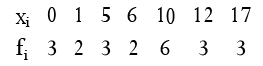
If the variance $$\sigma^2$$ of the data
is $$k$$, then the value of $$k$$ is ______ (where $$.$$ denotes the greatest integer function)
The number of symmetric relations defined on the set $$\{1, 2, 3, 4\}$$ which are not reflexive is _______.
The area of the region enclosed by the parabola $$(y-2)^2 = x - 1$$, the line $$x - 2y + 4 = 0$$ and the positive coordinate axes is __________.
Let $$Y = Y(X)$$ be a curve lying in the first quadrant such that the area enclosed by the line $$Y - y = Y'(x)(X - x)$$ and the co-ordinate axes, where $$(x, y)$$ is any point on the curve, is always $$\frac{-y^2}{2Y'(x)} + 1$$, $$Y'(x) \neq 0$$. If $$Y(1) = 1$$, then $$12Y(2)$$ equals ________.
Let a line passing through the point $$(-1, 2, 3)$$ intersect the lines $$L_1: \frac{x-1}{3} = \frac{y-2}{2} = \frac{z+1}{-2}$$ at $$M(\alpha, \beta, \gamma)$$ and $$L_2: \frac{x+2}{-3} = \frac{y-2}{-2} = \frac{z-1}{4}$$ at $$N(a, b, c)$$. Then the value of $$\frac{(\alpha + \beta + \gamma)^2}{(a + b + c)^2}$$ equals ________________.