NTA JEE Mains 30th Jan 2024 Shift 1
For the following questions answer them individually
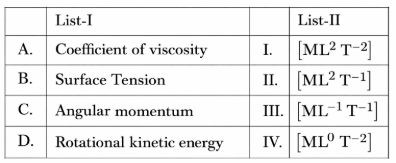
NTA JEE Mains 30th Jan 2024 Shift 1 - Question 2
A particle of mass $$m$$ projected with a velocity $$u$$ making an angle of $$30°$$ with the horizontal. The magnitude of angular momentum of the projectile about the point of projection when the particle is at its maximum height $$h$$ is :
NTA JEE Mains 30th Jan 2024 Shift 1 - Question 3
All surfaces shown in figure are assumed to be frictionless and the pulleys and the string are light. The acceleration of the block of mass $$2 \text{ kg}$$ is
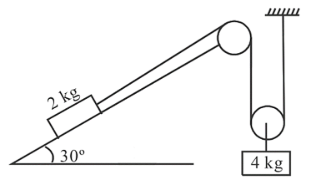

NTA JEE Mains 30th Jan 2024 Shift 1 - Question 4
A particle is placed at the point $$A$$ of a frictionless track $$ABC$$ as shown in figure. It is gently pushed towards right. The speed of the particle when it reaches the point $$B$$ is: (Take $$g = 10 \text{ m s}^{-2}$$).
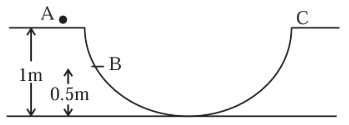
NTA JEE Mains 30th Jan 2024 Shift 1 - Question 5
A spherical body of mass $$100 \text{ g}$$ is dropped from a height of $$10 \text{ m}$$ from the ground. After hitting the ground, the body rebounds to a height of $$5 \text{ m}$$. The impulse of force imparted by the ground to the body is given by: (given $$g = 9.8 \text{ m s}^{-2}$$)
NTA JEE Mains 30th Jan 2024 Shift 1 - Question 6
The gravitational potential at a point above the surface of earth is $$-5.12 \times 10^7 \text{ J kg}^{-1}$$ and the acceleration due to gravity at that point is $$6.4 \text{ m s}^{-2}$$. Assume that the mean radius of earth to be $$6400 \text{ km}$$. The height of this point above the earth's surface is:
NTA JEE Mains 30th Jan 2024 Shift 1 - Question 7
Young's modulus of material of a wire of length $$L$$ and cross-sectional area $$A$$ is $$Y$$. If the length of the wire is doubled and cross-sectional area is halved then Young's modulus will be:
NTA JEE Mains 30th Jan 2024 Shift 1 - Question 8
At which temperature the r.m.s. velocity of a hydrogen molecule equal to that of an oxygen molecule at $$47°C$$?
NTA JEE Mains 30th Jan 2024 Shift 1 - Question 9
Two thermodynamical processes are shown in the figure. The molar heat capacity for process $$A$$ and $$B$$ are $$C_A$$ and $$C_B$$. The molar heat capacity at constant pressure and constant volume are represented by $$C_P$$ and $$C_V$$, respectively. Choose the correct statement.
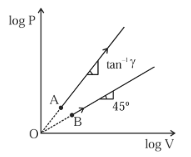
NTA JEE Mains 30th Jan 2024 Shift 1 - Question 10
The electrostatic potential due to an electric dipole at a distance $$r$$ varies as :