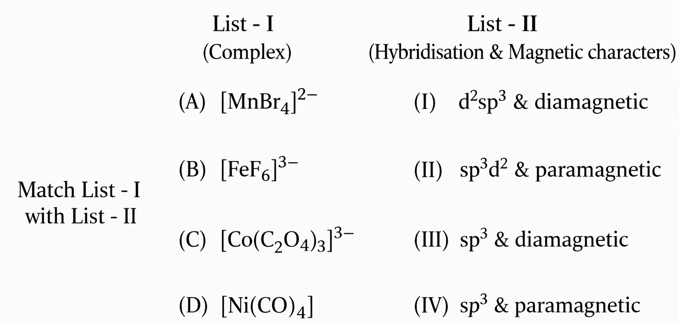
Choose the correct answer from the options given below :
Sign in
Please select an account to continue using cracku.in
↓ →

Join Our JEE Preparation Group
Prep with like-minded aspirants; Get access to free daily tests and study material.
Choose the correct answer from the options given below :
500J of energy is transferred as heat to 0.5 mol of Argon gas at 298 K and 1.00 atm. The final temperature and the change in internal energy respectively are: Given : $$R = 8.3 J K^{-1}mol^{-1}$$
At temperature $$T$$, compound $$AB_{2(g)}$$ dissociates as $$AB_{2} \rightleftharpoons AB_{(g)}+\frac{1}{2}B_{2(g)}$$ having degree of dissociation $$x$$ (small compared to unity). The correct expression for $$x$$ in terms of $$K_{p}$$ and p is
Login to view the detailed solution.
.webp)
An element 'E'has the ionisation enthalpy value of $$374 kJ mol^{-1}$$.'E'reacts with elements A, B, C and D with electron gain enthalpy values of −328, −349, −325 and $$-295 kJ mol^{-1}$$, respectively. The correct order of the products EA, EB, EC and ED in terms of ionic character is :
Total number of nucleophiles from the following is :
$$NH_{3},PhSH,(H_{3}C)_{2}S,H_{2}C=CH_{2},\ominus\\O H,H_{3}O^{\oplus},(CH_{3})_{2}CO,\rightleftharpoons NCH_{3}$$
Login to view the detailed solution.
The steam volatile compounds among the following are :
(A)
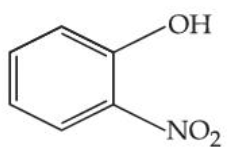
(B)
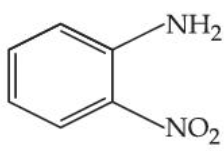
(C)
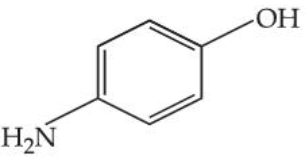
(D)
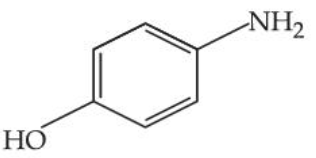
Choose the correct answer from the options given below :
.webp)
Given below are two statements : Statement (I): The radii of isoelectronic species increases in the order. $$Mg^{2+} < Na^{+} < F^{-} < O^{2-}$$ Statement (II): The magnitude of electron gain enthalpy of halogen decreases in the order. Cl > F > Br > I In the light of the above statements, choose the most appropriate answer from the options given below :
Match List - I with List - II.
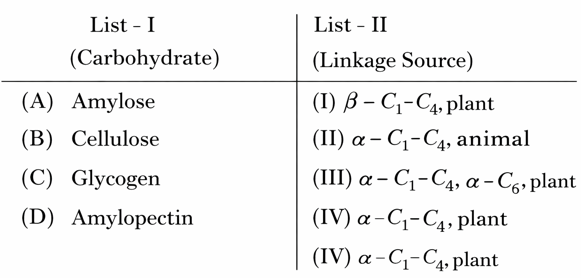
choose the correct answer from the options given below :
Login to view the detailed solution.
The molar conductivity of a weak electrolyte when plotted against the square root of its concentration, which of the following is expected to be observed ?
Login to view the detailed solution.
.webp)
The standard reduction potential values of some of the p-block ions are given below. Predict the one with the strongest oxidising capacity.
Login to view the detailed solution.
The product (P) formed in the following reaction is :
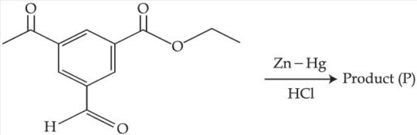
If $$a_{\circ}$$ is denoted as the Bohr radius of hydrogen atom, then what is the de-Broglie wavelength $$(\lambda)$$ of the electron present in the second orbit of hydrogen atom? [n : any integer]
Login to view the detailed solution.
.webp)
Match List - I with List - II.
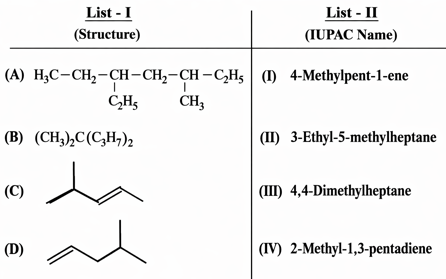
Choose the correct answer from the options given below :
The reaction $$A_{2}+B_{2}\rightarrow 2AB$$ follows the mechanism
$$A_{2}k_{1}A+A(fast)\\ \text{ }{_{k_{-1}}}\\ \\A+B_{2}\xrightarrow{k_{2}}AB+B(slow)\\A+B \rightarrow AB(fast)$$
The overall order of the reaction is :
Login to view the detailed solution.
1.24 g of $$AX_{2}$$ (molar mass 124 g $$mol^{-1}$$) is dissolved in 1 kg of water to form a solution with boiling point of $$100.0156^{\circ}C$$, while $$25.4g^{\circ}$$ of $$AY_{2}$$ (molar mass 250 g $$mol^{-1}$$) in 2 kg of water constitutes a solution with a boiling point of $$100.0260^{\circ}C.K_{b}(H_{2}O)=0.52 K$$ kg $$mol^{-1}$$ Which of the following is correct ?
Login to view the detailed solution.

Choose the correct statements. (A) Weight of a substance is the amount of matter present in it. (B) Mass is the force exerted by gravity on an object. (C) Volume is the amount of space occupied by a substance. (D) Temperatures below $$O^{\circ}C$$ are possible in Celsius scale, but in Kelvin scale negative temperature is not possible. (E) Precision refers to the closeness of various measurements for the same quantity. Choose the correct answer from the options given below :
Login to view the detailed solution.
The correct option with order of melting points of the pairs (Mn, Fe), (Tc, Ru) and (Re, Os) is :
For a $$Mg|Mg^{2+}(aq)||Ag^{+}(aq)|Ag$$ the correct Nernst Equation is :
Login to view the detailed solution.
_1.webp)
In The following substitution reaction :
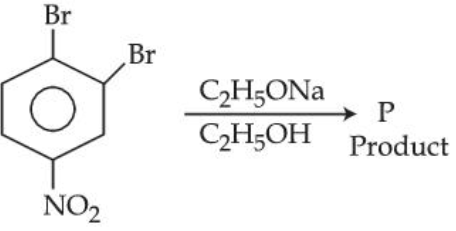
product 'P'formed is :
The correct increasing order of stability of the complexes based on $$\Delta_{\circ}$$ value is: I.$$[Mn(CN)_{6}]^{3}$$ II.$$[Co(CN)_{6}]^{4-}$$ III.$$[Fe(CN)_{6}]^{4-}$$ IV.$$[Fe(CN)_{6}]^{3-}$$
The molar mass of the water insoluble product formed from the fusion of chromite ore $$(FeCr_{2}O_{4})$$ with $$Na_{2}CO_{3}$$ in presence of $$O_{2}$$ is_______$$gmol^{-1}$$.
Login to view the detailed solution.
Given below are some nitrogen containing compounds
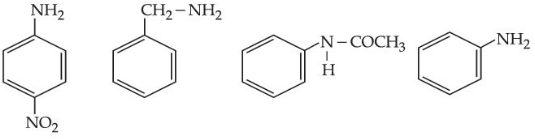
Each of them is treated with HCl separately. 1.0 g of the most basic compound will consume _______ mg of HCl. (Given molar mass in $$gmol^{-1}$$ C : 12, H : 1, O : 16, Cl : 35.5)
The sum of sigma $$(\sigma)$$ and pi$$(\pi)$$ bonds in Hex-1,3-dien-5-yne is _______.
Login to view the detailed solution.
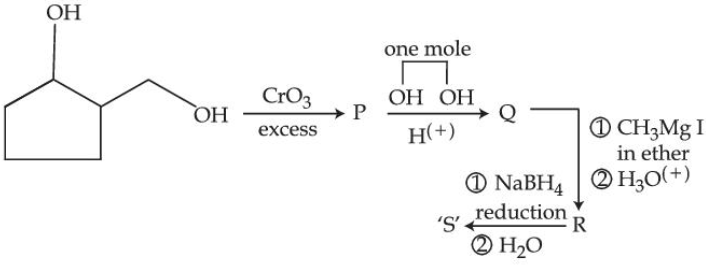
0.1 mole of compound ' S ' will weigh _______ g. (Given molar mass in $$gmol^{-1}$$ C : 12, H : 1, O : 16)
If $$A_{2}B$$ is 30% ionised in an aqueous solution, then the value of van't Hoff factor (i) is ______ $$\times 10^{-1}$$
Login to view the detailed solution.
Educational materials for JEE preparation
 Share
Share