If $$A = \{x \in R : |x| < 2\}$$ and $$B = \{x \in R : |x - 2| \ge 3\}$$; then:

Join Our JEE Preparation Group
Prep with like-minded aspirants; Get access to free daily tests and study material.
Sign in
Please select an account to continue using cracku.in
↓ →
Join Our JEE Preparation Group
Prep with like-minded aspirants; Get access to free daily tests and study material.
If $$A = \{x \in R : |x| < 2\}$$ and $$B = \{x \in R : |x - 2| \ge 3\}$$; then:
Login to view the detailed solution.
Let $$a, b \in R, a \ne 0$$ be such that the equation, $$ax^2 - 2bx + 5 = 0$$ has a repeated root $$\alpha$$, which is also a root of the equation, $$x^2 - 2bx - 10 = 0$$. If $$\beta$$ is the other root of this equation, then $$\alpha^2 + \beta^2$$ is equal to:
Login to view the detailed solution.
If $$z$$ is a complex number satisfying $$|Re(z)| + |Im(z)| = 4$$, then $$|z|$$ cannot be:
Login to view the detailed solution.
.webp)
Let $$a_n$$ be the $$n^{th}$$ term of a G.P. of positive terms. If $$\sum_{n=1}^{100} a_{2n+1} = 200$$ and $$\sum_{n=1}^{100} a_{2n} = 100$$, then $$\sum_{n=1}^{200} a_n$$ is equal to:
Login to view the detailed solution.
If $$x = \sum_{n=0}^{\infty} (-1)^n \tan^{2n}\theta$$ and $$y = \sum_{n=0}^{\infty} \cos^{2n}\theta$$, for $$0 < \theta < \frac{\pi}{4}$$, then:
Login to view the detailed solution.
In the expansion of $$\left(\frac{x}{\cos\theta} + \frac{1}{x\sin\theta}\right)^{16}$$, if $$l_1$$ is the least value of the term independent of $$x$$ when $$\frac{\pi}{8} \le \theta \le \frac{\pi}{4}$$ and $$l_2$$ is the least value of the term independent of $$x$$ when $$\frac{\pi}{16} \le \theta \le \frac{\pi}{8}$$, then the ratio $$l_2 : l_1$$ is equal to:
Login to view the detailed solution.
.webp)
If one end of a focal chord $$AB$$ of the parabola $$y^2 = 8x$$ is at $$A\left(\frac{1}{2}, -2\right)$$, then the equation of the tangent to it at $$B$$ is:
Login to view the detailed solution.
The length of the minor axis (along y-axis) of an ellipse in the standard form is $$\frac{4}{\sqrt{3}}$$. If this ellipse touches the line $$x + 6y = 8$$ then its eccentricity is:
Login to view the detailed solution.
If $$p \to (p \wedge \sim q)$$ is false, then the truth values of $$p$$ and $$q$$ are respectively:
Login to view the detailed solution.
.webp)
The following system of linear equations
$$7x + 6y - 2z = 0$$
$$3x + 4y + 2z = 0$$
$$x - 2y - 6z = 0$$, has:
Login to view the detailed solution.
Let $$a - 2b + c = 1$$.
If $$f(x) = \begin{vmatrix} x+a & x+2 & x+1 \\ x+b & x+3 & x+2 \\ x+c & x+4 & x+3 \end{vmatrix}$$, then:
Login to view the detailed solution.
Let $$[t]$$ denote the greatest integer $$\le t$$ and $$\lim_{x \to 0} x\left[\frac{4}{x}\right] = A$$. Then the function, $$f(x) = [x^2]\sin(\pi x)$$ is discontinuous, when $$x$$ is equal to:
Login to view the detailed solution.
.webp)
If $$x = 2\sin\theta - \sin 2\theta$$ and $$y = 2\cos\theta - \cos 2\theta$$, $$\theta \in [0, 2\pi]$$, then $$\frac{d^2y}{dx^2}$$ at $$\theta = \pi$$ is:
Login to view the detailed solution.
Let $$f$$ and $$g$$ be differentiable functions on $$R$$ such that $$fog$$ is the identity function. If for some $$a, b \in R$$, $$g'(a) = 5$$ and $$g(a) = b$$, then $$f'(b)$$ is equal to:
Login to view the detailed solution.
Let a function $$f : [0, 5] \to R$$ be continuous, $$f(1) = 3$$ and $$F$$ be defined as:
$$F(x) = \int_1^x t^2 g(t) \; dt$$, where $$g(t) = \int_1^t f(u) \; du$$.
Then for the function $$F(x)$$, the point $$x = 1$$ is:
Login to view the detailed solution.

If $$\int \frac{d\theta}{\cos^2\theta(\tan 2\theta + \sec 2\theta)} = \lambda \tan\theta + 2\log_e|f(\theta)| + C$$ where $$C$$ is a constant of integration, then the ordered pair $$(\lambda, f(\theta))$$ is equal to:
Login to view the detailed solution.
Given: $$f(x) = \begin{cases} x, & 0 \le x \lt \frac{1}{2} \\ \frac{1}{2}, & x = \frac{1}{2} \\ 1-x, & \frac{1}{2} \lt x \le 1 \end{cases}$$
and $$g(x) = \left(x - \frac{1}{2}\right)^2, x \in R$$. Then, the area (in sq. units) of the region bounded by the curves, $$y = f(x)$$ and $$y = g(x)$$ between the lines $$2x = 1$$ and $$2x = \sqrt{3}$$, is:
Login to view the detailed solution.
If $$\frac{dy}{dx} = \frac{xy}{x^2+y^2}$$; $$y(1) = 1$$; then a value of $$x$$ satisfying $$y(x) = e$$ is:
Login to view the detailed solution.
_1.webp)
If 10 different balls are to be placed in 4 distinct boxes at random, then the probability that two of these boxes contain exactly 2 and 3 balls is:
Login to view the detailed solution.
A random variable $$X$$ has the following probability distribution:
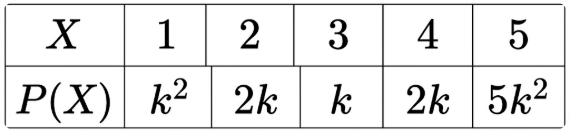
Then, $$P(X > 2)$$ is equal to:
Login to view the detailed solution.
The number of terms common to the two A.P.'s 3, 7, 11, ..., 407 and 2, 9, 16, ..., 709 is ___________.
Login to view the detailed solution.
If $$C_r \equiv {}^{25}C_r$$ and $$C_0 + 5 \cdot C_1 + 9 \cdot C_2 + \ldots + (101) \cdot C_{25} = 2^{25} \cdot k$$, then $$k$$ is equal to ___________.
Login to view the detailed solution.
If the curves, $$x^2 - 6x + y^2 + 8 = 0$$ and $$x^2 - 8y + y^2 + 16 - k = 0$$, $$(k \gt 0)$$ touch each other at a point, then the largest value of $$k$$ is ___________.
Login to view the detailed solution.
Let $$\vec{a}, \vec{b}$$ and $$\vec{c}$$ be three vectors such that $$|\vec{a}| = \sqrt{3}$$, $$|\vec{b}| = 5$$, $$\vec{b} \cdot \vec{c} = 10$$ and the angle between $$\vec{b}$$ and $$\vec{c}$$ is $$\frac{\pi}{3}$$. If $$\vec{a}$$ is perpendicular to the vector $$\vec{b} \times \vec{c}$$, then $$\left|\vec{a} \times (\vec{b} \times \vec{c})\right|$$ is equal to ___________.
Login to view the detailed solution.
If the distance between the plane, $$23x - 10y - 2z + 48 = 0$$ and the plane containing the lines $$\frac{x+1}{2} = \frac{y-3}{4} = \frac{z+1}{3}$$ and $$\frac{x+3}{2} = \frac{y+2}{6} = \frac{z-1}{\lambda}$$ $$(\lambda \in R)$$ is equal to $$\frac{k}{\sqrt{633}}$$, then $$k$$ is equal to ___________.
Login to view the detailed solution.
Educational materials for JEE preparation
 Share
Share