For the following questions answer them individually
The first and second ionisation enthalpies of a metal are 496 and 4560 kJ mol$$^{-1}$$, respectively. How many moles of HCl and H$$_2$$SO$$_4$$, respectively, will be needed to react completely with 1 mole of the metal hydroxide?
A mixture of gases $$O_2$$, $$H_2$$ and CO are taken in a closed vessel containing charcoal. The graph that represents the correct behaviour of pressure with time is:
The true statement amongst the following is:
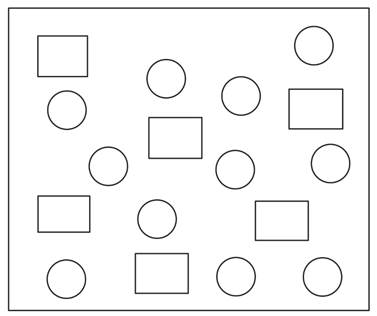
In the figure shown below reactant A (represented by square) is in equilibrium with product B (represented by circle). The equilibrium constant is (approx):
The solubility product of $$Cr(OH)_3$$ at 298K is $$6.0 \times 10^{-31}$$. The concentration of hydroxide ions in a saturated solution of $$Cr(OH)_3$$ will be:
5g of zinc is treated separately with an excess of
(a) dilute hydrochloric acid and
(b) aqueous sodium hydroxide.
The ratio of the volumes of $$H_2$$ evolved in these two reactions is:
Among the statements (a) - (d), the correct ones are:
(a) Lithium has the highest hydration enthalpy among the alkali metals.
(b) Lithium chloride is insoluble in pyridine.
(c) Lithium cannot form ethynide upon its reaction with ethyne.
(d) Both lithium and magnesium react slowly with $$H_2O$$.
The reaction of $$H_3N_3B_3Cl_3(A)$$ with $$LiBH_4$$ in tetrahydrofuran gives inorganic benzene (B). Further, the reaction of (A) with (C) leads to $$H_3N_3B_3(Me)_3$$. Compounds (B) and (C) respectively, are:
Which of the following has the shortest C - Cl bond?
Which of the following reactions will not produce a racemic product?
The number of $$sp^2$$ hybrid orbitals in a molecule of benzene is:
Biochemical Oxygen Demand (BOD) is the amount of oxygen required (in ppm):
Amongst the following, the form of water with the lowest ionic conductance at 298K is:
The correct order of the spin-only magnetic moments of the following complexes is:
(I) $$[Cr(H_2O)_6]Br_2$$
(II) $$Na_4[Fe(CN)_6]$$
(III) $$Na_3[Fe(C_2O_4)_3]$$ $$(\Delta_0 \gt P)$$
(IV) $$(Et_4N)_2[CoCl_4]$$
The isomer(s) of $$[Co(NH_3)_4Cl_2]$$ that has/have a Cl - Co - Cl angle of 90$$°$$, is/are:
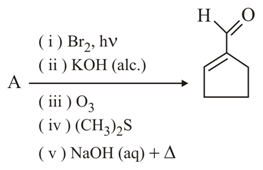
In the following reaction A is:
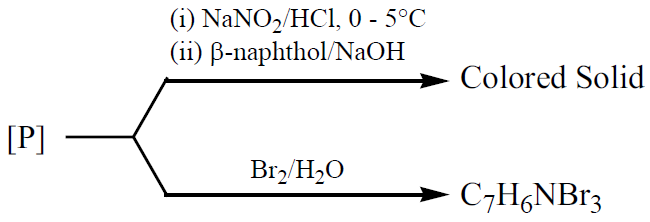
Consider the following reactions,
The compound [P] is:
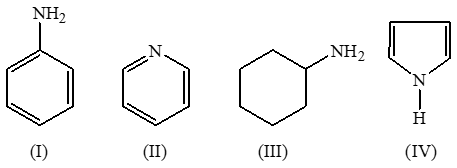
The decreasing order of basicity of the following amines is:
Which polymer has 'chiral' monomer(s)?
A, B and C are three biomolecules. The results of the tests performed on them are given below:
| Molisch's test | Barfoed Test | Biuret Test | |
|---|---|---|---|
| A | Positive | Negative | Negative |
| B | Positive | Positive | Negative |
| C | Negative | Negative | Positive |
10.30 mg of $$O_2$$ is dissolved into a liter of sea water of density 1.03 g/mL. The concentration of $$O_2$$ in ppm is ___________.
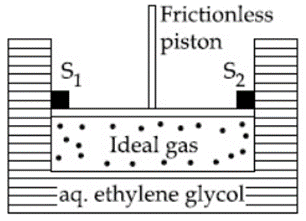
A cylinder containing an ideal gas (0.1 mol of 1.0 dm$$^3$$) is in thermal equilibrium with a large volume of 0.5 molal aqueous solution of ethylene glycol at its freezing point. If the stoppers $$S_1$$ and $$S_2$$ (as shown in the figure) are suddenly withdrawn, the volume of the gas in litres after equilibrium is achieved will be ___________.
(Given, $$K_f$$(water) $$= 2.0$$ K kg mol$$^{-1}$$, R $$= 0.08$$ dm$$^3$$ atm K$$^{-1}$$ mol$$^{-1}$$)
A sample of milk splits after 60 min at 300K and after 40 min at 400K when the population of lactobacillus acidophilus in it doubles. The activation energy (in kJ/mol) for this process is closest to ___________.
(Given, $$R = 8.3$$ J mol$$^{-1}$$ K$$^{-1}$$, $$\ln\left(\frac{2}{3}\right) = 0.4$$, $$e^{-3} = 4.0$$)
The sum of the total number of bonds between chromium and oxygen atoms in chromate and dichromate ions is ___________.
Consider the following reactions: $$A \xrightarrow[(ii)H_3O^+]{(i)CH_3MBr}B \xrightarrow[573K]{Cu} 2-methyl-2-butene$$. The mass percentage of carbon in A is ___________.