The de Broglie wavelength of an electron in the $$4^{th}$$ Bohr orbit is:

Join Our JEE Preparation Group
Prep with like-minded aspirants; Get access to free daily tests and study material.
Sign in
Please select an account to continue using cracku.in
↓ →
Join Our JEE Preparation Group
Prep with like-minded aspirants; Get access to free daily tests and study material.
The de Broglie wavelength of an electron in the $$4^{th}$$ Bohr orbit is:
Login to view the detailed solution.
B has a smaller first ionization enthalpy than Be. Consider the following statement:
(I) it is easier to remove 2p electron than 2s electron
(II) 2p electron of B is more shielded from the nucleus by the inner core of electrons than the 2s electrons of Be
(III) 2s electron has more penetration power than 2p electron
(IV) atomic radius of B is more than Be
(atomic number B : 5, Be = 4)
The correct statements are:
Login to view the detailed solution.
The acidic, basic and amphoteric oxides, respectively, are:
Login to view the detailed solution.
.webp)
If the magnetic moment of a di-oxygen species is 1.73 B.M., it may be:
Login to view the detailed solution.
If enthalpy of atomization for $$Br_2(l)$$ is $$x$$ kJ/mol and bond enthalpy for $$Br_2$$ is $$y$$ kJ/mol, the relation between them:
Login to view the detailed solution.
The $$K_{sp}$$ for the following dissociation is $$1.6 \times 10^{-5}$$
$$PbCl_{2(s)} \rightleftharpoons Pb^{2+}_{(aq)} + 2Cl^{-}_{(aq)}$$
Which of the following choices is correct for a mixture of 300 mL 0.134 M $$Pb(NO_3)_2$$ and 100 mL 0.4 M NaCl?
Login to view the detailed solution.
.webp)
The compound that cannot act both as oxidizing and reducing agent is:
Login to view the detailed solution.
'X' melts at low temperature and is a bad conductor of electricity in both liquid and solid state. X is:
Login to view the detailed solution.
The increasing order of basicity for the following intermediates is (from weak to strong):
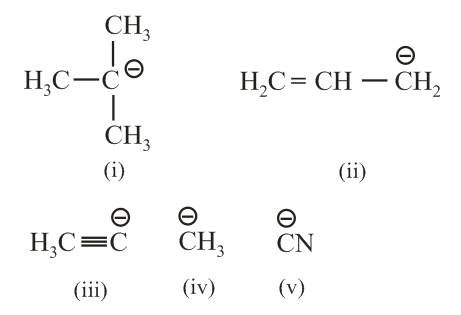
Login to view the detailed solution.
.webp)
The correct order of heat of combustion for following alkadienes is:
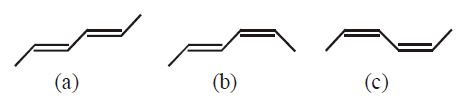
Login to view the detailed solution.
The major product (Y) in the following reactions is:
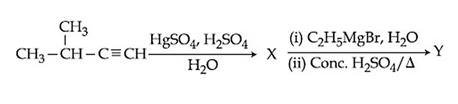
Login to view the detailed solution.
For the following reactions:
$$A \xrightarrow{700K} Product$$
$$A \xrightarrow[catalyst]{500K} Product$$
It was found that the $$E_a$$ is decreased by 30 KJ/mol in the presence of catalyst. If the rate remains unchanged, the activation energy for catalysed reaction is (Assume pre-exponential factor is same):
Login to view the detailed solution.
.webp)
According to the following diagram, A reduces $$BO_2$$ when the temperature is:
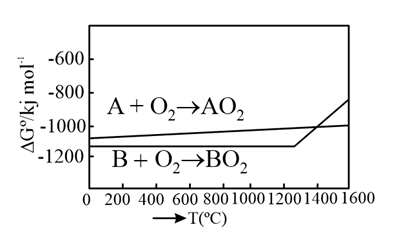
Login to view the detailed solution.
The electronic configurations of bivalent europium and trivalent cerium are:
(atomic number: Xe = 54, Ce = 58, Eu = 63)
Login to view the detailed solution.
Complex X of composition $$Cr(H_2O)_6Cl_n$$ has a spin only magnetic moment of 3.83 B.M. It reacts with $$AgNO_3$$ and shows geometrical isomerism. The IUPAC nomenclature of X is:
Login to view the detailed solution.

$$[Pd(F)(Cl)(Br)(I)]^{2-}$$ has $$n$$ number of geometrical isomers. Then, the spin-only magnetic moment and crystal field stabilization energy [CFSE] of $$[Fe(CN)_6]^{n-6}$$, respectively, are:
[Note: Ignore the pairing energy]
Login to view the detailed solution.
Which of these will produce the highest yield Friedel Crafts reaction?
Login to view the detailed solution.
Identify (A) in the following reaction sequence:
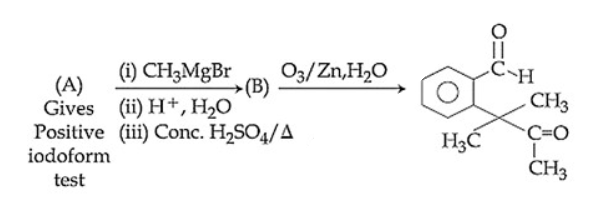
Login to view the detailed solution.
_1.webp)
The major product Z obtained in the following reaction scheme is:
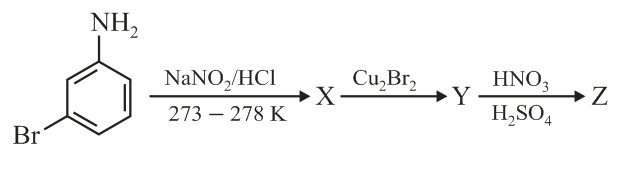
Login to view the detailed solution.
A chemist has 4 samples of artificial sweetener A, B, C and D. To identify these samples, he performed certain experiments and noted the following observations:
(i) A and D both form blue-violet colour with ninhydrin.
(ii) Lassaigne extract of C gives positive $$AgNO_3$$ test and negative $$Fe_4[Fe(CN)_6]_3$$ test.
(iii) Lassaigne extract of B and D gives positive sodium nitroprusside test.
Based on these observations which option is correct?
Login to view the detailed solution.
The molarity of $$HNO_3$$ in a sample which has density 1.4 g/mL and mass percentage of 63% is ___________.
(Molecular Weight of $$HNO_3 = 63$$)
Login to view the detailed solution.
The hardness of a water sample containing $$10^{-3}$$ M $$MgSO_4$$ expressed as $$CaCO_3$$ equivalents (in ppm) is ___________.
(molar mass of $$MgSO_4$$ is 120.37 g/mol)
Login to view the detailed solution.
How much amount of NaCl should be added to 600 g of water $$(\rho = 1.00 \; g/mL)$$ to decrease the freezing point of water to $$-0.2$$ °C? ___________. (The freezing point depression constant for water $$= 2$$ K $$kg \; mol^{-1}$$)
Login to view the detailed solution.
108 g of silver (molar mass 108 $$gmol^{-1}$$) is deposited at cathode from $$AgNO_3(aq)$$ solution by a certain quantity of electricity. The volume (in L) of oxygen gas produced at 273 K and 1 bar pressure from water by the same quantity of electricity is ___________.
Login to view the detailed solution.
The mass percentage of nitrogen in histamine is ___________.
Login to view the detailed solution.
Educational materials for JEE preparation
 Share
Share