NTA JEE Main 9th April 2019 Shift 1
For the following questions answer them individually
NTA JEE Main 9th April 2019 Shift 1 - Question 11
For given gas at 1 atm pressure, rms speed of the molecules is 200 m/s at 127°C. At 2 atm pressure and at 227°C, the rms speed of the molecules will be:
NTA JEE Main 9th April 2019 Shift 1 - Question 12
An HCl molecule has rotational, translational and vibrational motions. If the rms velocity of HCl molecules in its gaseous phase is $$\bar{v}$$, m is its mass and k$$_B$$ is Boltzmann's constant, then its temperature will be:
NTA JEE Main 9th April 2019 Shift 1 - Question 13
A simple pendulum oscillating in air has period T. The bob of the pendulum is completely immersed in a non-viscous liquid. The density of the liquid is $$\frac{1}{16}$$th of the material of the bob. If the bob is inside liquid all the time, its period of oscillation in this liquid is:

NTA JEE Main 9th April 2019 Shift 1 - Question 14
A string is clamped at both the ends and it is vibrating in its 4th harmonic. The equation of the stationary wave is $$y = 0.3 \sin(0.157x) \cos(200\pi t)$$. The length of the string is: (All quantities are in SI units.)
NTA JEE Main 9th April 2019 Shift 1 - Question 15
The pressure wave, $$P = 0.01 \sin[1000t - 3x]$$ N m$$^{-2}$$, corresponds to the sound produced by a vibrating blade on a day when atmospheric temperature is 0°C. On some other day when temperature is T, the speed of sound produced by the same blade and at the same frequency is found to be 336 m s$$^{-1}$$. Approximate value of T is:
NTA JEE Main 9th April 2019 Shift 1 - Question 16
A system of three charges are placed as shown in the figure: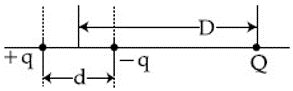
If $$D >> d$$, the potential energy of the system is best given by:
NTA JEE Main 9th April 2019 Shift 1 - Question 17
A capacitor with capacitance 5 $$\mu$$F is charged to 5 $$\mu$$C. If the plates are pulled apart to reduce the capacitance to 2 $$\mu$$F, how much work is done?
NTA JEE Main 9th April 2019 Shift 1 - Question 18
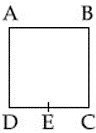
A wire of resistance R is bent to form a square ABCD as shown in the figure. The effective resistance between E and C is: (E is mid-point of arm CD)
NTA JEE Main 9th April 2019 Shift 1 - Question 19
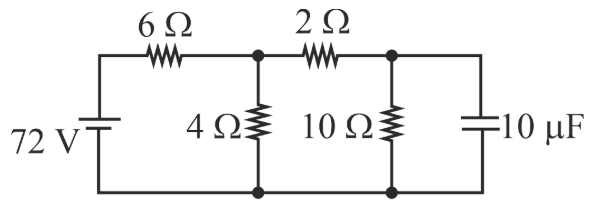
Determine the charge on the capacitor in the following circuit:
NTA JEE Main 9th April 2019 Shift 1 - Question 20
A moving coil galvanometer has resistance 50 $$\Omega$$ and it indicates full deflection at 4 mA current. A voltmeter is made using this galvanometer and a 5 k$$\Omega$$ resistance. The maximum voltage, that can be measured using this voltmeter, will be close to: