NTA JEE Main 9th April 2014 Online
For the following questions answer them individually
NTA JEE Main 9th April 2014 Online - Question 11
Modern vacuum pumps can evacuate a vessel down to a pressure of $$4.0 \times 10^{-15}$$ atm. at room temperature (300 K). Taking R = 8.3 JK$$^{-1}$$ mole$$^{-1}$$, 1 atm = $$10^5$$ Pa and $$N_{Avogadro} = 6 \times 10^{23}$$ mole$$^{-1}$$, the mean distance between molecules of gas in an evacuated vessel will be of the order of:
NTA JEE Main 9th April 2014 Online - Question 12
Two bodies of masses 1 kg and 4 kg are connected to a vertical spring, as shown in the figure. The smaller mass executes simple harmonic motion of angular frequency 25 rad s$$^{-1}$$, and amplitude 1.6 cm while the bigger mass remains stationary on the ground. The maximum force exerted by the system on the floor is (take $$g = 10$$ m s$$^{-2}$$).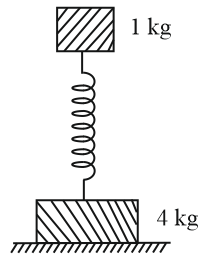
NTA JEE Main 9th April 2014 Online - Question 13
The amplitude of a simple pendulum, oscillating in air with a small spherical bob, decreases from 10 cm to 8 cm in 40 seconds. Assuming that Stokes law is valid, and ratio of the coefficient of viscosity of air to that of carbon dioxide is 1.3, the time in which amplitude of this pendulum will reduce from 10 cm to 5 cm in carbondioxide will be close to (ln 5 = 1.601, ln 2 = 0.693).

NTA JEE Main 9th April 2014 Online - Question 14
A particle which is simultaneously subjected to two perpendicular simple harmonic motions represented by; $$x = a_1 \cos \omega t$$ and $$y = a_2 \cos 2\omega t$$ traces a curve given by:
NTA JEE Main 9th April 2014 Online - Question 15
A transverse wave is represented by: $$y = \frac{10}{\pi} \sin\left(\frac{2\pi}{T}t - \frac{2\pi}{\lambda}x\right)$$. For what value of the wavelength the wave velocity is twice the maximum particle velocity?
NTA JEE Main 9th April 2014 Online - Question 16
The magnitude of the average electric field normally present in the atmosphere just above the surface of the Earth is about 150 N/C, directed inward towards the center of the Earth. This gives the total net surface charge carried by the Earth to be: [Given: $$\epsilon_0 = 8.85 \times 10^{-12}$$ C$$^2$$/N-m$$^2$$, $$R_E = 6.37 \times 10^6$$ m]
NTA JEE Main 9th April 2014 Online - Question 17
Three capacitances, each of 3 $$\mu$$F, are provided. These cannot be combined to provide the resultant capacitance of:
NTA JEE Main 9th April 2014 Online - Question 18
A d.c. main supply of e.m.f. 220 V is connected across a storage battery of e.m.f. 200 V through a resistance of 1 $$\Omega$$. The battery terminals are connected to external resistance $$R$$. The minimum value of $$R$$, so that a current passes through the battery to charge it is:
NTA JEE Main 9th April 2014 Online - Question 19
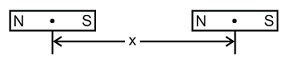
The mid points of two small magnetic dipoles of length $$d$$ in end-on positions, are separated by a distance $$x$$ ($$x \gg d$$). The magnitude of force between them is proportional to $$x^{-n}$$ where n is:
NTA JEE Main 9th April 2014 Online - Question 20
The magnetic field of earth at the equator is approximately $$4 \times 10^{-5}$$ T. The radius of earth is $$6.4 \times 10^6$$ m. Then the dipole moment of the earth will be nearly of the order of: