NTA JEE Main 8th January 2020 Shift 2
For the following questions answer them individually
NTA JEE Main 8th January 2020 Shift 2 - Question 11
Consider two charged metallic spheres $$S_1$$ and $$S_2$$ of radii $$R_1$$ and $$R_2$$, respectively. The electric fields $$E_1$$ (on $$S_1$$) and $$E_2$$ (on $$S_2$$) on their surfaces are such that $$\frac{E_1}{E_2} = \frac{R_1}{R_2}$$. Then the ratio $$V_1$$ (on $$S_1$$)/$$V_2$$ (on $$S_2$$) of the electrostatic potentials on each sphere is:
NTA JEE Main 8th January 2020 Shift 2 - Question 12
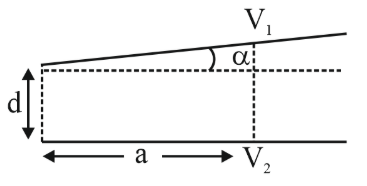
A capacitor is made of two square plates each of side 'a' making a very small angle $$\alpha$$ between them, as shown in figure. The capacitance will be close to:
NTA JEE Main 8th January 2020 Shift 2 - Question 13
A galvanometer having a coil resistance 100 $$\Omega$$ gives a full scale deflection when a current of 1 mA is passed through it. What is the value of the resistance which can convert this galvanometer into a voltmeter giving full scale deflection for a potential difference of 10 V?

NTA JEE Main 8th January 2020 Shift 2 - Question 14
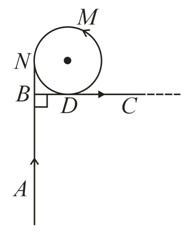
A very long wire ABDMNDC is shown in figure carrying current I. AB and BC parts are straight, long and at right angle. At D wire forms a circular turn DMND of radius R. AB, BC parts are tangential to circular turn at N and D. Magnetic field at the center of circle is:
NTA JEE Main 8th January 2020 Shift 2 - Question 15
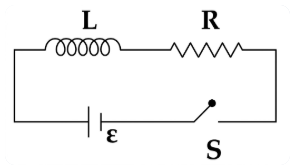
As shown in the figure, a battery of emf $$\varepsilon$$ is connected to an inductor L and resistance R in series. The switch is closed at $$t = 0$$. The total charge that flows from the battery, between $$t = 0$$ and $$t = t_c$$ ($$t_c$$ is the time constant of the circuit) is:
NTA JEE Main 8th January 2020 Shift 2 - Question 16
A plane electromagnetic wave of frequency 25 GHz is propagating in vacuum along the z-direction. At a particular point in space and time, the magnetic field is given by $$\vec{B} = 5 \times 10^{-8}\hat{j}$$ T. The corresponding electric field $$\vec{E}$$ is (speed of light = $$3 \times 10^8$$ m s$$^{-1}$$)
NTA JEE Main 8th January 2020 Shift 2 - Question 17
An object is gradually moving away from the focal point of a concave mirror along the axis of the mirror. The graphical representation of the magnitude of linear magnification (m) versus distance of the object from the mirror (x) is correctly given by (Graphs are drawn schematically and are not to scale)
NTA JEE Main 8th January 2020 Shift 2 - Question 18
In a double-slit experiment, at a certain point on the screen the path difference between the two interfering waves is $$\frac{1}{8}$$th of a wavelength. The ratio of the intensity of light at that point to that at the center of a bright fringe is:
NTA JEE Main 8th January 2020 Shift 2 - Question 19
An electron (mass m) with initial velocity $$\vec{v} = v_0\hat{i} + v_0\hat{j}$$ is in an electric field $$\vec{E} = -E_0\hat{k}$$. If $$\lambda_0$$ is initial de-Broglie wavelength of electron, its de-Broglie wave length at time $$t$$ is given by:
NTA JEE Main 8th January 2020 Shift 2 - Question 20
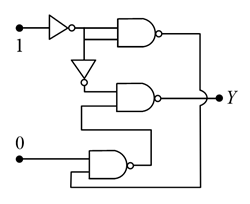
In the given circuit, value of Y is: