Preparation of Bakelite proceeds via reactions:

Join Our JEE Preparation Group
Prep with like-minded aspirants; Get access to free daily tests and study material.
Sign in
Please select an account to continue using cracku.in
↓ →
Join Our JEE Preparation Group
Prep with like-minded aspirants; Get access to free daily tests and study material.
Preparation of Bakelite proceeds via reactions:
Login to view the detailed solution.
The increasing order of the atomic radii of the following elements is:
(a) C
(b) O
(c) F
(d) Cl
(e) Br
Login to view the detailed solution.
Arrange the following bonds according to their average bond energies in descending order:
C-Cl, C-Br, C-F, C-I
Login to view the detailed solution.
.webp)
Among the compounds A and B with molecular formula C$$_9$$H$$_{18}$$O$$_3$$, A is having higher boiling point than B. The possible structures of A and B are:
Login to view the detailed solution.
For the following Assertion and Reason, the correct option is:
Assertion: The pH of water increases with increase in temperature.
Reason: The dissociation of water into H$$^+$$ and OH$$^-$$ is an exothermic reaction.
Login to view the detailed solution.
Among the reactions (a) - (d), the reaction(s) that does/do not occur in the blast furnace during the extraction of iron is/are:
(a) CaO + SiO$$_2$$ $$\rightarrow$$ CaSiO$$_3$$
(b) 3Fe$$_2$$O$$_3$$ + CO $$\rightarrow$$ 2Fe$$_3$$O$$_4$$ + CO$$_2$$
(c) FeO + SiO$$_2$$ $$\rightarrow$$ FeSiO$$_3$$
(d) FeO $$\rightarrow$$ Fe + $$\frac{1}{2}$$O$$_2$$
Login to view the detailed solution.
.webp)
The radius of the second Bohr orbit, in terms of the Bohr radius, $$a_0$$, in Li$$^{2+}$$ is:
Login to view the detailed solution.
Kjeldahl's method cannot be used to estimate nitrogen for which of the following compounds?
Login to view the detailed solution.
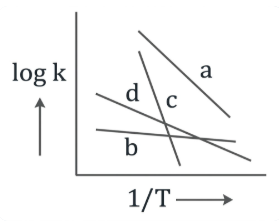
Consider the following plots of rate constant versus $$\frac{1}{T}$$ for four different reactions. Which of the following orders is correct for the activation energies of these reactions?
Login to view the detailed solution.
.webp)
An unsaturated hydrocarbon X absorbs two hydrogen molecules on catalytic hydrogenation, and also gives following reaction:
X $$\xrightarrow[\frac{(ii) Zn}{H_2O}]{(i) O_3}$$ A $$\xrightarrow{[Ag(NH_3)_2]^+}$$ B (3-oxo-hexanedicarboxylic acid). X will be:
Login to view the detailed solution.
Which of the following compounds is likely to show both Frenkel and Schottky defects in its crystalline form?
Login to view the detailed solution.
Among (a) - (d), the complexes that can show geometrical isomerism are:
(a) [Pt(NH$$_3$$)$$_3$$Cl]$$^+$$
(b) [Pt(NH$$_3$$)Cl$$_5$$]$$^-$$
(c) [Pt(NH$$_3$$)$$_2$$Cl(NO$$_2$$)]
(d) [Pt(NH$$_3$$)$$_4$$ClBr]$$^{2+}$$
Login to view the detailed solution.
.webp)
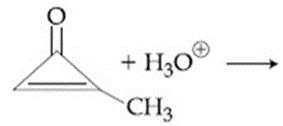
The major product in the following reaction is:
Login to view the detailed solution.
White phosphorus on reaction with concentrated NaOH solution in an inert atmosphere of CO$$_2$$ gives phosphine and compound (X). (X) on acidification with HCl gives compound (Y). The basicity of compound (Y) is:
Login to view the detailed solution.
Hydrogen has three isotopes (A), (B) and (C). If the number of neutron(s) in (A), (B) and (C) respectively, are (x), (y) and (z), the sum of (x), (y) and (z) is
Login to view the detailed solution.

A metal (A) on heating in nitrogen gas gives compound B. B on treatment with H$$_2$$O gives a colourless gas which when passed through CuSO$$_4$$ solution gives a dark blue-violet coloured solution. A and B respectively, are:
Login to view the detailed solution.
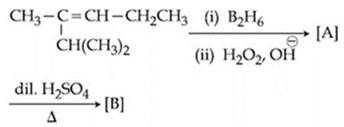
The major product [B] in the following sequence of reactions is:
Login to view the detailed solution.
The correct order of the calculated spin-only magnetic moments of complexes (A) to (D) is:
(A) Ni(CO)$$_4$$
(B) [Ni(H$$_2$$O)$$_6$$]Cl$$_2$$
(C) Na$$_2$$[Ni(CN)$$_4$$]
(D) PdCl$$_2$$(PPh$$_3$$)$$_2$$
Login to view the detailed solution.
_1.webp)
Two monomers in maltose are:
Login to view the detailed solution.
For the following Assertion and Reason, the correct option is:
Assertion: For hydrogenation reactions, the catalytic activity increases from Group 5 to Group 11 metals with maximum activity shown by Group 7-9 elements.
Reason: The reactants are most strongly adsorbed on group 7-9 elements.
Login to view the detailed solution.
NaClO$$_3$$ is used, even in spacecrafts, to produce O$$_2$$. The daily consumption of pure O$$_2$$ by a person in 492 L at 1 atm, 300K. How much amount of NaClO$$_3$$, in grams, is required to produce O$$_2$$ for the daily consumption of a person at 1 atm, 300K?
NaClO$$_3$$(s) + Fe(s) $$\rightarrow$$ O$$_2$$(g) + NaCl(s) + FeO(s)
R = 0.082 L atm mol$$^{-1}$$ K$$^{-1}$$
Login to view the detailed solution.
At constant volume, 4 mol of an ideal gas when heated from 300K to 500K changes its internal energy by 5000J. The molar heat capacity at constant volume is
Login to view the detailed solution.
In the following sequence of reactions the maximum number of atoms present in molecule 'C' in one plane is __________.
A $$\xrightarrow[Cu tube]{\text{Red hot }}$$ B $$\xrightarrow[\text{Anhydrous AlCl}_3]{CH_3Cl(1 eq)}$$ C
(A is a lowest molecular weight alkyne)
Login to view the detailed solution.
For an electrochemical cell Sn(s)|Sn$$^{2+}$$(aq, 1M)||Pb$$^{2+}$$(aq, 1M)|Pb(s) the ratio $$\frac{[Sn^{2+}]}{[Pb^{2+}]}$$ when this cell attains equilibrium is __________.
(Given: E$$^0_{Sn^{2+}|Sn} = -0.14$$ V, E$$^0_{Pb^{2+}|Pb} = -0.13$$ V, $$\frac{2.303RT}{F} = 0.06$$)
Login to view the detailed solution.
Complexes (ML$$_5$$) of metals Ni and Fe have ideal square pyramidal and trigonal bipyramidal geometries, respectively. The sum of the 90$$^\circ$$, 120$$^\circ$$ and 180$$^\circ$$ L-M-L angles in the two complexes is
Login to view the detailed solution.
Educational materials for JEE preparation
 Share
Share