For the following questions answer them individually
For the Balmer series, in the spectrum of H atom, $$\bar{v} = R_H\left\{\frac{1}{n_1^2} - \frac{1}{n_2^2}\right\}$$, the correct statements among (I) to (IV) are,
(I) As wavelength decreases, the lines in the series converge.
(II) The integer $$n_1$$ is equal to 2.
(III) The lines of the longest wavelength correspond to $$n_2 = 3$$.
(IV) The ionization energy of hydrogen can be calculated from the wave number of these lines.
The first ionization energy (in kJ/mol) of Na, Mg, Al and Si respectively are:
The third ionization enthalpy is minimum for:
The predominant intermolecular forces present in ethyl acetate, a liquid, are:
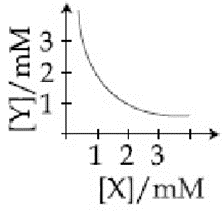
The stoichiometry and solubility product of a salt with the solubility curve given below is, respectively:
The strength of an aqueous NaOH solution is most accurately determined by titrating: (Note: consider that an appropriate indicator is used)
When gypsum is heated to 393K, it forms:
Arrange the following compounds in increasing order of C-OH bond length: methanol, phenol, p-ethoxyphenol
A flask contains a mixture of isohexane and 3-methylpentane. One of the liquids boils at 63$$^\circ$$C while the other boils at 60$$^\circ$$C. What is the best way to separate the two liquids and which one will be distilled out first?
Among the gases (a) - (e), the gases that cause greenhouse effect are:
(a) CO$$_2$$
(b) H$$_2$$O
(c) CFCs
(d) O$$_2$$
(e) O$$_3$$
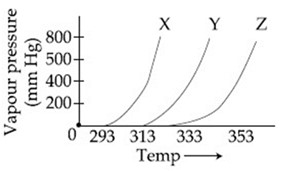
A graph of vapour pressure and temperature for three different liquids X, Y and Z is shown below:
The following inferences are made:
(A) X has higher intermolecular interactions compared to Y.
(B) X has lower intermolecular interactions compared to Y.
(C) Z has lower intermolecular interactions compared to Y.
The correct inferences is/are:
The rate of a certain biochemical reaction at physiological temperature (T) occurs $$10^6$$ times faster with enzyme than without. The change in the activation energy upon adding enzyme is:
As per Hardy-Schulze formulation, the flocculation values of the following for ferric hydroxide sol are in the order:
The number of bonds between sulphur and oxygen atoms in S$$_2$$O$$_8^{2-}$$ and the number of bonds between sulphur and sulphur atoms in rhombic sulphur, respectively are:
The complex that can show fac- and mer-isomers is:
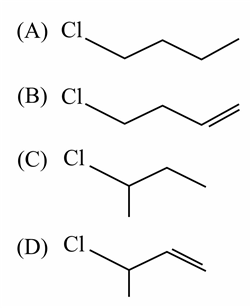
The decreasing order of reactivity towards dehydrohalogenation (E$$_1$$) reaction of the following compounds is:
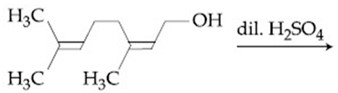
The major product of the following reaction is:
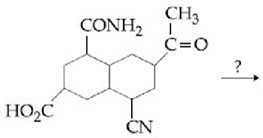
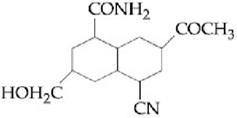
The most suitable reagent for the given conversion is:
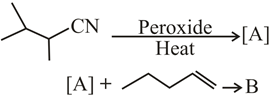
The major products A and B in the following reactions are
Which of the following statement is not true for glucose?
The volume (in mL) of 0.125 M AgNO$$_3$$ required to quantitatively precipitate chloride ions in 0.3 g of [Co(NH$$_3$$)$$_6$$]Cl$$_3$$ is __________.
M[Co(NH$$_3$$)$$_6$$]Cl$$_3$$ = 267.46 g/mol
M AgNO$$_3$$ = 169.87 g/mol
Report the nearest integer as the answer.
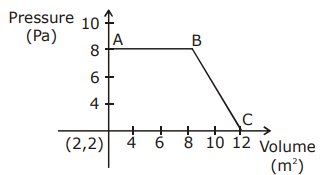
The magnitude of work done by a gas that undergoes a reversible expansion along the path ABC shown in the figure is __________.
Ferrous sulphate heptahydrate is used to fortify foods with iron. The amount (in grams) of the salt required to achieve 10 ppm of iron in 100 kg of wheat is __________.
Atomic weight: Fe = 55.85; S = 32.00; O = 16.00
What would be the electrode potential for the given half-cell reaction at pH = 5?
2H$$_2$$O $$\rightarrow$$ O$$_2$$ + 4H$$^+$$ + 4e$$^-$$; E$$_{red}^0 = 1.23$$ V
(R = 8.314 J mol$$^{-1}$$ K$$^{-1}$$; Temp = 298K; oxygen under standard atm. pressure of 1 bar)
The number of chiral centres in penicillin is __________.