For the following questions answer them individually
The density of a material, in the shape of a cube, is determined by measuring three sides of the cube and its mass. If the relative errors in measuring the mass and length are 1.5% and 1%, respectively, the maximum error in determining the density is:
All the graphs below are intended to represent the same motion. One of them does it incorrectly. Pick it up.
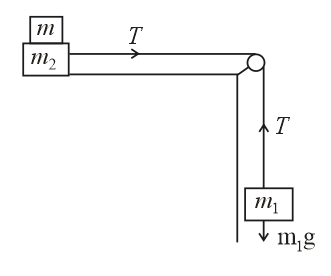
Two masses $$m_1 = 5$$ kg and $$m_2 = 10$$ kg, connected by an inextensible string over a frictionless pulley, are moving as shown in the figure. The coefficient of friction of horizontal surface is 0.15. The minimum weight m that should be put on top of $$m_2$$ to stop the motion is:
A particle is moving in a circular path of radius a under the action of an attractive potential $$U = -\frac{k}{2r^2}$$. Its total energy is:
In a collinear collision, a particle with an initial speed $$v_0$$ strikes a stationary particle of the same mass. If the final total kinetic energy is 50% greater than the original kinetic energy, the magnitude of the relative velocity between the two particles, after the collision, is:
It is found that if a neutron suffers an elastic collinear collision with a deuterium at rest, the fractional loss of its energy is $$P_d$$, while for its similar collision with a carbon nucleus at rest, the fractional loss of energy is $$P_c$$. The values of $$P_d$$ and $$P_c$$ are respectively:
The mass of a hydrogen molecule is $$3.32 \times 10^{-27}$$ kg. If $$10^{23}$$ hydrogen molecules strike, per second, a fixed wall of the area 2 cm$$^2$$ at an angle of 45$$^\circ$$ to the normal, and rebound elastically with a speed of $$10^3$$ m s$$^{-1}$$, then the pressure on the wall is nearly:
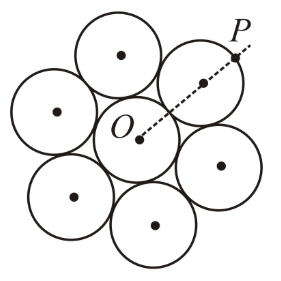
Seven identical circular planar disks, each of mass M and radius R are welded symmetrically as shown. The moment of inertia of the arrangement about the axis normal to the plane and passing through the point P is:
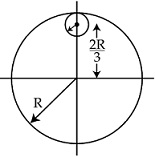
From a uniform circular disc of radius R and mass 9 M, a small disc of radius $$\frac{R}{3}$$ is removed as shown in the figure. The moment of inertia of the remaining disc about an axis perpendicular to the plane of the disc and passing through centre of disc is:
A particle is moving with a uniform speed in a circular orbit of radius R in a central force inversely proportional to the $$n^{th}$$ power of R. If the period of rotation of the particle is T, then:
A solid sphere of radius r made of a soft material of bulk modulus K is surrounded by a liquid in a cylindrical container. A massless piston of area a floats on the surface of the liquid, covering entire cross-section of cylindrical container. When a mass m is placed on the surface of the piston to compress the liquid, the fractional decrement in the radius of the sphere $$\left(\frac{dr}{r}\right)$$, is:
Two moles of an ideal monoatomic gas occupies a volume V at 27$$^\circ$$C. The gas expands adiabatically to a volume 2V. Calculate (a) the final temperature of the gas and (b) change in its internal energy.
A silver atom in a solid oscillates in simple harmonic motion in some direction with a frequency of $$10^{12}$$ s$$^{-1}$$. What is the force constant of the bonds connecting one atom with the other? (Mole wt. of silver = 108 g mol$$^{-1}$$ and Avogadro number = $$6.02 \times 10^{23}$$)
A granite rod of 60 cm length is clamped at its middle point and is set into longitudinal vibrations. The density of granite is $$2.7 \times 10^3$$ kg m$$^{-3}$$ and its Young's modulus is $$9.27 \times 10^{10}$$ Pa. What will be the fundamental frequency of the longitudinal vibrations?
Three concentric metal shells A, B and C of respective radii a, b and c (a < b < c) have surface charge densities $$+\sigma$$, $$-\sigma$$ and $$+\sigma$$ respectively. The potential of shell B is:
A parallel plate capacitor of capacitance 90 pF is connected to a battery of EMF 20 V. If a dielectric material of dielectric constant $$K = \frac{5}{3}$$ is inserted between the plates, the magnitude of the induced charge will be:
Two batteries with e.m.f. 12 V and 13 V are connected in parallel across a load resistor of 10 $$\Omega$$. The internal resistance of the two batteries are 1 $$\Omega$$ and 2 $$\Omega$$ respectively. The voltage across the load lies between,
On interchanging the resistances, the balance point of a meter bridge shifts to the left by 10 cm. The resistance of their series combination is 1 k$$\Omega$$. How much was the resistance on the left slot before interchanging the resistances?
In a potentiometer experiment, it is found that no current passes through the galvanometer when the terminals of the cell are connected across 52 cm of the potentiometer wire. If the cell is shunted by a resistance of 5 $$\Omega$$, a balance is found when the cell is connected across 40 cm of the wire. Find the internal resistance of the cell.
The dipole moment of a circular loop carrying a current I, is m and the magnetic field at the centre of the loop is $$B_1$$. When the dipole moment is doubled by keeping the current constant, the magnetic field at the centre of the loop is $$B_2$$. The ratio $$\frac{B_1}{B_2}$$ is:
An electron, a proton and an alpha particle having the same kinetic energy are moving in circular orbits of radii $$r_e$$, $$r_p$$, $$r_\alpha$$ respectively in a uniform magnetic field B. The relation between $$r_e$$, $$r_p$$, $$r_\alpha$$ is:
For an RLC circuit driven with voltage of amplitude $$v_m$$ and frequency $$\omega_0 = \frac{1}{\sqrt{LC}}$$, the current exhibits resonance. The quality factor, Q is given by:
In an A.C. circuit, the instantaneous e.m.f. and current are given by, $$E = 100 \sin 30t$$, $$I = 20 \sin\left(30t - \frac{\pi}{4}\right)$$. In one cycle of A.C., the average power consumed by the circuit (in watt) and the watt-less current (in ampere) are, respectively:
An EM wave from air enters a medium. The electric fields are $$\vec{E_1} = E_{01}\hat{x}\cos\left[2\pi\nu\left(\frac{z}{c} - t\right)\right]$$ in air and $$\vec{E_2} = E_{02}\hat{x}\cos[k(2z - ct)]$$ in medium, where the wave number k and frequency $$\nu$$ refer to their values in the air. The medium is non-magnetic. If $$\epsilon_{r_1}$$ and $$\epsilon_{r_2}$$ refer to relative permittivities of air and medium respectively, which of the following options is correct?
Unpolarized light of intensity I passes through an ideal polariser A. Another identical polariser B is placed behind A. The intensity of light beyond B is found to be $$\frac{I}{2}$$. Now another identical polariser C is placed between A and B. The intensity beyond B is now found to be $$\frac{I}{8}$$. The angle between polariser A and C is:
The angular width of the central maximum in a single slit diffraction pattern is 60$$^\circ$$. The width of the slit is 1 $$\mu$$m. The slit is illuminated by monochromatic plane waves. If another slit of the same width is made near it, Young's fringes can be observed on a screen placed at a distance 50 cm from the slits. If the observed fringe width is 1 cm, what is slit separation distance? (i.e., the distance between the centres of each slit.)
An electron from various excited states of hydrogen atom emit radiation to come to the ground state. Let $$\lambda_n$$, $$\lambda_g$$ be the de Broglie wavelength of the electron in the $$n^{th}$$ state and the ground state respectively. Let $$\Lambda_n$$ be the wavelength of the emitted photon in the transition from the $$n^{th}$$ state to the ground state. For large n, (A, B are constants)
If the series limit frequency of the Lyman series is $$V_L$$, then the series limit frequency of the Pfund series is:
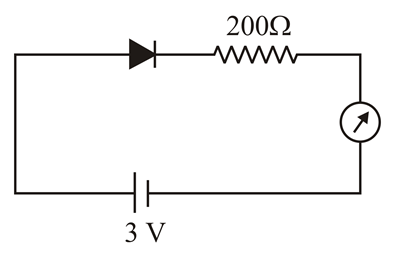
The reading of the ammeter for a silicon diode in the given circuit is:
A telephonic communication service is working at a carrier frequency of 10 GHz. Only 10% of it is utilized for transmission. How many telephonic channels can be transmitted simultaneously if each channel requires a bandwidth of 5 kHz?