For the following questions answer them individually
The ratio of mass percent of C and H of an organic compound ($$C_XH_YO_Z$$) is 6 : 1. If one molecule of the above compound ($$C_XH_YO_Z$$) contains half as much oxygen as required to burn one molecule of compound $$C_XH_Y$$ completely to $$CO_2$$ and $$H_2O$$. The empirical formula of the compound $$C_XH_YO_Z$$ is:
According to molecular orbital theory, which of the following molecule will not be available?
Which of the following compounds contain(s) no covalent bond(s)?
KCl, PH$$_3$$, O$$_2$$, B$$_2$$H$$_6$$, H$$_2$$SO$$_4$$
Total number of lone pair of electrons in I$$_3^-$$ ion is:
The combustion of benzene (l) gives CO$$_2$$(g) and H$$_2$$O(l). Given that heat of combustion of benzene at constant volume is $$-3263.9$$ kJ mol$$^{-1}$$ at 25$$^\circ$$C; the heat of combustion (in kJ mol$$^{-1}$$) of benzene at constant pressure will be:
(R = 8.314 JK$$^{-1}$$ mol$$^{-1}$$)
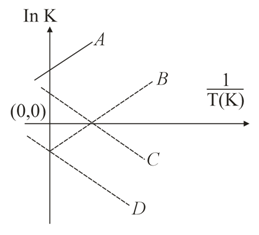
Which of the following lines correctly show the temperature dependence of equilibrium constant K, for an exothermic reaction?
An aqueous solution contains 0.10 M H$$_2$$S and 0.20 M HCl. If the equilibrium constant for the formation of HS$$^-$$ from H$$_2$$S is $$1.0 \times 10^{-7}$$ and that of S$$^{2-}$$ from HS$$^-$$ ions is $$1.2 \times 10^{-13}$$, then the concentration of S$$^{2-}$$ ions in the aqueous solution is:
An aqueous solution contains an unknown concentration of Ba$$^{2+}$$. When 50 mL of a 1 M solution of Na$$_2$$SO$$_4$$ is added, BaSO$$_4$$ just begins to precipitate. The final volume is 500 mL. The solubility product of BaSO$$_4$$ is $$1 \times 10^{-10}$$. What is the original concentration of Ba$$^{2+}$$?
Which of the following are Lewis acids?
Which of the following salts is the most basic in aqueous solution?
An alkali is titrated against acid with methyl orange as an indicator, which of the following is a correct combination?
Hydrogen peroxide oxidises [Fe(CN)$$_6$$]$$^{4-}$$ to [Fe(CN)$$_6$$]$$^{3-}$$ in acidic medium, but reduces [Fe(CN)$$_6$$]$$^{3-}$$ to [Fe(CN)$$_6$$]$$^{4-}$$ in alkaline medium. The other products formed are, respectively:
When metal M is treated with NaOH, a white gelatinous precipitate X is obtained, which is soluble in excess of NaOH. Compound X when heated strongly gives an oxide which is used in chromatography as an adsorbent. The metal M is:
Which of the following compounds will be suitable for Kjeldahl's method for nitrogen estimation?
The trans-alkenes are formed by the reduction of alkynes with:
The recommended concentration of fluoride ion in drinking water is up to 1 ppm as fluoride ion is required to make teeth enamel harder by converting [3Ca$$_3$$(PO$$_4$$)$$_2$$.Ca(OH)$$_2$$] to:
Which type of 'defect' has the presence of cations in the interstitial sites?
For 1 molal aqueous solution of the following compounds, which one will show the highest freezing point?
How long (approximate) should water be electrolysed by passing through 100 amperes current so that the oxygen released can completely burn 27.66 g of diborane? (Atomic weight of B = 10.8 u)
At 518$$^\circ$$C, the rate of decomposition of a sample of gaseous acetaldehyde, initially at a pressure of 363 Torr was 1.00 Torr s$$^{-1}$$ when 5% had reacted and 0.50 Torr s$$^{-1}$$ when 33% had reacted. The order of the reaction is:
The compound that does not produce nitrogen gas by thermal decomposition is:
Consider the following reaction and statements:
$$[Co(NH_3)_4Br_2]^+ + Br^- \rightarrow [Co(NH_3)_3Br_3] + NH_3$$
(i) Two isomers are produced if the reactant complex ion is a cis-isomer.
(ii) Two isomers are produced if the reactant complex ion is a trans-isomer.
(iii) Only one isomer is produced if the reactant complex ion is a trans-isomer.
(iv) Only one isomer is produced if the reactant complex ion is a cis-isomer.
The correct statements are:
The oxidation states of Cr in [Cr(H$$_2$$O)$$_6$$]Cl$$_3$$, [Cr(C$$_6$$H$$_6$$)$$_2$$] and K$$_2$$[Cr(CN)$$_2$$(O)$$_2$$(O$$_2$$)(NH$$_3$$)], respectively, are:
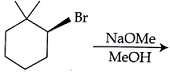
The major product of the following reaction is:
Phenol reacts with methyl chloroformate in the presence of NaOH to form product A. A reacts with Br$$_2$$ to form product B. A and B are respectively:
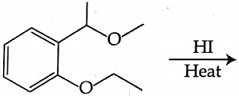
The major product formed in the following reaction is:
Phenol on treatment with $$CO_2$$ in the presence of NaOH followed by acidification produces compound X as the major product. X on treatment with $$(CH_3CO)_2O$$ in the presence of catalytic amount of $$H_2SO_4$$ produces:
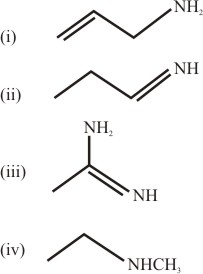
The increasing order of basicity of the following compounds is:
Glucose on prolonged heating with HI gives:
The predominant form of histamine present in human blood is (pK$$_a$$, Histidine = 6.0):