NTA JEE Main 7th January 2020 Shift 2
For the following questions answer them individually
NTA JEE Main 7th January 2020 Shift 2 - Question 11
In a building there are 15 bulbs of 45 W, 15 bulbs of 100 W, 15 small fans of 10 W and 2 heaters of 1 kW. The voltage of electric main supply is 220 V. The minimum fuse capacity (rated value) of the building will be:
NTA JEE Main 7th January 2020 Shift 2 - Question 12
In the figure, potential difference between A and B is: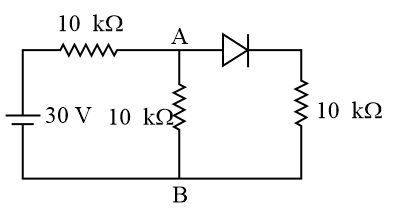
NTA JEE Main 7th January 2020 Shift 2 - Question 13
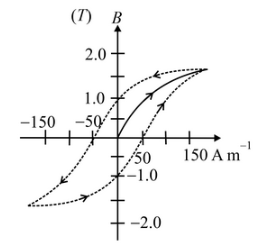
The figure gives experimentally measured B vs. H variation in a ferromagnetic material. The retentivity, coercivity and saturation, respectively, of the material are

NTA JEE Main 7th January 2020 Shift 2 - Question 14
The electric field of a plane electromagnetic wave is given by $$\vec{E} = E_0 \frac{\hat{i}+\hat{j}}{\sqrt{2}}\cos(kz + \omega t)$$. At $$t = 0$$, a positively charged particle is at the point $$(x, y, z) = \left(0, 0, \frac{\pi}{k}\right)$$. If its instantaneous velocity at $$(t = 0)$$ is $$v_0 \hat{k}$$, the force acting on it due to the wave is:
NTA JEE Main 7th January 2020 Shift 2 - Question 15
A planar loop of wire rotates in a uniform magnetic field. Initially, at $$t = 0$$, the plane of the loop is perpendicular to the magnetic field. If it rotates with a period of 10s about an axis in its plane then the magnitude of induced emf will be maximum and minimum, respectively at:
NTA JEE Main 7th January 2020 Shift 2 - Question 16
An emf of 20 V is applied at time $$t = 0$$ to a circuit containing in series 10 mH inductor and 5 $$\Omega$$ resistor. The ratio of the currents at time $$t = \infty$$ and at $$t = 40$$ s is close to: (Take $$e^2 = 7.389$$)
NTA JEE Main 7th January 2020 Shift 2 - Question 17
A thin lens made of glass (refractive index = 1.5) of focal length $$f = 16$$ cm is immersed in a liquid of refractive index 1.42. If its focal length in liquid is $$f_l$$, then the ratio $$f_l/f$$ is closest to the integer:
NTA JEE Main 7th January 2020 Shift 2 - Question 18
In a Young's double slit experiment, the separation between the slits is 0.15 mm. In the experiment, a source of light of wavelength 589 nm is used and the interference pattern is observed on a screen kept 1.5 m away. The separation between the successive bright fringes on the screen is:
NTA JEE Main 7th January 2020 Shift 2 - Question 19
An electron (of mass $$m$$) and a photon have the same energy $$E$$ in the range of a few eV. The ratio of the de-Broglie wavelength associated with the electron and the wavelength of the photon is (c = speed of light in vacuum)
NTA JEE Main 7th January 2020 Shift 2 - Question 20
The activity of a radioactive sample falls from 700 s$$^{-1}$$ to 500 s$$^{-1}$$ in 30 minutes. Its half life is close to: