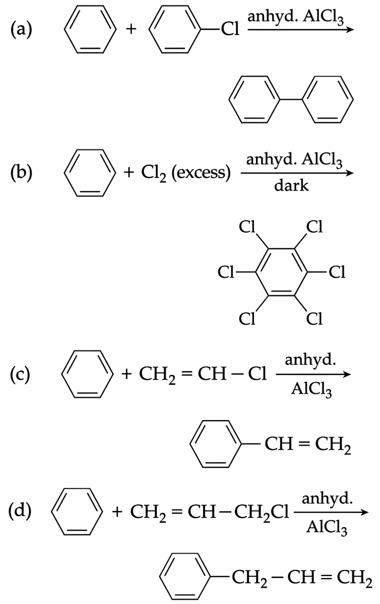
For the following questions answer them individually
The ammonia (NH$$_3$$) released on quantitative reaction of 0.6 g urea (NH$$_2$$CONH$$_2$$) with sodium hydroxide (NaOH) can be neutralized by
Within each pair of elements F and Cl, S and Se, and Li and Na, respectively, the elements that release more energy upon an electron gain are
The bond order and the magnetic characteristic of CN$$^-$$ are
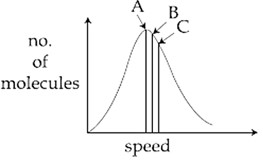
Identify the correct labels of A, B and C in the following graph from the options given below:
Root mean square speed (V$$_{rms}$$); most probable speed (V$$_{mp}$$); Average speed (V$$_{av}$$)
The redox reaction among the following is
Among statements (a) - (d), the correct ones are:
(a) Decomposition of hydrogen peroxide gives di-oxygen.
(b) Like hydrogen peroxide, compounds, such as KClO$$_3$$, Pb(NO$$_3$$) and NaNO$$_3$$ when heated liberate di-oxygen.
(c) 2-Ethylanthraquinone is useful for the industrial preparation of hydrogen peroxide.
(d) Hydrogen peroxide is used for the manufacture of sodium perborate.
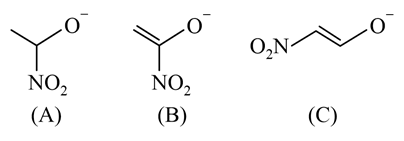
The correct order of stability for the following alkoxides is:
A chromatography column, packed with silica gel as stationary phase, was used to separate a mixture of compounds consisting of (A) benzanilide (B) aniline and (C) acetophenone. When the column is eluted with a mixture of solvents, hexane:ethyl acetate (20 : 80), the sequence of obtained compounds is:
Two open beakers one containing a solvent and the other containing a mixture of that solvent with a non volatile solute are together sealed in a container. Over time:
The equation that is incorrect is:
For the reaction $$2H_2(g) + 2NO(g) \rightarrow N_2(g) + 2H_2O(g)$$ the observed rate expression is, rate $$= k_f[NO]^2[H_2]$$. The rate expression for the reverse reaction is:
The refining method used when the metal and the impurities have low and high melting temperatures, respectively, is
In the following reactions, products (A) and (B), respectively, are:
NaOH + Cl$$_2$$ $$\rightarrow$$ (A) + side products (hot and conc.)
Ca(OH)$$_2$$ + Cl$$_2$$ $$\rightarrow$$ (B) + side products (dry)
The number of possible optical isomers for the complexes MA$$_2$$B$$_2$$ with sp$$^3$$ and dsp$$^2$$ hybridized metal atom, respectively, is:
Note: A and B are unidentate neutral and unidentate monoanionic ligands, respectively.
Among the statements (a) - (d), the incorrect ones are:
(a) Octahedral Co(III) complexes with strong field ligands have very high magnetic moments
(b) When $$\Delta_0 < P$$, the d-electron configuration of Co(III) in an octahedral complex is $$t_{eg}^4 e_g^2$$
(c) Wavelength of light absorbed by [Co(en)$$_3$$]$$^{3+}$$ is lower than that of [CoF$$_6$$]$$^{3-}$$
(d) If the $$\Delta_0$$ for an octahedral complex of Co(III) is 18,000 cm$$^{-1}$$, the $$\Delta_t$$ for its tetrahedral complex with the same ligand will be 16,000 cm$$^{-1}$$.
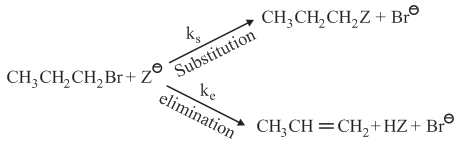
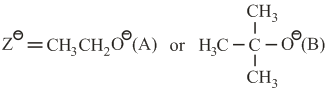
For the following reactions
where:
k$$_s$$ and k$$_e$$ are respectively the rate constants for substitution and elimination, and $$\mu = \frac{k_s}{k_e}$$, the correct option is
Consider the following reactions:
Which of these reactions are possible?
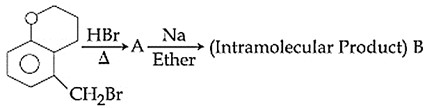
In the following reaction sequence, structures of A and B are, respectively
Cyclohexanone-CH$$_2$$Br $$\xrightarrow{\text{HBr}}$$ A $$\xrightarrow{\text{Na/Ether}}$$ (Intramolecular Product) B
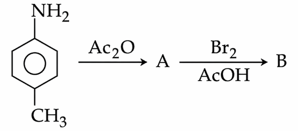
In the following reaction sequence,

the major product B is
Which of the following statements is correct?
The standard heat of formation $$(\Delta_f H_{298}^0)$$ of ethane (in kJ/mol), if the heat of combustion of ethane, hydrogen and graphite are $$-1560$$, $$-393.5$$ and $$-286$$ kJ/mol, respectively is
3 g of acetic acid is added to 250 mL of 0.1 M HCl and the solution made up to 500 mL. To 20 mL of this solution $$\frac{1}{2}$$ mL of 5M NaOH is added. The pH of the solution is
[Given: pKa of acetic acid = 4.75, molar mass of acetic acid 60 g/mol, log 3 = 0.4771, Neglect any changes in volume]
Consider the following reactions:
NaCl + K$$_2$$Cr$$_2$$O$$_7$$ + H$$_2$$SO$$_4$$ (Conc.) $$\rightarrow$$ (A) + side products
(A) + NaOH $$\rightarrow$$ (B) + side products
(B) + H$$_2$$SO$$_4$$ + H$$_2$$O$$_2$$ (dilute) $$\rightarrow$$ (C) + side products
The sum of the total number of atoms in one molecule each of (A), (B) and (C) is
The flocculation value of HCl for arsenic sulphide sol is 30 mmolL$$^{-1}$$. If H$$_2$$SO$$_4$$ is used for the flocculation of arsenic sulphide, the amount, in grams, of H$$_2$$SO$$_4$$ in 250 ml required for the above purpose is (molecular mass of H$$_2$$SO$$_4$$ = 98 g/mol)
The number of sp$$^2$$ hybridised carbons present in "Aspartame" is