Amongst the following statements, that which was not proposed by Dalton was:

Join Our JEE Preparation Group
Prep with like-minded aspirants; Get access to free daily tests and study material.
Sign in
Please select an account to continue using cracku.in
↓ →
Join Our JEE Preparation Group
Prep with like-minded aspirants; Get access to free daily tests and study material.
Amongst the following statements, that which was not proposed by Dalton was:
Login to view the detailed solution.
The number of orbitals associated with quantum numbers $$n = 5$$, $$m_s = +\frac{1}{2}$$ is:
Login to view the detailed solution.
The electron gain enthalpy (in kJ/mol) of fluorine, chlorine, bromine and iodine, respectively, are
Login to view the detailed solution.
.webp)
The dipole moments of CCl$$_4$$, CHCl$$_3$$ and CH$$_4$$ are in the order
Login to view the detailed solution.
The relative strength of the interionic/ intermolecular forces in a decreasing order is:
Login to view the detailed solution.
Oxidation number of potassium in K$$_2$$O, K$$_2$$O$$_2$$ and KO$$_2$$, respectively, is:
Login to view the detailed solution.
.webp)
In comparison to the zeolite process for the removal of permanent hardness, the synthetic resin method is
Login to view the detailed solution.
A solution of m-chloroaniline, m-chlorophenol and m-chlorobenzoic acid in ethyl acetate was extracted initially with a saturated solution of NaHCO$$_3$$ to give fraction A. The left over organic phase was extracted with dilute NaOH solution to give fraction B. The final organic layer was labelled as fraction C. Fractions A, B and C, contain respectively:
Login to view the detailed solution.
The increasing order of pK$$_b$$ for the following compounds will be:
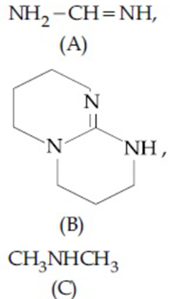
Login to view the detailed solution.
.webp)
Consider the following reactions:
(a) $$(CH_3)_3CCH(OH)CH_3 \xrightarrow{\text{conc.} H_2SO_4}$$
(b) $$(CH_3)_2CHCH(Br)CH_3 \xrightarrow{\text{alc. KOH}}$$
(c) $$(CH_3)_2CHCH(Br)CH_3 \xrightarrow{(CH_3)_3O^\ominus K^\oplus}$$
(d)
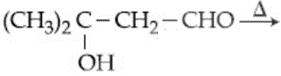
Which of the reaction(s) will not produce Saytzeff product?
Login to view the detailed solution.
At 35 $$^\circ$$C, the vapour pressure of CS$$_2$$ is 512 mmHg and that of acetone is 144 mmHg. A solution of CS$$_2$$ in acetone has a total vapour pressure of 600 mmHg. The false statement amongst the following is:
Login to view the detailed solution.
Given that the standard potentials (E$$^\circ$$) of Cu$$^{2+}$$/Cu and Cu$$^+$$/Cu are 0.34V and 0.522V respectively, the E$$^\circ$$ of Cu$$^{2+}$$/Cu$$^+$$ is:
Login to view the detailed solution.
.webp)
The purest form of commercial iron is:
Login to view the detailed solution.
The atomic radius of Ag is closest to
Login to view the detailed solution.
The IUPAC name of the complex [Pt(NH$$_3$$)$$_2$$Cl(NH$$_2$$CH$$_3$$)]Cl is
Login to view the detailed solution.

The theory that can completely/properly explain the nature of bonding in [Ni(CO)$$_4$$] is:
Login to view the detailed solution.
1-methyl ethylene oxide when treated with an excess of HBr produces
Login to view the detailed solution.
What is the product of the following reaction?
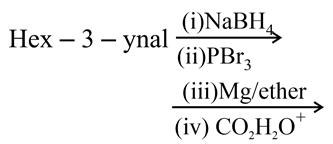
Login to view the detailed solution.
_1.webp)
Consider the following reaction:

The product 'X' is used:
Login to view the detailed solution.
Match the following:
(i) Riboflavin (a) Beriberi
(ii) Thiamine (b) Scurvy
(iii) Pyridoxine (c) Cheilosis
(iv) Ascorbic acid (d) Convulsions
Login to view the detailed solution.
For the reaction:
A(l) $$\rightarrow$$ 2B(g)
$$\Delta U = 2.1$$ kcal, $$\Delta S = 20$$ cal K$$^{-1}$$ at 300K.
Hence $$\Delta G$$ in kcal is
Login to view the detailed solution.
Two solutions, A and B, each of 100L was made by dissolving 4g of NaOH and 9.8g of H$$_2$$SO$$_4$$ in water, respectively. The pH of the resultant solution obtained from mixing 40L of solution A and 10L of solution B is (log 2 = 0.3)
Login to view the detailed solution.
During the nuclear explosion, one of the products is $$^{90}$$Sr with half life of 6.93 years. If 1$$\mu$$g of $$^{90}$$Sr was absorbed in the bones of a newly born baby in place of Ca, how much time, in years, is required to reduce it by 90% if it is not lost metabolically
Login to view the detailed solution.
Chlorine reacts with hot and concentrated NaOH and produces compounds (X) and (Y). Compound (X) gives white precipitate with silver nitrate solution. The average bond order between Cl and O atoms in (Y) is
Login to view the detailed solution.
The number of chiral carbons in chloramphenicol is
Login to view the detailed solution.
Educational materials for JEE preparation
 Share
Share