NTA JEE Main 7th April 2013 Online
For the following questions answer them individually
NTA JEE Main 7th April 2013 Online - Question 1
Let $$[\epsilon_0]$$ denote the dimensional formula of the permittivity of vacuum. If M = mass, L = length, T = time and A = electric current, then :
NTA JEE Main 7th April 2013 Online - Question 2
A projectile is given an initial velocity of $$(\hat{i} + 2\hat{j})$$ m s$$^{-1}$$, where $$\hat{i}$$ is along the ground and $$\hat{j}$$ is along the vertical upward. If $$g = 10$$ m s$$^{-2}$$, the equation of its trajectory is :
NTA JEE Main 7th April 2013 Online - Question 3
A uniform cylinder of length L and mass M having cross-sectional area A is suspended, with its length vertical, from a fixed point by a massless spring, such that it is half submerged in a liquid of density $$\sigma$$ at equilibrium position. The extension $$x_0$$ of the spring when it is in equilibrium is :

NTA JEE Main 7th April 2013 Online - Question 4
This question has Statement - I and Statement - II. Of the four choices given after the Statements, choose the one that best describes the two Statements.
Statement - I: A point particle of mass $$m$$ moving with speed $$v$$ collides with stationary point particle of mass $$M$$. If the maximum energy loss possible is given as $$f\left(\frac{1}{2}mv^2\right)$$ then $$f = \left(\frac{m}{M+m}\right)$$.
Statement - II: Maximum energy loss occurs when the particles get stuck together as a result of the collision.
NTA JEE Main 7th April 2013 Online - Question 5
A hoop of radius r and mass m rotating with an angular velocity $$\omega_0$$ is placed on a rough horizontal surface. The initial velocity of the centre of the hoop is zero. What will be the velocity of the centre of the hoop when it ceases to slip?
NTA JEE Main 7th April 2013 Online - Question 6
What is the minimum energy required to launch a satellite of mass m from the surface of a planet of mass M and radius R in a circular orbit at an altitude of 2R?
NTA JEE Main 7th April 2013 Online - Question 7
Assume that a drop of a liquid evaporates by a decrease in its surface energy so that its temperature remains unchanged. The minimum radius of the drop for this to be possible is. (The surface tension is T, the density of the liquid is $$\rho$$ and L is its latent heat of vaporisation.)
NTA JEE Main 7th April 2013 Online - Question 8
If a piece of metal is heated to temperature $$\theta$$ and then allowed to cool in a room which is at temperature $$\theta_0$$, the graph between the temperature T of the metal and time t will be closest to :
NTA JEE Main 7th April 2013 Online - Question 9
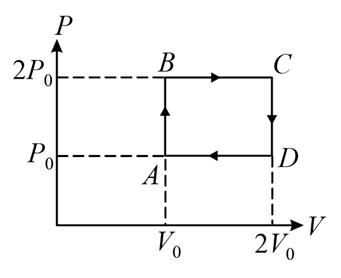
The below P-V diagram represents the thermodynamic cycle of an engine, operating with an ideal mono-atomic gas. The amount of heat, extracted from the source in a single cycle, is:
NTA JEE Main 7th April 2013 Online - Question 10
Two charges, each equal to q, are kept at $$x = -a$$ and $$x = a$$ on the x-axis. A particle of mass m and charge $$q_0 = -\frac{q}{2}$$ is placed at the origin. If charge $$q_0$$ is given a small displacement ($$y << a$$) along the y-axis, the net force acting on the particle is proportional to :