For the following questions answer them individually
For a concentrated solution of a weak electrolyte ($$K_{eq}$$ = equilibrium constant) A$$_2$$B$$_3$$ of concentration 'C', the degree of dissociation '$$\alpha$$' is
Which of the following options are correct for the reaction?
$$2Au(CN)_2Â ^-(aq) + Zn(s) \rightarrow 2Au(s) + Zn(CN)_4Â ^{2-}(aq)$$
A. Redox reaction
B. Displacement reaction
C. Decomposition reaction
D. Combination reaction
Strong reducing and oxidizing agents among the following, respectively, are
Given below are two statements, one is labelled as Assertion A and the other is labelled as Reason R.
Assertion A: Loss of electron from hydrogen atom results in nucleus of ~$$1.5 \times 10^{-3}$$ pm size.
Reason R: Proton H$$^+$$ always exists in combined form.
In the light of the above statements, choose the most appropriate answer from the options given below:
The setting time of Cement is increased by adding
Match List-I with List-II.
List-I (Element detected)   List-II (Reagent used/Product formed)
A. Nitrogen              I.    Na$$_2$$FeCN$$_5$$NO
B. Sulphur               II.    AgNO$$_3$$
C. Phosphorus            III.   Fe$$_4$$FeCN$$_{6_{3}}$$
D. Halogen               IV.  NH$$_{4_{2}}$$MoO$$_4$$
The possibility of photochemical smog formation is more at
A compound is formed by two elements X and Y. The element Y forms cubic close packed arrangement and those of element X occupy one third of the tetrahedral voids. What is the formula of the compound?
The standard electrode potential of M$$^+$$/M in aqueous solution does not depend on
Match List I with List II
LIST I - Enzymatic reaction               LIST II - Enzyme
A. Sucrose $$\rightarrow$$ Glucose and Fructose       I. Zymase
B. Glucose $$\rightarrow$$ ethyl alcohol and CO$$_2$$         II. Pepsin
C. Starch $$\rightarrow$$ Maltose                      III. Invertase
D. Proteins $$\rightarrow$$ Amino acids                 IV. Diastase
The difference between electron gain enthalpies will be maximum between:
Match List I with List II
List I (Oxide)   List II (Type of bond)
A. N$$_2$$O$$_4$$         I. 1 N=O bond
B. NO$$_2$$         II. 1 N-O-N bond
C. N$$_2$$O$$_5$$         III. 1 N-N bond
D. N$$_2$$O          IV. 1 N=N/N$$\equiv$$N bond
Match List-I with List-II.
List-I (Name of reaction)           List-II (Reagent used)
A. Hell-Volhard Zelinsky reaction     I. NaOH + I$$_2$$
B. Iodoform reaction                II. (i) CrO$$_2$$Cl$$_2$$, CS$$_2$$ (ii) H$$_2$$O
C. Etard reaction                   III. (i) Br$$_2$$/red phosphorus (ii) H$$_2$$O
D. Gatterman-Koch reaction         IV. CO, HCl, anhyd. AlCl$$_3$$
Given below are two statements, one is labelled as Assertion A and the other is labelled as Reason R.
Assertion A: The spin only magnetic moment value for Fe(CN)$$_6^{3-}$$ is 1.74 BM, whereas for [Fe(H$$_2$$O)$$_6$$]$$^{3+}$$ is 5.92 BM.
Reason B: In both complexes, Fe is present in +3 oxidation state.
In the light of the above statements, choose the correct answer from the options given below:
For the reaction

The correct statement is
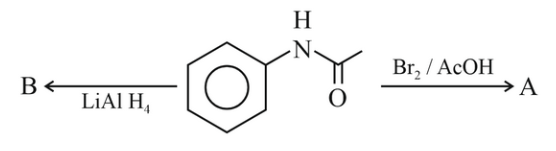
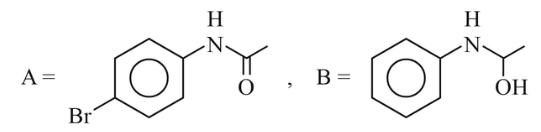
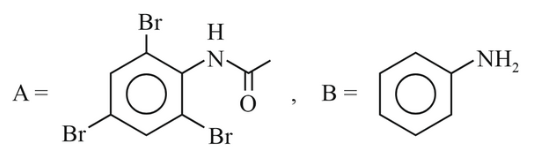
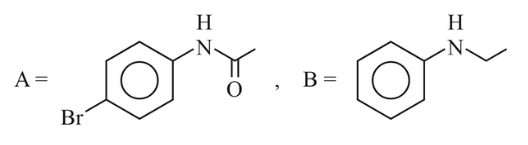
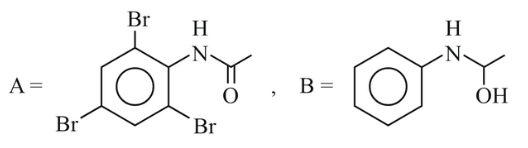
The major products A and B from the following reactions are:

(1)

(2)

(3)

(4)
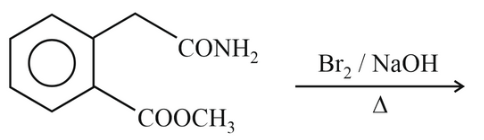
The major product formed in the following reaction is

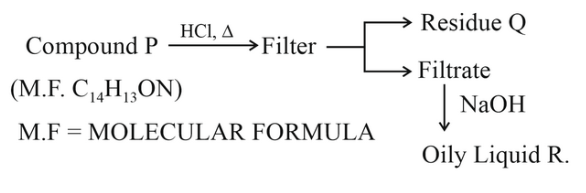
Compound P is neutral, Q gives effervescence with NaHCO$$_3$$ while R reacts with Hinsberg's reagent to give solid soluble in NaOH. Compound P is
Polymer used in orlon is:
Match List I and List II
List I (Vitamin)         List II (Deficiency disease)
A. Vitamin A            I. Beri-Beri
B. Thiamine             II. Cheilosis
C. Ascorbic acid        III. Xerophthalmia
D. Riboflavin            IV. Scurvy
Choose the correct answer from the options given below
If 5 moles of BaCl$$_2$$ is mixed with 2 moles of Na$$_3$$PO$$_4$$, the maximum number of moles of Ba$$_3$$(PO$$_4$$)$$_2$$ formed is ______ (Nearest integer)
The wavelength of an electron of kinetic energy $$4.50 \times 10^{-29}$$ J is ______ $$\times 10{-5}$$ m. (Nearest integer)
Given: mass of electron is $$9 \times 10{-31}$$ kg, h = $$6.6 \times 10{-34}$$ Js
The number of species from the following which have square pyramidal structure is ______
PF$$_5$$, BrF$$_4^-$$, IF$$_5$$, BrF$$_5$$, XeOF$$_4$$, ICl$$_4^-$$
The value of log K for the reaction A $$\rightleftharpoons$$ B at 298 K is ______. (Nearest integer)
Given: $$\Delta H° = -54.07$$ kJ mol$$^{-1}$$, $$\Delta S° = 10$$ J K$$^{-1}$$ mol$$^{-1}$$
(Taken $$2.303 \times 8.314 \times 298 = 5705$$)
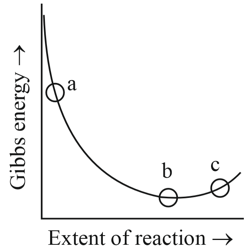
Consider the graph of Gibbs free energy G vs extent of reaction. The number of statement/s from the following which are true with respect to points (a), (b) and (c) is ______

A. Reaction is spontaneous at (a) and (b)
B. Reaction is at equilibrium at point (b) and non-spontaneous at point (c)
C. Reaction is spontaneous at (a) and non-spontaneous at (c)
D. Reaction is non-spontaneous at (a) and (b)
Number of bromo derivatives obtained on treating ethane with excess of Br$$_2$$ in diffused sunlight is ______
Mass of Urea NH$$_2$$CONH$$_2$$ required to be dissolved in 1000 g of water in order to reduce the vapour pressure of water by 25% is ______ g. (Nearest integer)
Given: Molar mass of N, C, O and H are 14, 12, 16 and 1 g mol$$^{-1}$$ respectively.
For the adsorption of hydrogen on platinum, the activation energy is 30 kJ mol$$^{-1}$$ and for the adsorption of hydrogen on nickel, the activation energy is 41.4 kJ mol$$^{-1}$$. The logarithm of the ratio of the rates of chemisorption on equal areas of the metals at 300 K is ______ (Nearest integer)
Given: ln10 = 2.3, R = 8.3 J K$$^{-1}$$ mol$$^{-1}$$
In ammonium-phosphomolybdate, the oxidation state of Mo is +______
Number of ambidentate ligands in a representative metal complex M(en)(SCN)$$_4$$ is ______. [en = ethylenediamine]