The correct statement about probability density (except at infinite distance from nucleus) is:

Join Our JEE Preparation Group
Prep with like-minded aspirants; Get access to free daily tests and study material.
Sign in
Please select an account to continue using cracku.in
↓ →
Join Our JEE Preparation Group
Prep with like-minded aspirants; Get access to free daily tests and study material.
The correct statement about probability density (except at infinite distance from nucleus) is:
Login to view the detailed solution.
The correct order of the ionic radii of $$\text{O}^{2-}$$, $$\text{N}^{3-}$$, $$\text{F}^-$$, $$\text{Mg}^{2+}$$, $$\text{Na}^+$$ and $$\text{Al}^{3+}$$ is:
Login to view the detailed solution.
The increasing order of boiling points of the following compounds is:
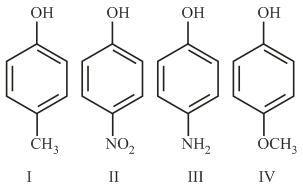
Login to view the detailed solution.
.webp)
The compound that has the largest $$H-M-H$$ bond angle ($$M = N, O, S, C$$) is:
Login to view the detailed solution.
Lattice enthalpy and enthalpy of solution of NaCl are $$788\,\text{kJ mol}^{-1}$$ and $$4\,\text{kJ mol}^{-1}$$, respectively. The hydration enthalpy of $$NaCl$$ is:
Login to view the detailed solution.
Hydrogen peroxide, in the pure state, is:
Login to view the detailed solution.
.webp)
The one that is NOT suitable for the removal of permanent hardness of water is:
Login to view the detailed solution.
Among the following compounds, geometrical isomerism is exhibited by:
Login to view the detailed solution.
The final major product of the following reaction is:
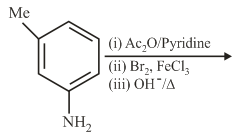
Login to view the detailed solution.
.webp)
The major product formed in the following reaction is:
$$\text{CH}_2\text{CH} = \text{CHCH(CH}_3)_2 \xrightarrow{\text{HBr}}$$
Login to view the detailed solution.
An element crystallises in a face-centred cubic (fcc) unit cell with cell edge $$a$$. The distance between the centres of two nearest octahedral voids in the crystal lattice is:
Login to view the detailed solution.
The variation of molar conductivity with concentration of an electrolyte (X) in aqueous solution is shown in the given figure.
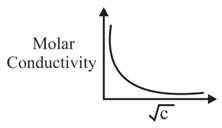
The electrolyte X is:
Login to view the detailed solution.
.webp)
The rate constant $$(k)$$ of a reaction is measured at different temperature $$(T)$$, and the data are plotted in the given figure. The activation energy of the reaction in $$\text{kJ mol}^{-1}$$ is: (R is gas constant)
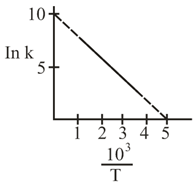
Login to view the detailed solution.
Adsorption of a gas follows Freundlich adsorption isotherm. If $$x$$ is the mass of the gas adsorbed on mass $$m$$ of the adsorbent, the correct plot of $$\frac{x}{m}$$ versus $$p$$ is:
Login to view the detailed solution.
Boron and silicon of very high purity can be obtained through:

Reaction of ammonia with excess $$Cl_2$$ gives:
Login to view the detailed solution.
Consider the complex ions, trans-$$[\text{Co(en)}_2\text{Cl}_2]^+$$ (A) and cis-$$[\text{Co(en)}_2\text{Cl}_2]^+$$ (B). The correct statement regarding them is:
Login to view the detailed solution.
The major product of the following reaction is:
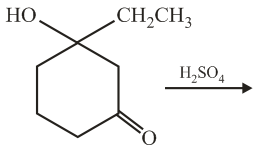
Login to view the detailed solution.
_1.webp)
Which one of the following polymers is not obtained by condensation polymerisation?
Login to view the detailed solution.
The following molecule acts as an:
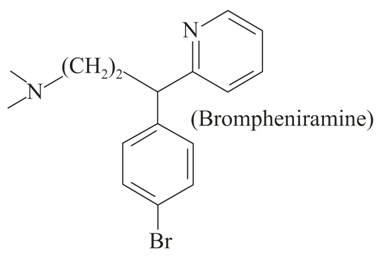
Login to view the detailed solution.
For a dimerization reaction,
$$2A(g) \to A_2(g)$$
at 298K, $$\Delta U^- = -20\,\text{kJ mol}^{-1}$$, $$\Delta S^- = -30\,\text{JK}^{-1}\text{mol}^{-1}$$, then the $$\Delta G^-$$ will be .....J.
Login to view the detailed solution.
For a reaction $$X + Y = 2Z$$, $$1.0\,\text{mol}$$ of X, $$1.5\,\text{mol}$$ of Y and $$0.5\,\text{mol}$$ of Z were taken in a 1L vessel and allowed to react. At equilibrium, the concentration of Z was $$1.0\,\text{mol L}^{-1}$$. The equilibrium constant of the reaction is $$\frac{x}{15}$$. The value of x is.......
Login to view the detailed solution.
The volume, in mL, of $$0.02\,\text{M}\,\text{K}_2\text{Cr}_2\text{O}_7$$ solution required to react with $$0.288\,\text{g}$$ of ferrous oxalate in acidic medium is............ (Molar mass of Fe = $$56\,\text{g mol}^{-1}$$)
Login to view the detailed solution.
Considering that $$\Delta_0 > P$$, the magnetic moment (in BM) of $$[\text{Ru}(\text{H}_2\text{O})_6]^{2+}$$ would be
Login to view the detailed solution.
The number of chiral carbons present in sucrose is..........
Login to view the detailed solution.
Educational materials for JEE preparation