NTA JEE Main 5th September 2020 Shift 1
For the following questions answer them individually
NTA JEE Main 5th September 2020 Shift 1 - Question 11
In a resonance tube experiment when the tube is filled with water up to a height of $$17.0\,\text{cm}$$, from bottom, it resonates with a given tuning fork. When the water level is raised the next resonance with the same tuning fork occurs at a height of $$24.5\,\text{cm}$$. If the velocity of sound in air is $$330\,\text{m s}^{-1}$$, the tuning fork frequency is:
NTA JEE Main 5th September 2020 Shift 1 - Question 12
A solid sphere of radius $$R$$ carries a charge $$Q + q$$ distributed uniformly over its volume. A very small point like piece of it of mass $$m$$ gets detached from the bottom of the sphere and falls down vertically under gravity. This piece carries charge $$q$$. If it acquires a speed $$v$$ when it has fallen through a vertical height $$y$$ (see figure), then (assume the remaining portion to be spherical)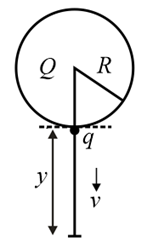
NTA JEE Main 5th September 2020 Shift 1 - Question 13
Two capacitors of capacitances $$C$$ and $$2C$$ are charged to potential differences $$V$$ and $$2V$$, respectively. These are then connected in parallel in such a manner that the positive terminal of one is connected to the negative terminal of the other. The final energy of this configuration is:

NTA JEE Main 5th September 2020 Shift 1 - Question 14
A galvanometer of resistance $$G$$ is converted into a voltmeter of range $$0 - 1\,\text{V}$$ by connecting a resistance $$R$$ in series with it. The additional resistance that should be connected in series with $$R_1$$ to increase the range of the voltmeter to $$0 - 2\,\text{V}$$ will be:
NTA JEE Main 5th September 2020 Shift 1 - Question 15
An electrical power line, having a total resistance of $$2\,\Omega$$, delivers $$1\,\text{kW}$$ at $$220\,\text{V}$$. The efficiency of the transmission line is approximately:
NTA JEE Main 5th September 2020 Shift 1 - Question 16
An electron is constrained to move along the $$y$$-axis with a speed of $$0.1\,c$$ ($$c$$ is the speed of light) in the presence of electromagnetic wave, whose electric field is $$\vec{E} = 30\hat{j}\sin(1.5 \times 10^7 t - 5 \times 10^{-2}x)\,\text{V m}^{-1}$$, where $$t$$ in in seconds and $$x$$ is in meters. The maximum magnetic force experienced by the electron will be: (given $$c = 3 \times 10^8\,\text{m s}^{-1}$$ and electron charge $$= 1.6 \times 10^{-19}\,\text{Coulombs}$$)
NTA JEE Main 5th September 2020 Shift 1 - Question 17
A square loop of side $$2a$$, and carrying current $$I$$, is kept in $$XZ$$ plane with its centre at origin. A long wire carrying the same current $$I$$ is placed parallel to the $$z$$-axis and passing through the point $$(0, b, 0)$$, $$(b >> a)$$. The magnitude of the torque on the loop about $$z$$-axis is given by:
NTA JEE Main 5th September 2020 Shift 1 - Question 18
For a concave lens of focal length $$f$$, the relation between object and image distance $$u$$ and $$v$$, respectively, from its pole can best be represented by ($$u = v$$ is the reference line):
NTA JEE Main 5th September 2020 Shift 1 - Question 19
Activities of three radioactive substances $$A$$, $$B$$ and $$C$$ are represented by the curves $$A$$, $$B$$ and $$C$$, in the figure. Then their half-lives $$T_{1/2}(A) : T_{1/2}(B) : T_{1/2}(C)$$ are in the ratio: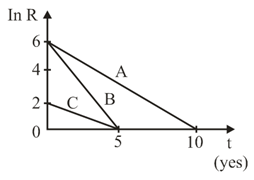
NTA JEE Main 5th September 2020 Shift 1 - Question 20
With increasing biasing voltage of a photo diode, the photocurrent magnitude: