NTA JEE Main 4th September 2020 Shift 1
For the following questions answer them individually
NTA JEE Main 4th September 2020 Shift 1 - Question 11
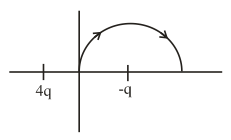
A two point charges $$4q$$ and $$-q$$ are fixed on the $$x$$-axis at $$x = \frac{-d}{2}$$ and $$x = \frac{d}{2}$$, respectively. If the third point charge 'q' is taken from the origin to $$x = d$$ along the semicircle as shown in the figure, the energy of the charge will:
NTA JEE Main 4th September 2020 Shift 1 - Question 12
A battery of 3.0 V is connected to a resistor dissipating 0.5 W of power. If the terminal voltage of the battery is 2.5 V, the power dissipated within the internal resistance is:
NTA JEE Main 4th September 2020 Shift 1 - Question 13
A small bar magnet is placed with its axis at 30° with an external magnetic field of 0.06 T experiences a torque of 0.018 Nm. The minimum work required to rotate it from its stable to unstable equilibrium position is:

NTA JEE Main 4th September 2020 Shift 1 - Question 14
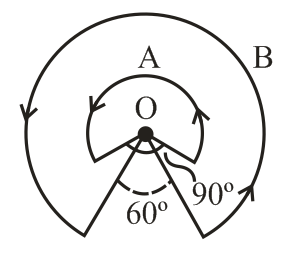
A wire A, bent in the shape of an arc of a circle, carrying a current of 2 A and having radius 2 cm and another wire B, also bent in the shape of an arc of a circle, carrying a current of 3 A and having radius of 4 cm, are placed as shown in the figure. The ratio of the magnetic fields due to the wires A and B at the common centre O is:
NTA JEE Main 4th September 2020 Shift 1 - Question 15
A small bar magnet is moved through a coil at constant speed from one end to the other. Which of the following series of observations will be seen on the galvanometer G attached across the coil?
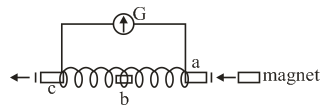
Three positions shown describe: (a) the magnet's entry (b) magnet is completely inside and (c) magnet's exit.
NTA JEE Main 4th September 2020 Shift 1 - Question 16
Choose the correct option relating wavelengths of different parts of electromagnetic wave spectrum:
NTA JEE Main 4th September 2020 Shift 1 - Question 17
A beam of plane polarized light of large cross-sectional area and uniform intensity of 3.3 W m$$^{-2}$$ falls normally on a polarizer (cross-sectional area $$3 \times 10^{-4}$$ m$$^2$$), which rotates about its axis with an angular speed of 31.4 rad s$$^{-1}$$. The energy of light passing through the polarizer per revolution, is close to:
NTA JEE Main 4th September 2020 Shift 1 - Question 18
Particle A of mass $$m_A = \frac{m}{2}$$ moving along the x-axis with velocity $$v_0$$ collides elastically with another particle B at rest having mass $$m_B = \frac{m}{3}$$. If both particles move along the x-axis after the collision, the change $$\Delta\lambda$$ in the wavelength of particle A, in terms of its de-Broglie wavelength $$(\lambda_0)$$ before the collision is:
NTA JEE Main 4th September 2020 Shift 1 - Question 19
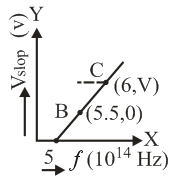
Given figure shows few data points in a photo-electric effect experiment for a certain metal. The minimum energy for ejection of electrons from its surface is: (Planck's constant h = 6.62 $$\times$$ 10$$^{-34}$$ J.s)
NTA JEE Main 4th September 2020 Shift 1 - Question 20
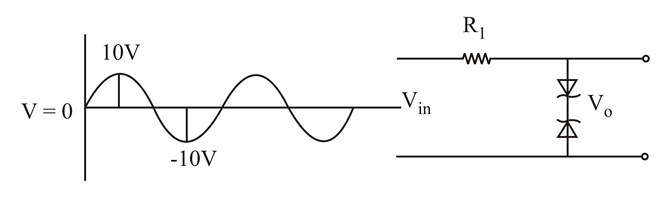
Take the breakdown voltage of the zener diode used in the given circuit as 6V. For the input voltage shown in the figure below, the time variation of the output voltage is: (Graphs drawn are schematic and not to the scale)