The region in the electromagnetic spectrum where the Balmer series lines appear is:

Join Our JEE Preparation Group
Prep with like-minded aspirants; Get access to free daily tests and study material.
Sign in
Please select an account to continue using cracku.in
↓ →
Join Our JEE Preparation Group
Prep with like-minded aspirants; Get access to free daily tests and study material.
The region in the electromagnetic spectrum where the Balmer series lines appear is:
Login to view the detailed solution.
The elements with atomic numbers 101 and 104 belong to, respectively:
Loading solution...
The ionic radii of $$O^{2-}$$, $$F^-$$, $$Na^+$$ and $$Mg^{2+}$$ are in the order:
Loading solution...
.webp)
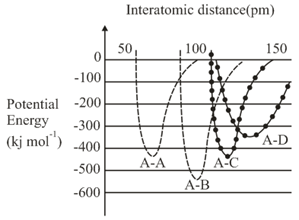
The intermolecular potential energy for the molecules A, B, C and D given below suggests that:
Loading solution...
For one mole of an ideal gas, which of these statements must be true?
(a) Internal energy (U) and enthalpy (H) each depends on temperature.
(b) Compressibility factor Z is not equal to 1
(c) $$C_{P,m} - C_{V,m} = R$$
(d) $$dU = C_v dT$$ for any process
Loading solution...
On combustion of Li, Na and K in excess of air, the major oxides formed, respectively, are:
Loading solution...
.webp)
On heating, lead (II) nitrate gives a brown gas (A). The gas (A) on cooling changes to a colourless solid/liquid (B). (B) on heating with NO changes to a blue solid (C). The oxidation number of nitrogen in solid (C) is:
Loading solution...
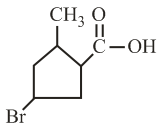
The IUPAC name of the following compound is:
Loading solution...
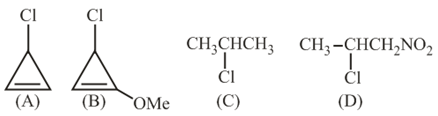
The decreasing order of reactivity of the following organic molecules towards AgNO$$_3$$ solution is:
Loading solution...
.webp)
Identify the incorrect statement from the options below for the above cell:
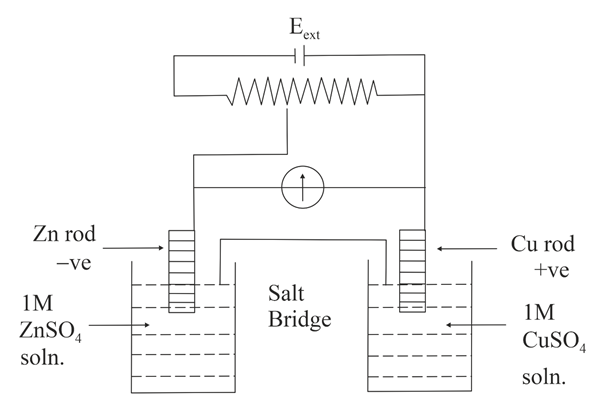
$$E^0_{Cu^{2+}|Cu} = +0.34$$ V,
$$E^0_{Zn^{2+}|Zn} = -0.76$$ V
Loading solution...
For the equilibrium $$A \rightleftharpoons B$$, the variation of the rate of the forward (a) and reverse (b) reaction with time is given by:
Loading solution...
Match the following:
(i) Foam (a) smoke
(ii) Gel (b) cell fluid
(iii) Aerosol (c) jellies
(iv) Emulsion (d) rubber
(e) froth
(f) milk
Loading solution...
.webp)
Among statements (a) - (d), the correct ones are:
(a) Lime stone is decomposed to CaO during the extraction of iron from its oxides.
(b) In the extraction of silver, silver is extracted as an anionic complex.
(c) Nickel is purified by Mond's process.
(d) Zr and Ti are purified by Van Arkel method.
Loading solution...
The number of isomers possible for $$[Pt(en)(NO_2)_2]$$ is:
Loading solution...
The pair in which both the species have the same magnetic moment (spin only) is:
Loading solution...

An organic compound (A) (molecular formula $$C_6H_{12}O_2$$) was hydrolysed with dil. $$H_2SO_4$$ to give a carboxylic acid (B) and an alcohol (C). 'C' gives white turbidity immediately when treated with anhydrous $$ZnCl_2$$ and conc. HCl. The organic compound (A) is:
Loading solution...
When neopentyl alcohol is heated with an acid, it slowly converted into an 85:15 mixture of alkenes A and B, respectively. What are these alkenes?
Loading solution...
[P] on treatment with $$Br_2/FeBr_3$$ in $$CCl_4$$ produced a single isomer $$C_8H_7O_2Br$$ while heating [P] with sodalime gives toluene. The compound [P] is:
Loading solution...
_1.webp)
Which of the following will react with $$CHCl_3$$ + alc. KOH?
Loading solution...
What are the functional groups present in the structure of maltose?
Loading solution...
The mass of ammonia in grams produced when 2.8 kg of dinitrogen quantitatively reacts with 1 kg of dihydrogen is __________
Loading solution...
A 20.0 mL solution containing 0.2 g impure $$H_2O_2$$ reacts completely with 0.316 g of $$KMnO_4$$ in acid solution. The purity of $$H_2O_2$$ (in %) is __________ (mol. wt. of $$H_2O_2$$ = 34; mol. wt. of $$KMnO_4$$ = 158)
Loading solution...
At 300 K, the vapour pressure of a solution containing 1 mole of n-hexane and 3 moles of n-heptane is 550 mm of Hg. At the same temperature, if one more mole of n-heptane is added to this solution, the vapour pressure of the solution increases by 10 mm of Hg. What is the vapour pressure in mmHg of n-heptane in its pure state?
Loading solution...
If 75% of a first order reaction was completed in 90 minutes, 60% of the same reaction would be completed in approximately (in minutes) __________ (Take: log 2 = 0.30; log 2.5 = 0.40)
Loading solution...
The number of chiral centres present in [B] is __________

Loading solution...
Educational materials for JEE preparation
 Share
Share