NTA JEE Main 29th June 2022 Shift 1
For the following questions answer them individually
NTA JEE Main 29th June 2022 Shift 1 - Question 1
Two vectors $$\vec{A}$$ and $$\vec{B}$$ have equal magnitudes. If magnitude of $$\vec{A} + \vec{B}$$ is equal to two times the magnitude of $$\vec{A} - \vec{B}$$, then the angle between $$\vec{A}$$ and $$\vec{B}$$ will be
NTA JEE Main 29th June 2022 Shift 1 - Question 2
In van dar Wall equation $$\left[P + \frac{a}{V^2}\right][V - b] = RT$$; $$P$$ is pressure, $$V$$ is volume, $$R$$ is universal gas constant and $$T$$ is temperature. The ratio of constants $$\frac{a}{b}$$ is dimensionally equal to:
NTA JEE Main 29th June 2022 Shift 1 - Question 3
Two balls $$A$$ and $$B$$ are placed at the top of 180 m tall tower. Ball $$A$$ is released from the top at $$t = 0$$ s. Ball $$B$$ is thrown vertically down with an initial velocity $$u$$ at $$t = 2$$ s. After a certain time, both balls meet 100 m above the ground. Find the value of $$u$$ in m s$$^{-1}$$. [use $$g = 10$$ m s$$^{-2}$$]
NTA JEE Main 29th June 2022 Shift 1 - Question 4
A block of metal weighing 2 kg is resting on a frictionless plane (as shown in figure). It is struck by a jet releasing water at a rate of 1 kg s$$^{-1}$$ and at a speed of 10 m s$$^{-1}$$. Then, the initial acceleration of the block, in m s$$^{-2}$$, will be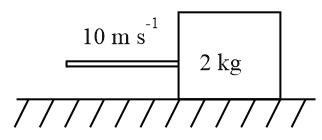
NTA JEE Main 29th June 2022 Shift 1 - Question 5
A particle of mass 500 g is moving in a straight line with velocity $$v = bx^{\frac{5}{2}}$$. The work done by the net force during its displacement from $$x = 0$$ to $$x = 4$$ m is (Take b = 0.25 m$$^{\frac{-3}{2}}$$s$$^{-1}$$).
NTA JEE Main 29th June 2022 Shift 1 - Question 6
A body of mass $$M$$ at rest explodes into three pieces, in the ratio of masses 1 : 1 : 2. Two smaller pieces fly off perpendicular to each other with velocities of 30 m s$$^{-1}$$ and 40 m s$$^{-1}$$ respectively. The velocity of the third piece will be
NTA JEE Main 29th June 2022 Shift 1 - Question 7
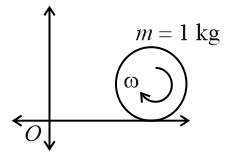
A spherical shell of 1 kg mass and radius $$R$$ is rolling with angular speed $$\omega$$ on horizontal plane (as shown in figure). The magnitude of angular momentum of the shell about the origin $$O$$ is $$\frac{a}{3}R^2\omega$$. The value of $$a$$ will be
NTA JEE Main 29th June 2022 Shift 1 - Question 8
The escape velocity of a body on a planet $$A$$ is 12 km s$$^{-1}$$. The escape velocity of the body on another planet $$B$$, whose density is four times and radius is half of the planet $$A$$, is
NTA JEE Main 29th June 2022 Shift 1 - Question 9
A wire of length $$L$$ is hanging from a fixed support. The length changes to $$L_1$$ and $$L_2$$ when masses 1 kg and 2 kg are suspended respectively from its free end. Then the value of $$L$$ is equal to
NTA JEE Main 29th June 2022 Shift 1 - Question 10
A cylinder of fixed capacity of 44.8 litres contains helium gas at standard temperature and pressure. The amount of heat needed to raise the temperature of gas in the cylinder by 20.0°C will be (Given gas constant R = 8.3 J K$$^{-1}$$ mol$$^{-1}$$)