For the following questions answer them individually
Given below are two statements:
Statement I: The decrease in first ionization enthalpy from B to Al is much larger than that from Al to Ga.
Statement II: The d orbitals in Ga are completely filled.
In the light of the above statements, choose the most appropriate answer from the options given below
According to MO theory the bond orders for O$$_2^{2-}$$, CO and NO$$^+$$ respectively, are
Which of the following relations are correct?
(A) $$\Delta U = q + p\Delta V$$
(B) $$\Delta G = \Delta H - T\Delta S$$
(C) $$\Delta S = \frac{q_{rev}}{T}$$
(D) $$\Delta H = \Delta U - \Delta nRT$$
Choose the most appropriate answer from the options given below:
An indicator 'X' is used for studying the effect of variation in concentration of iodide on the rate of reaction of iodide ion with H$$_2$$O$$_2$$ at room temp. The indicator 'X' forms blue colored complex with compound 'A' present in the solution. The indicator 'X' and compound 'A' respectively are
Given below are two statements:
Statement I: Nickel is being used as the catalyst for producing syn gas and edible fats.
Statement II: Silicon forms both electron rich and electron deficient hydrides.
In the light of the above statements, choose the most appropriate answer from the options given below:
When a hydrocarbon A undergoes combustion in the presence of air, it requires $$9.5$$ equivalents of oxygen and produces $$3$$ equivalents of water. What is the molecular formula of A?
The concentration of dissolved Oxygen in water for growth of fish should be more than X ppm and Biochemical Oxygen Demand in clean water should be less than Y ppm. X and Y in ppm are, respectively.
Match List I with List II.
| List I | List II |
|---|---|
| A. van't Hoff factor, i | I. Cryoscopic constant |
| B. k$$_f$$ | II. Isotonic solutions |
| C. Solutions with same osmotic pressure | III. $$\frac{\text{Normal molar mass}}{\text{Abnormal molar mass}}$$ |
| D. Azeotropes | IV. Solutions with same composition of vapour above it |
Match List-I and List-II
| List-I | List-II |
|---|---|
| A. Osmosis | I. Solvent molecules pass through semi permeable membrane towards solvent side. |
| B. Reverse osmosis | II. Movement of charged colloidal particles under the influence of applied electric potential towards oppositely charged electrodes |
| C. Electro osmosis | III. Solvent molecules pass through semi permeable membrane towards solution side |
| D. Electrophoresis | IV. Dispersion medium moves in an electric field. |
The major component of which of the following ore is sulphide based mineral?
A solution of CrO$$_5$$ in amyl alcohol has a ____colour
The set of correct statements is:
(i) Manganese exhibits $$+7$$ oxidation state in its oxide.
(ii) Ruthenium and Osmium exhibit $$+8$$ oxidation in their oxides.
(iii) Sc shows $$+4$$ oxidation state which is oxidizing in nature.
(iv) Cr shows oxidising nature in $$+6$$ oxidation state.
Correct order of spin only magnetic moment of the following complex ions is:
(Given At. No. Fe : 26, Co : 27)
The one giving maximum number of isomeric alkenes on dehydrohalogenation reaction is (excluding rearrangement)
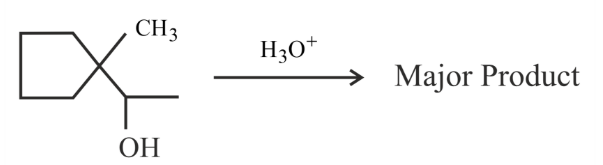
Find out the major product for the following reaction
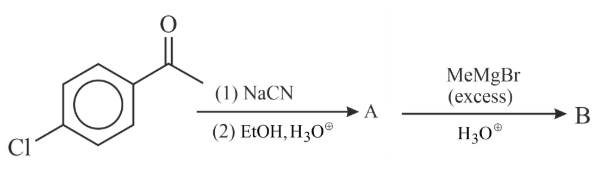
Find out the major products from the following reaction sequence.
Reaction of propanamide with Br$$_2$$ / KOH (aq) produces:
Match List-I and List-II.
| List-I | List-II |
|---|---|
| A. Elastomeric polymer | I. Urea formaldehyde resin |
| B. Fibre polymer | II. Polystyrene |
| C. Thermosetting polymer | III. Polyester |
| D. Thermoplastic polymer | IV. Neoprene |
A doctor prescribed the drug Equanil to a patient. The patient was likely to have symptoms of which disease?
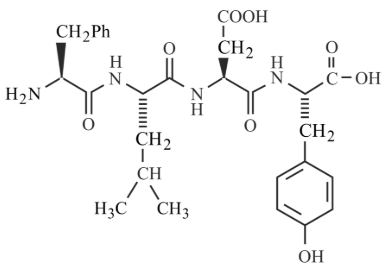
Following tetrapeptide can be represented as

(F, L, D, Y, I, Q, P are one letter codes for amino acids)
Assume that the radius of the first Bohr orbit of hydrogen atom is $$0.6$$ $$\text{\AA}$$. The radius of the third Bohr orbit of He$$^+$$ is ______ picometer. (Nearest Integer)
At 298 K
$$\text{N}_2(g) + 3\text{H}_2(g) \rightleftharpoons 2\text{NH}_3(g), K_1 = 4 \times 10^5$$
$$\text{N}_2(g) + \text{O}_2(g) \rightleftharpoons 2\text{NO}(g), K_2 = 1.6 \times 10^{12}$$
$$\text{H}_2(g) + \frac{1}{2}\text{O}_2(g) \rightleftharpoons \text{H}_2\text{O}(g), K_3 = 1.0 \times 10^{-13}$$
Based on above equilibria, the equilibrium constant of the reaction,
$$2\text{NH}_3(g) + \frac{5}{2}\text{O}_2(g) \rightleftharpoons 2\text{NO}(g) + 3\text{H}_2\text{O}(g)$$
is ______ $$\times 10^{-33}$$ (Nearest integer)
The volume of HCl, containing $$73$$ g L$$^{-1}$$, required to completely neutralise NaOH obtained by reacting $$0.69$$ g of metallic sodium with water, is ______ mL. (Nearest Integer)
(Given: molar Masses of Na, Cl, O, H are 23, 35.5, 16 and 1 g mol$$^{-1}$$ respectively)
On heating, LiNO$$_3$$ gives how many compounds among the following?
Li$$_2$$O, N$$_2$$, O$$_2$$, LiNO$$_2$$, NO$$_2$$
When $$0.01$$ mol of an organic compound containing $$60\%$$ carbon was burnt completely, $$4.4$$ g of CO$$_2$$ was produced. The molar mass of compound is ______ g mol$$^{-1}$$ (Nearest integer)
A metal M forms hexagonal close-packed structure. The total number of voids in $$0.02$$ mol of it is ______ $$\times 10^{21}$$ (Nearest integer)
(Given N$$_A = 6.02 \times 10^{23}$$)
The equilibrium constant for the reaction Zn(s) + Sn$$^{2+}$$(aq) $$\rightleftharpoons$$ Zn$$^{2+}$$(aq) + Sn(s) is $$1 \times 10^{20}$$ at 298 K. The magnitude of standard electrode potential of Sn/Sn$$^{2+}$$ if E$$^0_{\text{Zn}^{2+}/\text{Zn}} = -0.76$$ V is ______ $$\times 10^{-2}$$ V. (Nearest integer)
Given: $$\frac{2.303 RT}{F} = 0.059$$ V
For conversion of compound A $$\to$$ B, the rate constant of the reaction was found to be $$4.6 \times 10^{-5}$$ L mol$$^{-1}$$ s$$^{-1}$$. The order of the reaction is ______.
Total number of acidic oxides among N$$_2$$O$$_3$$, NO$$_2$$, N$$_2$$O, Cl$$_2$$O$$_7$$, SO$$_2$$, CO, CaO, Na$$_2$$O and NO is ______.
The denticity of the ligand present in the Fehling's reagent is ______.