For the following questions answer them individually
The shortest wavelength of hydrogen atom in Lyman series is $$\lambda$$. The longest wavelength in Balmer series of He$$^+$$ is
The bond dissociation energy is highest for
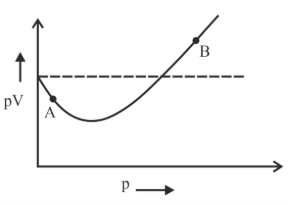
For 1 mol of gas, the plot of pV vs p is shown below. p is the pressure and V is the volume of the gas.

What is the value of compressibility factor at point A?
Which of the given compounds can enhance the efficiency of hydrogen storage tank?
The magnetic behaviour of Li$$_2$$O, Na$$_2$$O$$_2$$ and KO$$_2$$, respectively, are
The correct order of hydration enthalpies is
(A) K$$^+$$
(B) Rb$$^+$$
(C) Mg$$^{2+}$$
(D) Cs$$^+$$
(E) Ca$$^{2+}$$
Choose the correct answer from the options below:
During the borax bead test with CuSO$$_4$$, a blue green colour of the bead was observed in oxidising flame due to the formation of
Compound that will give positive Lassaigne's test for both nitrogen and halogen is
Correct statement about smog is
The standard electrode potential (M$$^{3+}$$/M$$^{2+}$$) for V, Cr, Mn & Co are $$-0.26$$ V, $$-0.41$$ V, $$+1.57$$ V and $$+1.97$$ V, respectively. The metal ions which can liberate H$$_2$$ from a dilute acid are
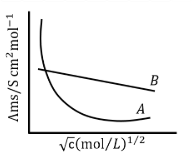
Following figure shows dependence of molar conductance of two electrolytes on concentration. $$\Lambda^0_m$$ is the limiting molar conductivity.
The number of Incorrect statement(s) from the following is ______
(A) $$\Lambda^0_m$$ for electrolyte A is obtained by extrapolation
(B) For electrolyte B, $$\Lambda_m$$ Vs $$\sqrt{c}$$ graph is a straight line with intercept equal to $$\Lambda^0_m$$
(C) At infinite dilution, the value of degree of dissociation approach zero for electrolyte B.
(D) $$\Lambda_m$$ for any electrolyte A or B can be calculated using $$\lambda°$$ for individual ions.
Which of the following salt solutions would coagulate the colloid solution formed when FeCl$$_3$$ is added to NaOH solution, at the fastest rate?
The reaction representing the Mond process for metal refining is ______
"A" obtained by Ostwald's method involving air oxidation of NH$$_3$$, upon further air oxidation produces "B". "B" on hydration forms an oxoacid of Nitrogen along with evolution of "A". The oxoacid also produces "A" and gives positive brown ring test
Chiral complex from the following is:
Here en = ethylene diamine
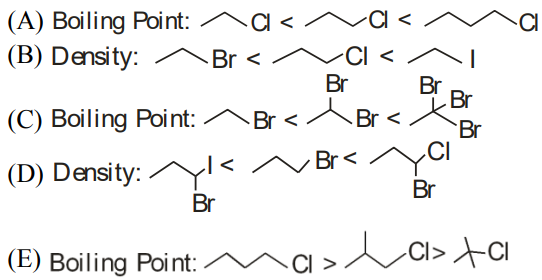
Identify the correct order for the given property for following compounds

Choose the correct answer from the option below:
The increasing order of pK$$_a$$ for the following phenols is
(A) 2,4-Dinitrophenol
(B) 4-Nitrophenol
(C) 2,4,5-Trimethylphenol
(D) Phenol
(E) 3-Chlorophenol
Choose the correct answer from the option given below:
Match List I with List II.
| List I (Reaction) | List II (Reagents) |
|---|---|
| (A) Hoffmann Degradation | (I) Conc. KOH, $$\Delta$$ |
| (B) Clemmensen reduction | (II) CHCl$$_3$$, NaOH/H$$_3$$O$$^+$$ |
| (C) Cannizzaro reaction | (III) Br$$_2$$, NaOH |
| (D) Reimer-Tiemann reaction | (IV) Zn $$-$$ Hg/HCl |
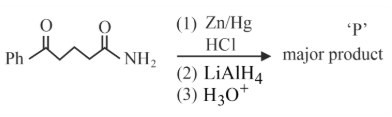
The major product 'P' for the following sequence of reactions is:
Match List I with List II
| List I (Antimicrobials) | List II (Names) |
|---|---|
| (A) Narrow Spectrum Antibiotic | (I) Furacin |
| (B) Antiseptic | (II) Sulphur dioxide |
| (C) Disinfectants | (III) Penicillin-G |
| (D) Broad spectrum antibiotic | (IV) Chloramphenicol |
Number of cyclic tripeptides formed with 2 amino acids A and B is:
The number of molecules or ions from the following, which do not have odd number of electrons are ______.
(A) NO$$_2$$
(B) ICl$$_4^-$$
(C) BrF$$_3$$
(D) ClO$$_2$$
(E) NO$$_2^+$$
(F) NO
Consider the following reaction approaching equilibrium at $$27°$$C and 1 atm pressure
$$\text{A} + \text{B} \underset{K_r=10^2}{\overset{K_f=10^3}{\rightleftharpoons}} \text{C} + \text{D}$$
The standard Gibb's energy change $$(\Delta_r G°)$$ at $$27°$$C is $$(-)$$ ______ kJ mol$$^{-1}$$. (Nearest integer).
(Given: R $$= 8.3$$ J K$$^{-1}$$ mol$$^{-1}$$ and $$\ln 10 = 2.3$$)
Water decomposes at 2300 K
$$\text{H}_2\text{O}(g) \to \text{H}_2(g) + \frac{1}{2}\text{O}_2(g)$$
The percent of water decomposing at 2300 K and 1 bar is ______ (Nearest integer). Equilibrium constant for the reaction is $$2 \times 10^{-3}$$ at 2300 K
Millimoles of calcium hydroxide required to produce 100 mL of the aqueous solution of pH 12 is $$x \times 10^{-1}$$. The value of $$x$$ is ______ (Nearest integer). Assume complete dissociation.
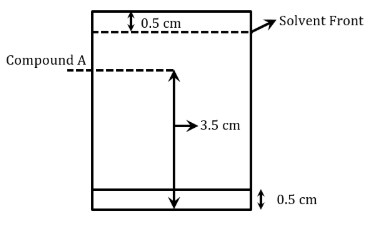
Following chromatogram was developed by adsorption of compound 'A' on a 6 cm TLC glass plate. Retardation factor of the compound 'A' is ______ $$\times 10^{-1}$$.
17 mg of a hydrocarbon (M.F. C$$_{10}$$H$$_{16}$$) takes up 8.40 mL of the H$$_2$$ gas measured at 0°C and 760 mm of Hg. Ozonolysis of the same hydrocarbon yields

The number of double bond/s present in the hydrocarbon is
Solid Lead nitrate is dissolved in 1 litre of water. The solution was found to boil at $$100.15°$$C. When $$0.2$$ mol of NaCl is added to the resulting solution, it was observed that the solution froze at $$-0.8°$$C. The solutibility product of PbCl$$_2$$ formed is ______ $$\times 10^{-6}$$ at 298 K. (Nearest integer)
Given: K$$_b = 0.5$$ K kg mol$$^{-1}$$ and K$$_f = 1.8$$ kg mol$$^{-1}$$. Assume molality to be equal to molarity in all cases.
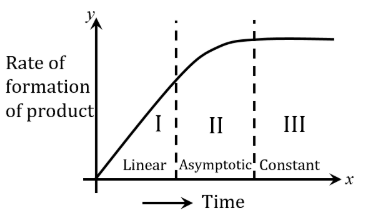
For certain chemical reaction X $$\to$$ Y, the rate of formation of product is plotted against the time as shown in the figure. The number of Correct statement/s from the following is ______

(A) Over all order of this reaction is one
(B) Order of this reaction can't be determined
(C) In region-I and III, the reaction is of first and zero order respectively
(D) In region-II, the reaction is of first order
(E) In region-II, the order of reaction is in the range of 0.1 to 0.9.
The sum of bridging carbonyls in W(CO)$$_6$$ and Mn$$_2$$(CO)$$_{10}$$ is ______.