NTA JEE Main 28th June 2022 Shift 2
For the following questions answer them individually
NTA JEE Main 28th June 2022 Shift 2 - Question 1
Velocity ($$v$$) and acceleration ($$a$$) in two systems of units 1 and 2 are related as $$v_2 = \frac{n}{m^2} v_1$$ and $$a_2 = \frac{a_1}{mn}$$ respectively. Here $$m$$ and $$n$$ are constants. The relations for distance and time in two systems respectively are
NTA JEE Main 28th June 2022 Shift 2 - Question 2
A ball is spun with angular acceleration $$\alpha = 6t^2 - 2t$$ where $$t$$ is in second and $$\alpha$$ is in rad s$$^{-2}$$. At $$t = 0$$, the ball has angular velocity of 10 rad s$$^{-1}$$ and angular position of 4 rad. The most appropriate expression for the angular position of the ball is
NTA JEE Main 28th June 2022 Shift 2 - Question 3
A block of mass 2 kg moving on a horizontal surface with speed of 4 m s$$^{-1}$$ enters a rough surface ranging from $$x = 0.5$$ m to $$x = 1.5$$ m. The retarding force in this range of rough surface is related to distance by $$F = -kx$$ where $$k = 12$$ N m$$^{-1}$$. The speed of the block as it just crosses the rough surface will be

NTA JEE Main 28th June 2022 Shift 2 - Question 4
Water falls from a 40 m high dam at the rate of $$9 \times 10^4$$ kg per hour. Fifty percentage of gravitational potential energy can be converted into electrical energy. Using this hydro electric energy number of 100 W lamps, that can be lit, is
(Take $$g = 10$$ ms$$^{-2}$$)
NTA JEE Main 28th June 2022 Shift 2 - Question 5
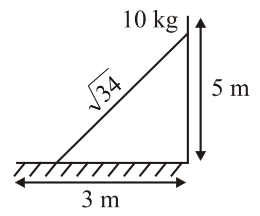
A $$\sqrt{34}$$ m long ladder weighing 10 kg leans on a frictionless wall. Its feet rest on the floor 3 m away from the wall as shown in the figure. If $$F_f$$ and $$F_w$$ are the reaction forces of the floor and the wall, then ratio of $$\frac{F_w}{F_f}$$ will be:
(Use $$g = 10$$ m s$$^{-2}$$.)
NTA JEE Main 28th June 2022 Shift 2 - Question 6
Two objects of equal masses placed at certain distance from each other attracts each other with a force of $$F$$. If one-third mass of one object is transferred to the other object, then the new force will be
NTA JEE Main 28th June 2022 Shift 2 - Question 7
A water drop of radius $$1 \mu$$m falls in a situation where the effect of buoyant force is negligible. Co-efficient of viscosity of air is $$1.8 \times 10^{-5}$$ N s m$$^{-2}$$ and its density is negligible as compared to that of water $$10^6$$ g m$$^{-3}$$. Terminal velocity of the water drop is
(Take acceleration due to gravity $$= 10$$ m s$$^{-2}$$)
NTA JEE Main 28th June 2022 Shift 2 - Question 8
Resistance of the wire is measured as $$2 \Omega$$ and $$3 \Omega$$ at $$10°$$C and $$30°$$C respectively. Temperature coefficient of resistance of the material of the wire is
NTA JEE Main 28th June 2022 Shift 2 - Question 9
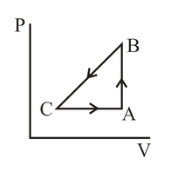
A sample of an ideal gas is taken through the cyclic process $$ABCA$$ as shown in figure. It absorbs, 40 J of heat during the part $$AB$$, no heat during $$BC$$ and rejects 60 J of heat during $$CA$$. A work of 50 J is done on the gas during the part $$BC$$. The internal energy of the gas at $$A$$ is 1560 J. The work done by the gas during the part $$CA$$ is
NTA JEE Main 28th June 2022 Shift 2 - Question 10
What will be the effect on the root mean square velocity of oxygen molecules if the temperature is doubled and oxygen molecule dissociates into atomic oxygen?