Join WhatsApp Icon JEE WhatsApp Group

NTA JEE Main 28th June 2022 Shift 2 - Chemistry

For the following questions answer them individually

Compound A contains 8.7% Hydrogen, 74% Carbon and 17.3% Nitrogen. The molecular formula of the compound is, Given: Atomic masses of C, H and N are 12, 1 and 14 amu respectively. The molar mass of the compound A is 162 g mol$$^{-1}$$.

Consider the following statements:
(A) The principal quantum number 'n' is a positive integer with values of 'n' = 1, 2, 3, ...
(B) The azimuthal quantum number 'l' for a given 'n' (principal quantum number) can have values as 'l' = 0, 1, 2, ... n has $$(2n + 1)$$ values.
(C) Magnetic orbital quantum number 'm' for a particular 'l' (azimuthal quantum number) has $$(2l + 1)$$ values.
(D) $$\pm \frac{1}{2}$$ are the two possible orientations of electron spin.
(E) For $$l = 5$$, there will be a total of 9 orbital.
Which of the above statements are correct?

Match List-I with List-II
List-I                                     List-II
(A) Cl$$_2$$O$$_7$$                           (I) Amphoteric
(B) Na$$_2$$O                            (II) Basic
(C) Al$$_2$$O$$_3$$                           (III) Neutral
(D) N$$_2$$O                              (IV) Acidic
Choose the correct answer from the options given below

In the structure of SF$$_4$$, the lone pair of electrons on S is in.

A student needs to prepare a buffer solution of propanoic acid and its sodium salt with pH 4. The ratio of $$\frac{[CH_3CH_2COO^-]}{[CH_3CH_2COOH]}$$ required to make buffer is Given: $$K_a(CH_3CH_2COOH) = 1.3 \times 10^{-5}$$

Hydrogen has three isotopes: protium ($$^1$$H), deuterium ($$^2$$H or D) and tritium ($$^3$$H or T). They have nearly same chemical properties but different physical properties. They differ in

Match List-I with List-II
List-I                                             List-II
(A)    negatively charged sol           (I)    Fe$$_2$$O$$_3$$ · xH$$_2$$O
(B)    macromolecular colloid        (II)    CdS sol
(C)    positively charged sol           (III)   Starch
(D)    Cheese                                    (IV)   a gel
Choose the correct answer from the options given below

In the metallurgical extraction of copper, following reaction is used:
$$\text{FeO} + \text{SiO}_2 \rightarrow \text{FeSiO}_3$$
FeO and FeSiO$$_3$$ respectively are.

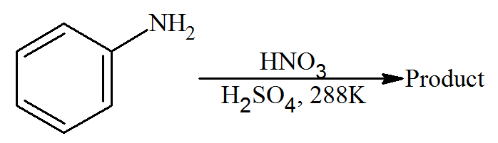
With respect to the following reaction, consider the given statements:

image


(A) o-Nitroaniline and p-nitroaniline are the predominant products.
(B) p-Nitroaniline and m-nitroaniline are the predominant products.
(C) HNO$$_3$$ acts as an acid.
(D) H$$_2$$SO$$_4$$ acts as an acid.
Choose the correct option.

Given below are two statements, one is Assertion and other is Reason.
Assertion: Natural rubber is a linear polymer of isoprene called cis-polyisoprene with elastic properties.
Reason: The cis-polyisoprene molecules consist of various chains held together by strong polar interactions with coiled structure.
In the light of the above statements, choose the correct one from the options given below

When sugar 'X' is boiled with dilute H$$_2$$SO$$_4$$ in alcoholic solution, two isomers 'A' and 'B' are formed. 'A' on oxidation with HNO$$_3$$ yields saccharic acid where as 'B' is laevorotatory. The compound 'X' is

The complete combustion of 0.492 g of an organic compound containing 'C', 'H' and 'O' gives 0.793 g of CO$$_2$$ and 0.442 g of H$$_2$$O. The percentage of oxygen composition in the organic compound is ______ (nearest integer)

Backspace
789
456
123
0.-
Clear All

100 g of an ideal gas is kept in a cylinder of 416 L volume at 27°C under 1.5 bar pressure. The molar mass of the gas is ______ g mol$$^{-1}$$. (Nearest integer)
(Given: R = 0.083 L bar K$$^{-1}$$ mol$$^{-1}$$)

Backspace
789
456
123
0.-
Clear All

For combustion of one mole of magnesium in an open container at 300 K and 1 bar pressure, $$\Delta_C H^\ominus = -601.70$$ kJ mol$$^{-1}$$, the magnitude of change in internal energy for the reaction is ______ kJ. (Nearest integer)
(Given: R = 8.3 J K$$^{-1}$$ mol$$^{-1}$$)

Backspace
789
456
123
0.-
Clear All

0.01 M KMnO$$_4$$ solution was added to 20.0 mL of 0.05 M Mohr's salt solution through a burette. The initial reading of 50 mL burette is zero. The volume of KMnO$$_4$$ solution left in the burette after the end point is ______ mL. (nearest integer)

Backspace
789
456
123
0.-
Clear All

For the given reactions
$$Sn^{2+} + 2e^- \rightarrow Sn$$
$$Sn^{4+} + 4e^- \rightarrow Sn$$
the electrode potentials are; $$E^\circ_{Sn^{2+}/Sn} = -0.140$$ V and $$E^\circ_{Sn^{4+}/Sn} = 0.010$$ V. The magnitude of standard electrode potential for $$Sn^{4+}/Sn^{2+}$$ i.e. $$E^\circ_{Sn^{4+}/Sn^{2+}}$$ is ______ $$\times 10^{-2}$$ V (Nearest integer)

Backspace
789
456
123
0.-
Clear All

2.5 g of protein containing only glycine (C$$_2$$H$$_5$$NO$$_2$$) is dissolved in water to make 500 mL of solution. The osmotic pressure of this solution at 300 K is found to be $$5.03 \times 10^{-3}$$ bar. The total number of glycine units present in the protein is
(Given: R = 0.083 L bar K$$^{-1}$$ mol$$^{-1}$$)

Backspace
789
456
123
0.-
Clear All