The correct order of ionic size of $$N^{3-}, Na^+, F^-, Mg^{2+}$$ and $$O^{2-}$$ is :

Join Our JEE Preparation Group
Prep with like-minded aspirants; Get access to free daily tests and study material.
Sign in
Please select an account to continue using cracku.in
↓ →
Join Our JEE Preparation Group
Prep with like-minded aspirants; Get access to free daily tests and study material.
The correct order of ionic size of $$N^{3-}, Na^+, F^-, Mg^{2+}$$ and $$O^{2-}$$ is :
Login to view the detailed solution.
Identify the incorrect statement for $$PCl_5$$ from the following.
Login to view the detailed solution.
The correct order of increasing intermolecular hydrogen bond strength is
Login to view the detailed solution.
.webp)
Which amongst the given plots is the correct plot for pressure (p) vs density (d) for an ideal gas?
Login to view the detailed solution.
Which of the following is most stable?
Login to view the detailed solution.
What will be the major product of following sequence of reactions?
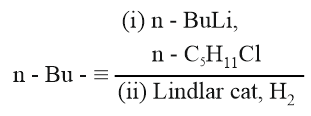
Login to view the detailed solution.
.webp)
Product 'A' of following sequence of reactions is

Login to view the detailed solution.
In 3d series, the metal having the highest $$M^{2+}/M$$ standard electrode potential is
Login to view the detailed solution.
Statement I: Leaching of gold with cyanide ion in absence of air/$$O_2$$ leads to cyano complex of Au(III).
Statement II: Zinc is oxidized during the displacement reaction carried out for gold extraction.
In the light of the above statements, choose the correct answer from the options given below
Login to view the detailed solution.
.webp)
The gas produced by treating an aqueous solution of ammonium chloride with sodium nitrite is
Login to view the detailed solution.
Given below are two statements: one is labelled as Assertion and the other is labelled as Reason.
Assertion: Flourine forms one oxoacid.
Reason: Flourine has smallest size amongst all halogens and is highly electronegative.
In the light of the above statements, choose the most appropriate answer from the Question: options given
below.
Login to view the detailed solution.
On the surface of polar stratospheric clouds, hydrolysis of chlorine nitrate gives A and B while its reaction with HCl produces B and C. A, B and C are, respectively
Login to view the detailed solution.
.webp)
The 'f' orbitals are half and completely filled, respectively in lanthanide ions [Given : Atomic no. Eu, 63 : Sm, 62 : Tm, 69; Tb, 65; Yb, 70; Dy, 66]
Login to view the detailed solution.
Arrange the following coordination compounds in the increasing order of magnetic moments. (Atomic numbers: Mn = 25; Fe = 26)
A. $$[FeF_6]^{3-}$$
B. $$[Fe(CN)_6]^{3-}$$
C. $$[MnCl_6]^{3-}$$ (high spin)
D. $$[Mn(CN)_6]^{3-}$$
Choose the correct answer from the options given below
Login to view the detailed solution.
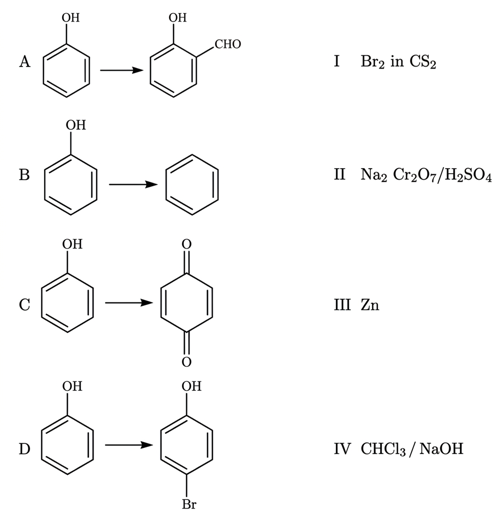
Match List-I with List-II
List - I List - II
Login to view the detailed solution.

Decarboxylation of all six possible forms of diaminobenzoic acids $$C_6H_3(NH_2)_2COOH$$ yields three products A, B and C. Three acids give a product 'A', two acids give a product 'B' and one acid give a product 'C'. The melting point of product 'C' is
Login to view the detailed solution.
Which is true about Buna-N?
Login to view the detailed solution.
Match List - I with List - II.
List - I List - II
| (A) Antipyretic | (I) Reduces pain |
| (B) Analgesic | (II) Reduces stress |
| (C) Tranquilizer | (III) Reduces fever |
| (D) Antacid | (IV) Reduces acidity(stomach) |
Choose the correct answer from the options given below
Login to view the detailed solution.
_1.webp)
Match List - I with List - II.
| List-I (Anion) | List-II (gas evolved on reaction with dil. $$H_2SO_4$$) |
|---|---|
| (A) $$CO_3^{2-}$$ | (I) Colourless gas which turns lead acetate paper black. |
| (B) $$S^{2-}$$ | (II) Colourless gas which turns acidified potassium dichromate solution green. |
| (C) $$SO_3^{2-}$$ | (III) Brown fumes which turns acidified KI solution containing starch blue. |
| (D) $$NO_2^-$$ | (IV) Colourless gas evolved with brisk effervescence, which turns lime water milky. |
Choose the correct answer from the options given below
Login to view the detailed solution.
Given below are two statements.
Statement I: Maltose has two $$\alpha - D$$ - glucose units linked at $$C_1$$ and $$C_4$$ and is a reducing sugar.
Statement II: Maltose has two monosaccharides: $$\alpha$$-D-glucose and $$\beta$$-D-glucose linked at $$C_1$$ and $$C_6$$ and it is a non-reducing sugar.
In the light of the above statements, choose the correct answer from the options Question: given below.
Login to view the detailed solution.
$$116$$ g of a substance upon dissociation reaction, yields $$7.5$$ g of hydrogen, $$60$$ g of oxygen and $$48.5$$ g of carbon. Given that the atomic masses of H, O and C are 1, 16 and 12, respectively. The data agrees with how many formulae of the following?
A. $$CH_3COOH$$
B. HCHO
C. $$CH_3OOCH_3$$
D. $$CH_3CHO$$
Login to view the detailed solution.
Consider the following set of quantum numbers.
A: n=3, l=3, m$$_{1}$$=-3
B: n=3, l=2, m$$_{1}$$=-2
C: n=2, l=1, m$$_{1}$$=+1
D: n=2, l=2, m$$_{1}$$=+2
The number of correct sets of quantum numbers is ______
Login to view the detailed solution.
When 5 moles of He gas expand isothermally and reversibly at $$300$$ K from $$10$$ litre to $$20$$ litre, the magnitude of the maximum work obtained is ______ J. [nearest integer] (Given : $$R = 8.3$$ J K$$^{-1}$$ mol$$^{-1}$$ and $$\log 2 = 0.3010$$)
Login to view the detailed solution.
pH value of $$0.001$$ M NaOH solution is ______
Login to view the detailed solution.
BeO reacts with HF in presence of ammonia to give [A] which on thermal decomposition produces [B] and ammonium fluoride. Oxidation state of Be in [A] is ______
Login to view the detailed solution.
$$0.25$$ g of an organic compound containing chlorine gave $$0.40$$ g of silver chloride in Carius estimation. The percentage of chlorine present in the compound is ______ [in nearest integer]
(Given: Molar mass of Ag is $$108$$ g mol$$^{-1}$$ and that of Cl is $$35.5$$ g mol$$^{-1}$$)
Login to view the detailed solution.
A solution containing $$2.5 \times 10^{-3}$$ kg of a solute dissolved in $$75 \times 10^{-3}$$ kg of water boils at $$373.535$$ K. The molar mass of the solute is ______ mol$$^{-1}$$. [nearest integer] (Given : $$K_b(H_2O) = 0.52$$ K kg mol$$^{-1}$$ and boiling point of water $$= 373.15$$ K)
Login to view the detailed solution.
For the reaction taking place in the cell:
$$Pt(s)|H_2(g)|H^+(aq) || Ag^+(aq)|Ag(s)$$
$$E_{cell} = +0.5332$$ V.
The value of $$\Delta_r G^\circ$$ is ______ kJ mol$$^{-1}$$. (in nearest integer)
Login to view the detailed solution.
It has been found that for a chemical reaction with rise in temperature by $$9$$ K the rate constant gets doubled. Assuming a reaction to be occurring at $$300$$ K, the value of activation energy is found to be ______ kJ mol$$^{-1}$$. [nearest integer] (Given $$\ln 10 = 2.3, R = 8.3$$ J K$$^{-1}$$ mol$$^{-1}$$, $$\log 2 = 0.30$$)
Login to view the detailed solution.
A Freundlich adsorption isotherm graph is shown.
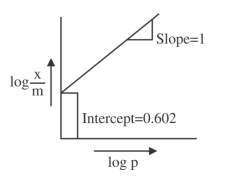
If the initial pressure of a gas is $$0.03$$ atm, the mass of the gas adsorbed per gram of the adsorbent is ______ $$\times 10^{-2}$$ g
Login to view the detailed solution.
Educational materials for JEE preparation
 Share
Share