For the following questions answer them individually
Given below are two statements : one is labelled as Assertion and the other is labelled as Reason.
Assertion: The ionic radii of $$O^{2-}$$ and $$Mg^{2+}$$ are same.
Reason: Both $$O^{2-}$$ and $$Mg^{2+}$$ are isoelectronic species.
Based upon VSEPR theory, match the shape (geometry) of the molecules in List-I with the molecules in List-II
| List-I (Shape) | List-II (Molecules) |
|---|---|
| A T-shaped | I. $$XeF_4$$ |
| B Trigonal planar | II. $$SF_4$$ |
| C Square planar | III. $$ClF_3$$ |
| D See-saw | IV. $$BF_3$$ |
Match List - I with List - II.
| List-I | List-II |
|---|---|
| (A) Spontaneous process | (I) $$\Delta H < 0$$ |
| (B) Process with $$\Delta P = 0, \Delta T = 0$$ | (II) $$\Delta G_{T,P} < 0$$ |
| (C) $$\Delta H_{reaction}$$ | (III) Isothermal and isobaric process |
| (D) Exothermic Process | (IV) [Bond energies in reactants] - [Bond energies in products] |
Choose the correct answer from the options given below
Addition of $$H_2SO_4$$ to $$BaO_2$$ produces
$$BeCl_2$$ reacts with $$LiAlH_4$$ to give
Match List - I with List - II.
| List-I (Si-Compounds) | List-II (Si-Polymeric/Other Products) |
|---|---|
| A $$(CH_3)_4Si$$ | I Chain Silicone |
| B $$(CH_3)Si(OH)_3$$ | II Dimeric Silicone |
| C $$(CH_3)_2Si(OH)_2$$ | III Silane |
| D $$(CH_3)_3Si(OH)$$ | IV 2D-Silicone |
Choose the correct answer from the options given below
L-isomer of a compound 'A'($$C_4H_8O_4$$) gives a positive test with $$[Ag(NH_3)_2]^+$$. Treatment of 'A' with acetic anhydride yields triacetate derivative. Compound 'A' produces an optically active compound (B) and an optically inactive compound (C) on treatment with bromine water and $$HNO_3$$ respectively. Compound (A) is :
Given below are two Statements :
Statement I : Classical smog occurs in cool humid climate. It is a reducing mixture of smoke, fog and sulphur dioxide.
Statement II : Photochemical smog has components, ozone, nitric oxide, acrolein, formaldehyde, PAN etc.
In the light of the above statements, choose the most appropriate answer from the options given below.
Given below are two statements : one is labelled as Assertion and the other is labelled as Reason.
Assertion: At $$10°$$C, the density of a $$5$$ M solution of KCl [atomic masses of K & Cl are $$39$$ & $$35.5$$ g mol$$^{-1}$$ respectively], is 'x' g mL$$^{-1}$$. The solution is cooled to $$-21°$$C. The molality of the solution will remain unchanged.
Reason: The molality of a solution does not change with temperature as mass remains unaffected with temperature.
In the light of the above statements, choose the most appropriate answer from the options given below.
Match List - I with List - II.
| List-I | List-II |
|---|---|
| A Lyophilic colloid | I Liquid-liquid colloid |
| B Emulsion | II Protective colloid |
| C Positively charged colloid | III $$FeCl_3 + NaOH$$ |
| D Negatively charged colloid | IV $$FeCl_3$$ + hot water |
Choose the correct answer from the options given below
Match List - I with List - II.
| List-I | List-II |
|---|---|
| A Concentration of gold ore | I Aniline |
| B Leaching of alumina | II NaOH |
| C Froth stabiliser | III $$SO_2$$ |
| D Blister copper | IV NaCN |
Choose the correct answer from the options given below
Heating white phosphorus with conc. NaOH solution gives mainly
Which of the following will have maximum stabilization due to crystal field?
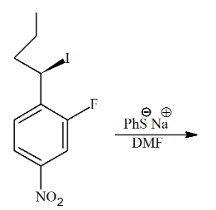
The major product of the following reaction is
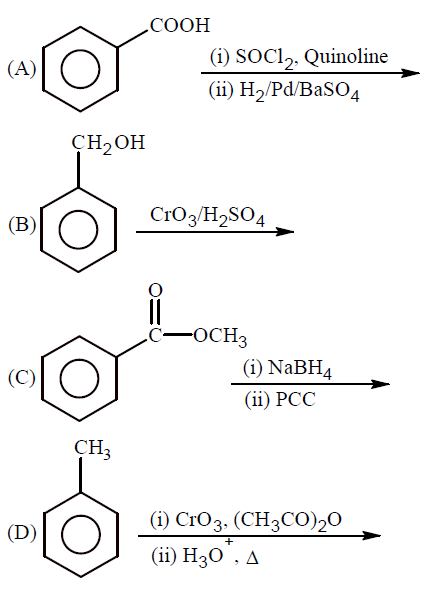
Which of the following reactions will yield benzaldehyde as a product?
'A' and 'B' respectively are
A $$\xrightarrow[(2) Zn-H_2O]{(1) O_3 \atop}$$ Ethane-1,2-dicarbaldehyde + Glyoxal/Oxaldehyde
B $$\xrightarrow[(2) Zn-H_2O]{(1) O_3 \atop}$$ 5-oxohexanal
Given below are two statements :
Statement - I : In Hofmann degradation reaction, the migration of only an alkyl group takes place from carbonyl carbon of the amide to the nitrogen atom.
Statement - II : The group is migrated in Hofmann degradation reaction to electron deficient atom.
In the light of the above statements, choose the most appropriate answer from the options given below
Match List - I with List - II.
| List-I (Polymer) | List-II (Used in) |
|---|---|
| A Bakelite | I Radio and television cabinets |
| B Glyptal | II Electrical switches |
| C PVC | III Paints and Lacquers |
| D Polystyrene | IV Water pipes |
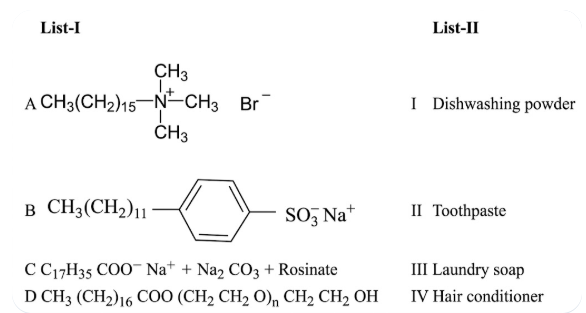
Match List - I with List - II.

Choose the correct answer from the options given below
Which of the following is structure of a separating funnel?
If the uncertainty in velocity and position of a minute particle in space are, $$2.4 \times 10^{-26}$$ (ms$$^{-1}$$) and $$10^{-7}$$ (m) respectively. The mass of the particle in g is ______ (Nearest integer)
(Given : $$h = 6.626 \times 10^{-34}$$ Js)
$$2NOCl(g) \rightleftharpoons 2NO(g) + Cl_2(g)$$
In an experiment, $$2.0$$ moles of NOCl was placed in a one-litre flask and the concentration of NO after equilibrium established, was found to be $$0.4$$ mol/L. The equilibrium constant at $$30°$$C is ______ $$\times 10^{-4}$$.
Total number of possible stereoisomers of dimethyl cyclopentane is ______
Metal deficiency defect is shown by $$Fe_{0.93}O$$. In the crystal, some $$Fe^{2+}$$ cations are missing and loss of positive charge is compensated by the presence of $$Fe^{3+}$$ ions. The percentage of $$Fe^{2+}$$ ions in the $$Fe_{0.93}O$$ crystals is ______ (Nearest integer)
Two elements A and B which form $$0.15$$ moles of $$A_2B$$ and $$AB_3$$ type compounds. If both $$A_2B$$ and $$AB_3$$ weigh equally, then the atomic weight of A is ______ times of atomic weight of B.
$$2$$ g of a non-volatile non-electrolyte solute is dissolved in $$200$$ g of two different solvents A and B whose ebullioscopic constants are in the ratio of $$1 : 8$$. The elevation in boiling points of A and B are in the ratio $$\frac{x}{y}$$ ($$x : y$$). The value of $$y$$ is ______ (Nearest Integer)
The limiting molar conductivities of NaI, $$NaNO_3$$ and $$AgNO_3$$ are $$12.7, 12.0$$ and $$13.3$$ mS m$$^2$$ mol$$^{-1}$$, respectively (all at $$25°$$C). The limiting molar conductivity of AgI at this temperature is ______ mS m$$^2$$ mol$$^{-1}$$.
The rate constant for a first order reaction is given by the following equation :
$$\ln k = 33.24 - \frac{2.0 \times 10^4 K}{T}$$
The Activation energy for the reaction is given by ______ kJ mol$$^{-1}$$. (In Nearest integer) (Given : $$R = 8.3$$ J K$$^{-1}$$ mol$$^{-1}$$)
The number of statement(s) correct from the following for Copper is/are
(A) Cu(II) complexes are always paramagnetic
(B) Cu(I) complexes are generally colourless
(C) Cu(I) is easily oxidized
(D) In Fehling solution, the active reagent has Cu(I)
Acidified potassium permanganate solution oxidises oxalic acid. The spin-only magnetic moment of the mangenese product formed from the above reaction is ______ B.M. (Nearest Integer)