For the following questions answer them individually
If $$\alpha, \beta$$ are the roots of the equation $$x^2 - (5 + 3^{\sqrt{\log_3 5}} - 5^{\sqrt{\log_5 3}})x + 3(3^{(\log_3 5)^{1/3}} - 5^{(\log_5 3)^{2/3}} - 1) = 0$$ then the equation, whose roots are $$\alpha + \dfrac{1}{\beta}$$ and $$\beta + \dfrac{1}{\alpha}$$, is
Let S be the set of all $$(\alpha, \beta)$$, $$\pi < \alpha, \beta < 2\pi$$, for which the complex number $$\frac{1-i\sin\alpha}{1+2i\sin\alpha}$$ is purely imaginary and $$\frac{1+i\cos\beta}{1-2i\cos\beta}$$ is purely real. Let $$Z_{\alpha\beta} = \sin 2\alpha + i\cos 2\beta, (\alpha,\beta) \in S$$. Then $$\sum_{(\alpha,\beta)\in S}(iZ_{\alpha\beta} + \frac{1}{i\bar{Z}_{\alpha\beta}})$$ is equal to
Let the sum of an infinite G.P., whose first term is $$a$$ and the common ratio is $$r$$, be 5. Let the sum of its first five terms be $$\frac{98}{25}$$. Then the sum of the first 21 terms of an A.P., whose first term is $$10ar$$, $$n^{th}$$ term is $$a_n$$ and the common difference is $$10ar^2$$, is equal to
Let $$S = \left\{\theta \in \left(0, \frac{\pi}{2}\right) : \sum_{m=1}^{9} \sec\left(\theta + (m-1)\frac{\pi}{6}\right) \sec\left(\theta + \frac{m\pi}{6}\right) = -\frac{8}{\sqrt{3}}\right\}$$. Then
The equations of the sides AB, BC and CA of a triangle ABC are $$2x + y = 0$$, $$x + py = 39$$ and $$x - y = 3$$ respectively and P(2,3) is its circumcentre. Then which of the following is NOT true
A circle $$C_1$$ passes through the origin O and has diameter 4 on the positive x-axis. The line $$y = 2x$$ gives a chord OA of circle $$C_1$$. Let $$C_2$$ be the circle with OA as a diameter. If the tangent to $$C_2$$ at the point A meets the x-axis at P and y-axis at Q, then $$QA : AP$$ is equal to
If the length of the latus rectum of a parabola, whose focus is $$(a, a)$$ and the tangent at its vertex is $$x + y = a$$, is 16, then $$|a|$$ is equal to
If the truth value of the statement $$(P \wedge (\sim R)) \to ((\sim R) \wedge Q)$$ is F, then the truth value of which of the following is F?
The angle of elevation of the top P of a vertical tower PQ of height 10 from a point A on the horizontal ground is $$45^\circ$$. Let R be a point on AQ and from a point B, vertically above R, the angle of elevation of P is $$60^\circ$$. If $$\angle BAQ = 30^\circ$$, $$AB = d$$ and the area of the trapezium PQRB is $$\alpha$$, then the ordered pair $$(d, \alpha)$$ is
Let $$A = \begin{pmatrix} 4 & -2 \\ \alpha & \beta \end{pmatrix}$$. If $$A^2 + \gamma A + 18I = O$$, then $$\det(A)$$ is equal to
The domain of the function $$f(x) = \sin^{-1}[2x^2 - 3] + \log_2\left(\log_{\frac{1}{2}}(x^2 - 5x + 5)\right)$$, where $$[t]$$ is the greatest integer function, is
If for $$p \neq q \neq 0$$, the function $$f(x) = \frac{7\sqrt[p]{729+x} - 3}{\sqrt[3]{729+qx} - 9}$$ is continuous at $$x = 0$$, then
Let $$f(x) = 2 + |x| - |x-1| + |x+1|$$, $$x \in \mathbb{R}$$. Consider
$$(S_1): f'(-3/2) + f'(-1/2) + f'(1/2) + f'(3/2) = 2$$
$$(S_2): \int_{-2}^{2} f(x) dx = 12$$
Then,
$$\int_0^2 \left|2x^2 - 3x + \left[x - \frac{1}{2}\right]\right| dx$$, where $$[t]$$ is the greatest integer function, is equal to
The area of the region enclosed by $$y \leq 4x^2$$, $$x^2 \leq 9y$$ and $$y \leq 4$$, is equal to
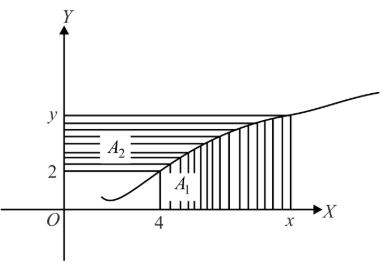
Consider a curve $$y = y(x)$$ in the first quadrant as shown in the figure. Let the area $$A_1$$ is twice the area $$A_2$$. Then the normal to the curve perpendicular to the line $$2x - 12y = 15$$ does NOT pass through the point
If the length of the perpendicular drawn from the point $$P(a, 4, 2)$$, $$a > 0$$ on the line $$\frac{x+1}{2} = \frac{y-3}{3} = \frac{z-1}{-1}$$ is $$2\sqrt{6}$$ units and Q$$(\alpha_1, \alpha_2, \alpha_3)$$ is the image of the point P in this line, then $$a + \sum_{i=1}^{3} \alpha_i$$ is equal to
If the line of intersection of the planes $$ax + by = 3$$ and $$ax + by + cz = 0$$, $$a > 0$$ makes an angle $$30^\circ$$ with the plane $$y - z + 2 = 0$$, then the direction cosines of the line are
Let X have a binomial distribution $$B(n, p)$$ such that the sum and the product of the mean and variance of X are 24 and 128 respectively. If $$P(X > n-3) = \frac{k}{2^n}$$, then $$k$$ is equal to
A six faced die is biased such that $$3 \times P(\text{a prime number}) = 6 \times P(\text{a composite number}) = 2 \times P(1)$$. Let X be a random variable that counts the number of times one gets a perfect square on some throws of this die. If the die is thrown twice, then the mean of X is
$$\frac{2^3 - 1^3}{1 \times 7} + \frac{4^3 - 3^3 + 2^3 - 1^3}{2 \times 11} + \frac{6^3 - 5^3 + 4^3 - 3^3 + 2^3 - 1^3}{3 \times 15} + \ldots + \frac{30^3 - 29^3 + 28^3 - 27^3 + \ldots + 2^3 - 1^3}{15 \times 63}$$ is equal to ______.
Let for the $$9^{th}$$ term in the binomial expansion of $$(3 + 6x)^n$$, in the increasing powers of $$6x$$, to be the greatest for $$x = \frac{3}{2}$$, the least value of $$n$$ is $$n_0$$. If $$k$$ is the ratio of the coefficient of $$x^6$$ to the coefficient of $$x^3$$, then $$k + n_0$$ is equal to
A common tangent T to the curves $$C_1: \frac{x^2}{4} + \frac{y^2}{9} = 1$$ and $$C_2: \frac{x^2}{42} - \frac{y^2}{143} = 1$$ does not pass through the fourth quadrant. If T touches $$C_1$$ at $$(x_1, y_1)$$ and $$C_2$$ at $$(x_2, y_2)$$, then $$|2x_1 + x_2|$$ is equal to _______.
Consider a matrix $$A = \begin{pmatrix} \alpha & \beta & \gamma \\ \alpha^2 & \beta^2 & \gamma^2 \\ \beta+\gamma & \gamma+\alpha & \alpha+\beta \end{pmatrix}$$, where $$\alpha, \beta, \gamma$$ are three distinct natural numbers. If $$\frac{\det(\text{adj}(\text{adj}(\text{adj}(\text{adj} A))))}{(\alpha-\beta)^{16}(\beta-\gamma)^{16}(\gamma-\alpha)^{16}} = 2^{32} \times 3^{16}$$, then the number of such 3-tuples $$(\alpha, \beta, \gamma)$$ is ______.
The number of functions $$f$$, from the set $$A = \{x \in \mathbb{N}: x^2 - 10x + 9 \leq 0\}$$ to the set $$B = \{n^2 : n \in \mathbb{N}\}$$ such that $$f(x) \leq (x-3)^2 + 1$$, for every $$x \in A$$, is _______.
For the curve $$C: (x^2 + y^2 - 3) + (x^2 - y^2 - 1)^{5} = 0$$, the value of $$3y' - y^3 y''$$, at the point $$(\alpha, \alpha)$$, $$\alpha > 0$$ on C, is equal to ________.
A water tank has the shape of a right circular cone with axis vertical and vertex downwards. Its semivertical angle is $$\tan^{-1}\frac{3}{4}$$. Water is poured in it at a constant rate of 6 cubic meter per hour. The rate (in square meter per hour), at which the wet curved surface area of the tank is increasing, when the depth of water in the tank is 4 meters, is _______.
Let $$f(x) = \min\{[x-1], [x-2], \ldots, [x-10]\}$$ where $$[t]$$ denotes the greatest integer $$\leq t$$. Then $$\int_0^{10} f(x)dx + \int_0^{10} (f(x))^2 dx + \int_0^{10} |f(x)| dx$$ is equal to _______.
Let $$f$$ be a differentiable function satisfying $$f(x) = \frac{2}{\sqrt{3}} \int_0^{\sqrt{3}} f\left(\frac{\lambda^2 x}{3}\right) d\lambda$$, $$x > 0$$ and $$f(1) = \sqrt{3}$$. If $$y = f(x)$$ passes through the point $$(\alpha, 6)$$, then $$\alpha$$ is equal to _______.
Let $$\vec{a}, \vec{b}, \vec{c}$$ be three non-coplanar vectors such that $$\vec{a} \times \vec{b} = 4\vec{c}$$, $$\vec{b} \times \vec{c} = 9\vec{a}$$ and $$\vec{c} \times \vec{a} = \alpha\vec{b}$$, $$\alpha > 0$$. If $$|\vec{a}| + |\vec{b}| + |\vec{c}| = {36}$$, then $$\alpha$$ is equal to _______.