NTA JEE Main 27th July 2021 Shift 2
For the following questions answer them individually
NTA JEE Main 27th July 2021 Shift 2 - Question 11
An object of mass 0.5 kg is executing simple harmonic motion. It amplitude is 5 cm and time period (T) is 0.2 s. What will be the potential energy of the object at an instant $$t = \frac{T}{4}$$ s starting from mean position. Assume that the initial phase of the oscillation is zero.
NTA JEE Main 27th July 2021 Shift 2 - Question 12
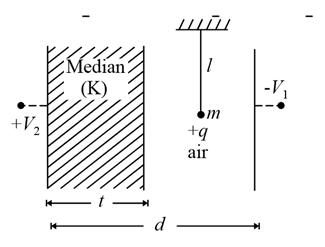
A simple pendulum of mass $$'m'$$, length $$'l'$$ and charge $$'+q'$$ suspended in the electric field produced by two conducting parallel plates as shown. The value of deflection of pendulum in equilibrium position will be
NTA JEE Main 27th July 2021 Shift 2 - Question 13
What will be the magnitude of the electric field at point $$O$$ as shown in the figure? Each side of the figure is $$l$$ and perpendicular to the other.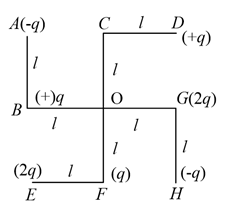

NTA JEE Main 27th July 2021 Shift 2 - Question 14
The resistance of a conductor at 15°C is 16 $$\Omega$$ and at 100°C is 20 $$\Omega$$. What will be the temperature coefficient of resistance of the conductor?
NTA JEE Main 27th July 2021 Shift 2 - Question 15
Figure A and B shown two long straight wires of circular cross-section ($$a$$ and $$b$$ with $$a < b$$), carrying current $$I$$ which is uniformly distributed across the cross-section. The magnitude of magnetic field $$B$$ varies with radius $$r$$ and can be represented as: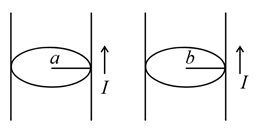
NTA JEE Main 27th July 2021 Shift 2 - Question 16
A 100$$\Omega$$ resistance, a 0.1$$\mu$$F capacitor and an inductor are connected in series across a 250 V supply at variable frequency. Calculate the value of inductance of inductor at which resonance will occur. Given that the resonant frequency is 60 Hz.
NTA JEE Main 27th July 2021 Shift 2 - Question 17
The expected graphical representation of the variation of angle of deviation '$$\delta$$' with angle of incidence 'i' in a prism is:
NTA JEE Main 27th July 2021 Shift 2 - Question 18
An electron and proton are separated by a large distance. The electron starts approaching the proton with energy 3 eV. The proton captures the electrons and forms a hydrogen atom in second excited state. The resulting photon is incident on a photosensitive metal of threshold wavelength 4000 A. What is the maximum kinetic energy of the emitted photoelectron?
NTA JEE Main 27th July 2021 Shift 2 - Question 19
Consider the following statements:
A. Atoms of each element emit characteristics spectrum.
B. According to Bohr's Postulate, an electron in a hydrogen atom revolves in a certain stationary orbit.
C. The density of nuclear matter depends on the size of the nucleus.
D. A free neutron is stable but a free proton decay is possible.
E. Radioactivity is an indication of the instability of nuclei. Choose the correct answer from the options given below.
NTA JEE Main 27th July 2021 Shift 2 - Question 20
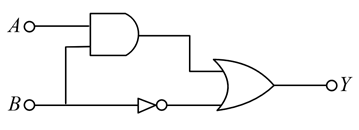
Find the truth table for the function Y of A and B represented in the following figure.