NTA JEE Main 25th July 2021 Shift 2
For the following questions answer them individually
NTA JEE Main 25th July 2021 Shift 2 - Question 11
Two ideal electric dipoles $$A$$ and $$B$$, having their dipole moment $$p_1$$ and $$p_2$$ respectively are placed on a plane with their centres at $$O$$ as shown in the figure. At point $$C$$ on the axis of dipole $$A$$, the resultant electric field is making an angle of 37° with the axis. The ratio of the dipole moment of $$A$$ and $$B$$, $$\frac{p_1}{p_2}$$ is: (take sin 37° = $$\frac{3}{5}$$)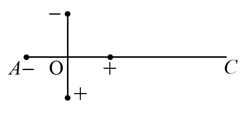
NTA JEE Main 25th July 2021 Shift 2 - Question 12
If $$q_f$$ is the free charge on the capacitor plates and $$q_b$$ is the bound charge on the dielectric slab of dielectric constant $$k$$ placed between the capacitor plates, then bound charge $$q_b$$ can be expressed as:
NTA JEE Main 25th July 2021 Shift 2 - Question 13
In the given potentiometer circuit arrangement, the balancing length AC is measured to be 250 cm. When the galvanometer connection is shifted from point (1) to point (2) in the given diagram, the balancing length becomes 400 cm. The ratio of the emf of two cells $$\frac{\varepsilon_1}{\varepsilon_2}$$ is: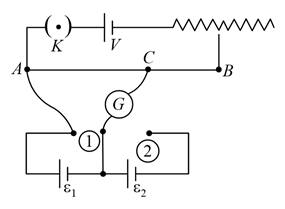

NTA JEE Main 25th July 2021 Shift 2 - Question 14
The given potentiometer has its wire of resistance 10 $$\Omega$$. When the sliding contact is in the middle of the potentiometer wire, the potential drop across 2 $$\Omega$$ resistor is: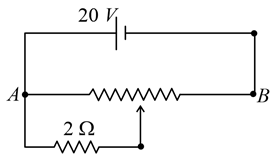
NTA JEE Main 25th July 2021 Shift 2 - Question 15
Two ions having same mass have charges in the ratio 1 : 2. They are projected normally in a uniform magnetic field with their speeds in the ratio 2 : 3. The ratio of the radii of their circular trajectories is,
NTA JEE Main 25th July 2021 Shift 2 - Question 16
A 10 $$\Omega$$ resistance is connected across 220 V - 50 Hz AC supply. The time taken by the current to change from its maximum value to the rms value is:
NTA JEE Main 25th July 2021 Shift 2 - Question 17
A prism of refractive index $$\mu$$ and angle of prism $$A$$ is placed in the position of minimum angle of deviation. If minimum angle of deviation is also $$A$$, then in terms of refractive index,
NTA JEE Main 25th July 2021 Shift 2 - Question 18
A ray of light entering from air into a denser medium of refractive index $$\frac{4}{3}$$, as shown in figure. The light ray suffers total internal reflection at the adjacent surface as shown. The maximum value of angle $$\theta$$ should be equal to: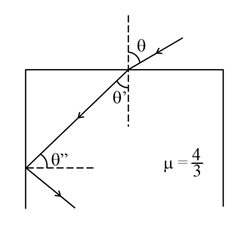
NTA JEE Main 25th July 2021 Shift 2 - Question 19
An electron moving with speed $$v$$ and a photon moving with speed $$c$$, have the same D-Broglie wavelength. The ratio of the kinetic energy of the electron to that of a photon is:
NTA JEE Main 25th July 2021 Shift 2 - Question 20
When radiation of wavelength $$\lambda$$ is incident on a metallic surface, the stopping potential of ejected photoelectrons is 4.8 V. If the same surface is illuminated by radiation of double the previous wavelength, then the stopping potential becomes 1.6 V. The threshold wavelength of the metal is: