The radius of the 2$$^{nd}$$ orbit of Li$$^{2+}$$ is $$x$$. The expected radius of the 3$$^{rd}$$ orbit of Be$$^{3+}$$ is
Sign in
Please select an account to continue using cracku.in
↓ →
Join Our JEE Preparation Group
Prep with like-minded aspirants; Get access to free daily tests and study material.
The radius of the 2$$^{nd}$$ orbit of Li$$^{2+}$$ is $$x$$. The expected radius of the 3$$^{rd}$$ orbit of Be$$^{3+}$$ is
Login to view the detailed solution.
'25 volume' hydrogen peroxide means
Login to view the detailed solution.
Match List I with List II
List I (Elements) List II (Colour imparted to the flame)
A. K I. Brick Red
B. Ca II. Violet
C. Sr III. Apple Green
D. Ba IV. Crimson Red
Choose the correct answer from the options given below:
Login to view the detailed solution.
Which of the following conformations will be the most stable?
Login to view the detailed solution.
The compound which will have the lowest rate towards nucleophilic aromatic substitution on treatment with OH$$^-$$ is
Login to view the detailed solution.
The correct sequence of reagents for the preparation of Q and R is:
Login to view the detailed solution.
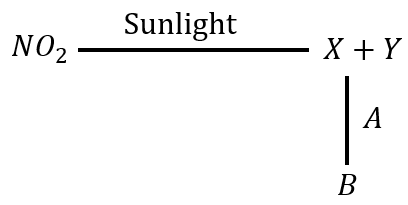
Some reactions of NO$$_2$$ relevant to photochemical smog formation are
Identify A, B, X and Y
Login to view the detailed solution.
A cubic solid is made up of two elements X and Y. Atoms of X are present on every alternate corner and one at the center of cube. Y is at $$\frac{1}{3}$$rd of the total faces. The empirical formula of the compound is
Login to view the detailed solution.
Which one of the following reactions does not occur during extraction of copper?
Login to view the detailed solution.
Reaction of thionyl chloride with white phosphorus forms a compound [A], which on hydrolysis gives [B], a dibasic acid. [A] and [B] are respectively
Login to view the detailed solution.
Compound A reacts with NH$$_4$$Cl and forms a compound B. Compound B reacts with H$$_2$$O and excess of CO$$_2$$ to form compound C which on passing through or reaction with saturated NaCl solution forms sodium hydrogen carbonate. Compound A, B and C, are respectively.
Login to view the detailed solution.
Inert gases have positive electron gain enthalpy. Its correct order is
Login to view the detailed solution.
Match the List-I with List-II:
Cations Group reaction
P $$\to$$ Pb$$^{2+}$$, Cu$$^{2+}$$ H$$_2$$S gas in presence of dilute HCl
Q $$\to$$ Al$$^{3+}$$, Fe$$^{3+}$$ (NH$$_4$$)$$_2$$CO$$_3$$ in presence of NH$$_4$$OH
R $$\to$$ Co$$^{2+}$$, Ni$$^{2+}$$ NH$$_4$$OH in presence of NH$$_4$$Cl
S $$\to$$ Ba$$^{2+}$$, Ca$$^{2+}$$ H$$_2$$S in presence of NH$$_4$$OH
Login to view the detailed solution.
In the cumene to phenol preparation in presence of air, the intermediate is
Login to view the detailed solution.
Given below are two statements: one is labelled as Assertion A and the other is labelled as Reason R:
Assertion A: Acetal/Ketal is stable in basic medium.
Reason R: The high leaving tendency of alkoxide ion gives the stability to acetal/ketal in basic medium.
In the light of the above statements, choose the correct answer from the options given below:
Login to view the detailed solution.
The correct order in aqueous medium of basic strength in case of methyl substituted amines is:
Login to view the detailed solution.
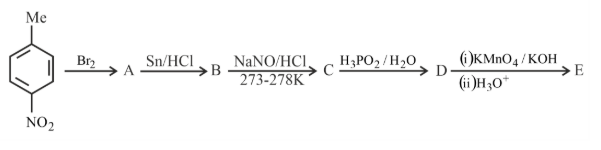
Identify the product formed (A and E)

Login to view the detailed solution.
Which of the following statements is incorrect for antibiotics?
Login to view the detailed solution.
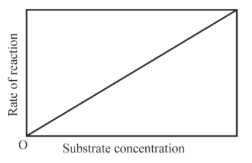
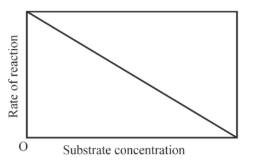
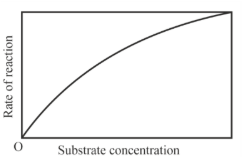
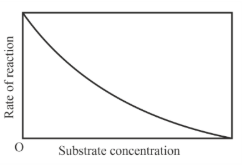
The variation of the rate of an enzyme catalyzed reaction with substrate concentration is correctly represented by graph
(a)

(b)

(c)

(d)

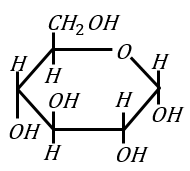
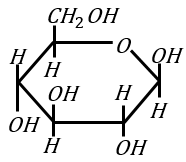
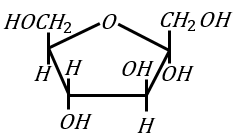
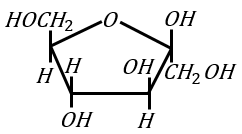
Match items of Row I with those of Row II.
Row I
(P)
(Q)
(R)
(S)
Row II:
(i) $$\alpha$$-D-(-) Fructofuranose
(ii) $$\beta$$-D-(-) Fructofuranose
(iii) $$\alpha$$-D-(-) Glucopyranose
(iv) $$\beta$$-D-(-) Glucopyranose
Correct match is
Login to view the detailed solution.
The total number of lone pairs of electrons on oxygen atoms of ozone is
Login to view the detailed solution.
A litre of buffer solution contains 0.1 mole of each of NH$$_3$$ and NH$$_4$$Cl. On the addition of 0.02 mole of HCl by dissolving gaseous HCl, the pH of the solution is found to be _____ $$\times 10^{-3}$$ (Nearest integer)
Given: pK$$_b$$(NH$$_3$$) = 4.745
log 2 = 0.301
log 3 = 0.477
T = 298 K
Login to view the detailed solution.
The density of a monobasic strong acid (Molar mass 24.2 g mol) is 1.21 kg L. The volume of its solution required for the complete neutralization of 25 mL of 0.24 M NaOH is $$10^{-2}$$ mL (Nearest integer)
Login to view the detailed solution.
In sulphur estimation. 0.471 g of an organic compound gave 1.4439 g of barium sulphate. The percentage of sulphur in the compound is _____ (Nearest Integer)
(Given: Atomic mass Ba: 137u, S: 32u, O: 16u)
Login to view the detailed solution.
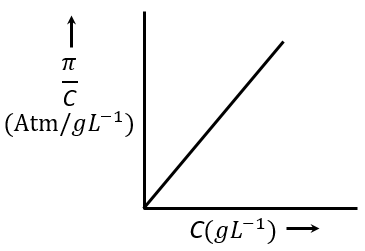
The osmotic pressure of solutions of PVC in cyclohexanone at 300 K are plotted on the graph. The molar mass of PVC is _____ g mol$$^{-1}$$ (Nearest integer)

(Given: R = 0.083 L atm K$$^{-1}$$ mol$$^{-1}$$)
Consider the cell Pt(s)|H$$_2$$(s)(1atm)|H$$^+$$(aq, [H$$^+$$] = 1)||Fe$$^{3+}$$(aq), Fe$$^{2+}$$(aq)|Pt(s)
Given: E$$_{Fe^{3+}/Fe^{2+}}^\circ$$ = 0.771 V and E$$_{H^+/\frac{1}{2}H_2}^\circ$$ = 0 V, T = 298 K
If the potential of the cell is 0.712 V the ratio of concentration of Fe$$^{2+}$$ to Fe$$^{3+}$$ is _____ (Nearest integer)
Login to view the detailed solution.
For the first order reaction A $$\to$$ B the half life is 30 min. The time taken for 75% completion of the reaction is _____ min. (Nearest integer)
Given: log 2 = 0.3010
log 3 = 0.4771
log 5 = 0.6989
Login to view the detailed solution.
The number of paramagnetic species from the following is
[Ni(CN)$$_4$$]$$^{2-}$$, [Ni(CO)$$_4$$], [NiCl$$_4$$]$$^{2-}$$
[Fe(CN)$$_6$$]$$^{4-}$$, [Cu(NH$$_3$$)$$_4$$]$$^{2+}$$
[Fe(CN)$$_6$$]$$^{3-}$$ and [Fe(H$$_2$$O)$$_6$$]$$^{2+}$$
Login to view the detailed solution.
How many of the following metal ions have similar value of spin only magnetic moment in gaseous state?
(Given: Atomic number: V, 23; Cr, 24; Fe, 26; Ni, 28)
V$$^{3+}$$, Cr$$^{3+}$$, Fe$$^{2+}$$, Ni$$^{3+}$$
Login to view the detailed solution.
An athlete is given 100 g of glucose (C$$_6$$H$$_{12}$$O$$_6$$) for energy. This is equivalent to 1800 kJ of energy. The 50% of this energy gained is utilized by the athlete for sports activities at the event. In order to avoid storage of energy, the weight of extra water he would need to perspire is _____ g (Nearest integer) Assume that there is no other way of consuming stored energy.
Given: The enthalpy of evaporation of water is 45 kJ mol$$^{-1}$$
Molar mass of C, H & O are 12.1 and 16 g mol$$^{-1}$$.
Login to view the detailed solution.
Educational materials for JEE preparation