NTA JEE Main 25th April 2013 Online
For the following questions answer them individually
NTA JEE Main 25th April 2013 Online - Question 21
A series LR circuit is connected to an ac source of frequency $$\omega$$ and the inductive reactance is equal to 2R. A capacitance of capacitive reactance equal to R is added in series with L and R. The ratio of the new power factor to the old one is :
NTA JEE Main 25th April 2013 Online - Question 22
A printed page is pressed by a glass of water. The refractive index of the glass and water is 1.5 and 1.33, respectively. If the thickness of the bottom of glass is 1 cm and depth of water is 5 cm, how much the page will appear to be shifted if viewed from the top?
NTA JEE Main 25th April 2013 Online - Question 23
A thin glass plate of thickness $$\frac{2500}{3}\lambda$$ ($$\lambda$$ is wavelength of light used) and refractive index $$\mu = 1.5$$ is inserted between one of the slits and the screen in Young's double slit experiment. At a point on the screen equidistant from the slits, the ratio of the intensities before and after the introduction of the glass plate is :

NTA JEE Main 25th April 2013 Online - Question 24
The source that illuminates the double-slit in 'double-slit interference experiment' emits two distinct monochromatic waves of wavelength 500 nm and 600 nm, each of them producing its own pattern on the screen. At the central point of the pattern when path difference is zero, maxima of both the patterns coincide and the resulting interference pattern is most distinct at the region of zero path difference. But as one moves out of this central region, the two fringe systems are gradually out of step such that maximum due to one wavelength coincides with the minimum due to the other and the combined fringe system becomes completely indistinct. This may happen when path difference in nm is:
NTA JEE Main 25th April 2013 Online - Question 25
This question has Statement-1 and Statement-2. Of the four choices given after the Statements, choose the one that best describes the two Statements.
Statement-1: Out of radio waves and microwaves, the radio waves undergo more diffraction.
Statement-2: Radio waves have greater frequency compared to microwaves.
NTA JEE Main 25th April 2013 Online - Question 26
In an experiment on photoelectric effect, a student plots stopping potential $$V_0$$ against reciprocal of the wavelength $$\lambda$$ of the incident light for two different metals A and B. These are shown in the figure.
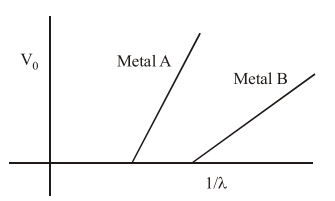
Looking at the graphs, you can most appropriately say that:
NTA JEE Main 25th April 2013 Online - Question 27
A copper ball of radius 1 cm and work function 4.47 eV is irradiated with ultraviolet radiation of wavelength 2500 $$\text{Å}$$. The effect of irradiation results in the emission of electrons from the ball. Further the ball will acquire charge and due to this there will be a finite value of the potential on the ball. The charge acquired by the ball is :
NTA JEE Main 25th April 2013 Online - Question 28
A 12.5 eV electron beam is used to bombard gaseous hydrogen at room temperature. It will emit:
NTA JEE Main 25th April 2013 Online - Question 29
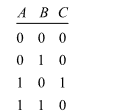
Which of the following circuits correctly represents the following truth table?
NTA JEE Main 25th April 2013 Online - Question 30
Which of the following modulated signal has the best noise-tolerance?