NTA JEE Main 24th January 2023 Shift 1
For the following questions answer them individually
NTA JEE Main 24th January 2023 Shift 1 - Question 11
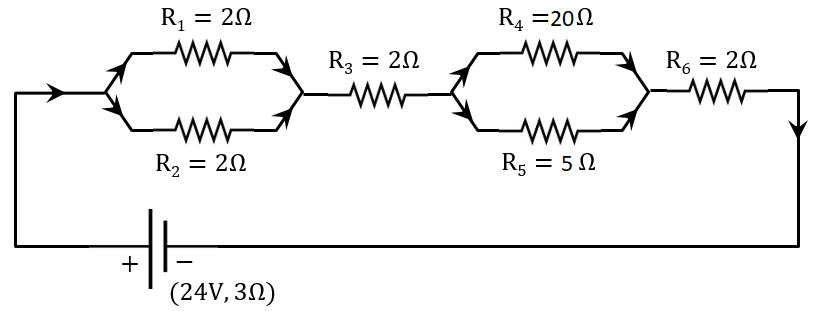
As shown in the figure, a network of resistors is connected to a battery of 24 V with an internal resistance of 3 $$\Omega$$. The currents through the resistors $$R_4$$ and $$R_5$$ are $$I_4$$ and $$I_5$$ respectively. The values of $$I_4$$ and $$I_5$$ are:
NTA JEE Main 24th January 2023 Shift 1 - Question 12
Two long straight wires $$P$$ and $$Q$$ carrying equal current 10 A each were kept parallel to each other at 5 cm distance. Magnitude of magnetic force experienced by 10 cm length of wire $$P$$ is $$F_1$$. If distance between wires is halved and currents on them are doubled, force $$F_2$$ on 10 cm length of wire $$P$$ will be:
NTA JEE Main 24th January 2023 Shift 1 - Question 13
A circular loop of radius $$R$$ is carrying current $$i$$ A. The ratio of magnetic field at the centre of circular loop and at a distance $$R$$ from the center of the loop on its axis is:
NTA JEE Main 24th January 2023 Shift 1 - Question 14
A conducting loop of radius $$\frac{10}{\sqrt{\pi}}$$ cm is placed perpendicular to a uniform magnetic field of 0.5 T. The magnetic field is decreased to zero in 0.5 s at a steady rate. The induced emf in the circular loop at 0.25 s is:
NTA JEE Main 24th January 2023 Shift 1 - Question 15
If $$\vec{E}$$ and $$\vec{K}$$ represent electric field and propagation vectors of the EM waves in vacuum, then magnetic field vector is given by: ($$\omega$$ - angular frequency)
NTA JEE Main 24th January 2023 Shift 1 - Question 16
Given below are two statements:
Statement I: If the Brewster's angle for the light propagating from air to glass is $$\theta_B$$, then Brewster's angle for the light propagating from glass to air is $$\frac{\pi}{2} - \theta_B$$.
Statement II: The Brewster's angle for the light propagating from glass to air is $$\tan^{-1} \mu_g$$, where $$\mu_g$$ is the refractive index of glass.
In the light of the above statements, choose the correct answer from the options given below:
NTA JEE Main 24th January 2023 Shift 1 - Question 17
From the photoelectric effect experiment, following observations are made. Identify which of these are correct:
A. The stopping potential depends only on the work function of the metal.
B. The saturation current increases as the intensity of incident light increases.
C. The maximum kinetic energy of a photo electron depends on the intensity of the incident light.
D. Photoelectric effect can be explained using wave theory of light.
Choose the correct answer from the options given below:
NTA JEE Main 24th January 2023 Shift 1 - Question 18
Consider the following radioactive decay process:
$${}^{218}_{84}A \xrightarrow{\alpha} A_1 \xrightarrow{\beta^-} A_2 \xrightarrow{\gamma} A_3 \xrightarrow{\alpha} A_4 \xrightarrow{\beta^+} A_5 \xrightarrow{\gamma} A_6$$
The mass number and the atomic number of $$A_6$$ are given by:
NTA JEE Main 24th January 2023 Shift 1 - Question 19
Given below are two statements: one is labelled as Assertion A and the other is labelled as Reason R.
Assertion A: Photodiodes are preferably operated in reverse bias condition for light intensity measurement.
Reason R: The current in the forward bias is more than the current in the reverse bias for a $$p$$-$$n$$ junction diode.
In the light of the above statement, choose the correct answer from the options given below:
NTA JEE Main 24th January 2023 Shift 1 - Question 20
A modulating signal is a square wave, as shown in the figure.
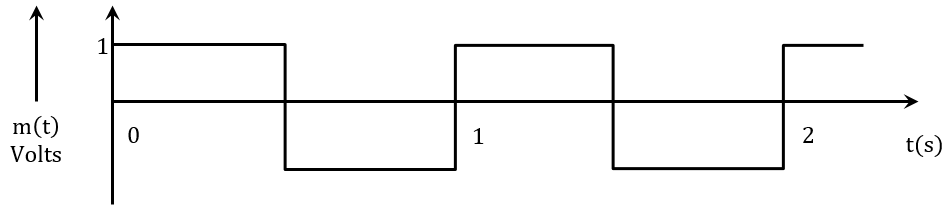
If the carrier wave is given as $$c(t) = 2\sin 8\pi t$$ volts, the modulation index is: