NTA JEE Main 23rd April 2013 Online
For the following questions answer them individually
NTA JEE Main 23rd April 2013 Online - Question 11
500 g of water and 100 g of ice at 0°C are in a calorimeter whose water equivalent is 40 g. 10 g of steam at 100°C is added to it. Then water in the calorimeter is : (Latent heat of ice = 80 cal/g, Latent heat of steam = 540 cal/g)
NTA JEE Main 23rd April 2013 Online - Question 12
This question has Statement-1 and Statement-2. Of the four choices given after the Statements, choose the one that best describes the two Statements.
Statement 1: The internal energy of a perfect gas is entirely kinetic and depends only on absolute temperature of the gas and not on its pressure or volume.
Statement 2: A perfect gas is heated keeping pressure constant and later at constant volume. For the same amount of heat the temperature of the gas at constant pressure is lower than that at constant volume.
NTA JEE Main 23rd April 2013 Online - Question 13
Bob of a simple pendulum of length $$l$$ is made of iron. The pendulum is oscillating over a horizontal coil carrying direct current. If the time period of the pendulum is T then :

NTA JEE Main 23rd April 2013 Online - Question 14
A sonometer wire of length 114 cm is fixed at both the ends. Where should the two bridges be placed so as to divide the wire into three segments whose fundamental frequencies are in the ratio 1 : 3 : 4?
NTA JEE Main 23rd April 2013 Online - Question 15
Consider a finite insulated, uncharged conductor placed near a finite positively charged conductor. The uncharged body must have a potential :
NTA JEE Main 23rd April 2013 Online - Question 16
A liquid drop having 6 excess electrons is kept stationary under a uniform electric field of 25.5 kVm$$^{-1}$$. The density of liquid is $$1.26 \times 10^3$$ kg m$$^{-3}$$. The radius of the drop is (neglect buoyancy).
NTA JEE Main 23rd April 2013 Online - Question 17
A parallel plate capacitor of area 60 cm$$^2$$ and separation 3 mm is charged initially to 90$$\mu$$C. If the medium between the plate gets slightly conducting and the plate loses the charge initially at the rate of $$2.5 \times 10^{-8}$$ C/s, then what is the magnetic field between the plates?
NTA JEE Main 23rd April 2013 Online - Question 18
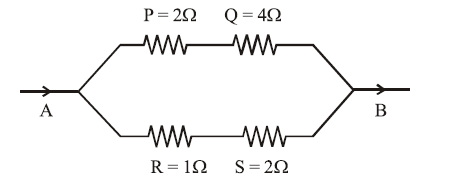
Which of the four resistances P, Q, R and S generate the greatest amount of heat when a current flows from A to B?
NTA JEE Main 23rd April 2013 Online - Question 19
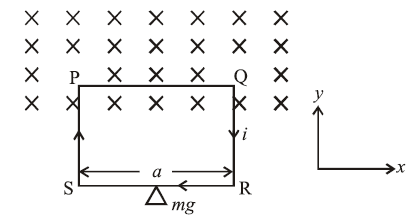
A rectangular loop of wire, supporting a mass m, hangs with one end in a uniform magnetic field $$\vec{B}$$ pointing out of the plane of the paper. A clockwise current is set up such that $$i > mg/Ba$$, where a is the width of the loop. Then :
NTA JEE Main 23rd April 2013 Online - Question 20
A particle of charge $$16 \times 10^{-16}$$ C moving with velocity 10 ms$$^{-1}$$ along x-axis enters a region where magnetic field of induction $$\vec{B}$$ is along the y-axis and an electric field of magnitude $$10^4$$ Vm$$^{-1}$$ is along the negative z-axis. If the charged particle continues moving along x-axis, the magnitude of $$\vec{B}$$ is :