NTA JEE Main 22nd July 2021 Shift 1
For the following questions answer them individually
NTA JEE Main 22nd July 2021 Shift 1 - Question 1
What will be the projection of vector $$\vec{A} = \hat{i} + \hat{j} + \hat{k}$$ on vector $$\vec{B} = \hat{i} + \hat{j}$$?
NTA JEE Main 22nd July 2021 Shift 1 - Question 2
A bullet of 4 g mass is fired from a gun of mass 4 kg. If the bullet moves with the muzzle speed of 50 ms$$^1$$, the impulse imparted to the gun and velocity of recoil of gun are
NTA JEE Main 22nd July 2021 Shift 1 - Question 3
The motion of a mass on a spring, with spring constant $$K$$ is as shown in figure.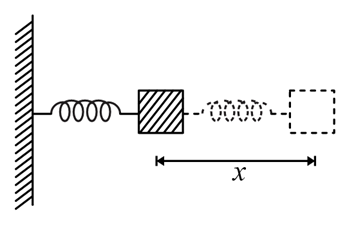
The equation of motion is given by, $$x(t) = A\sin\omega t + B\cos\omega t$$ with $$\omega = \sqrt{\frac{K}{m}}$$. Suppose that at time $$t = 0$$, the position of mass is $$x(0)$$ and velocity $$v(0)$$, then its displacement can also be represented as $$x(t) = C\cos(\omega t - \phi)$$, where $$C$$ and $$\phi$$ are:

NTA JEE Main 22nd July 2021 Shift 1 - Question 4
A porter lifts a heavy suitcase of mass 80 kg and at the destination lowers it down by a distance of 80 cm with a constant velocity. Calculate the work done by the porter in lowering the suitcase. (take $$g = 9.8$$ ms$$^{-2}$$)
NTA JEE Main 22nd July 2021 Shift 1 - Question 5
Consider a situation in which a ring, a solid cylinder and a solid sphere roll down on the same inclined plane without slipping. Assume that they start rolling from rest and having identical diameter. The correct statement for this situation is
NTA JEE Main 22nd July 2021 Shift 1 - Question 6
A body is projected vertically upwards from the surface of earth with a velocity sufficient enough to carry it to infinity. The time taken by it to reach height $$h$$ is ___ s.
NTA JEE Main 22nd July 2021 Shift 1 - Question 7
What will be the average value of energy for a monoatomic gas in thermal equilibrium at temperature $$T$$?
NTA JEE Main 22nd July 2021 Shift 1 - Question 8
$$T_0$$ is the time period of a simple pendulum at a place. If the length of the pendulum is reduced to $$\frac{1}{16}$$ times of its initial value, the modified time period is
NTA JEE Main 22nd July 2021 Shift 1 - Question 9
An electric dipole is placed on $$x$$-axis in proximity to a line charge of linear charge density $$3.0 \times 10^{-6}$$ C m$$^{-1}$$. Line charge is placed on $$z$$-axis and positive and negative charge of dipole is at a distance of 10 mm and 12 mm from the origin respectively. If total force of 4 N is exerted on the dipole, find out the amount of positive or negative charge of the dipole.
NTA JEE Main 22nd July 2021 Shift 1 - Question 10
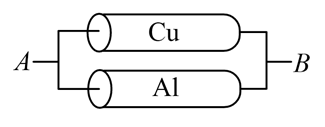
A Copper (Cu) rod of length 25 cm and cross-sectional area 3 mm$$^2$$ is joined with a similar Aluminium (Al) rod as shown in figure. Find the resistance of the combination between the ends A and B.
(Take resistivity of Copper = 1.7 $$\times 10^{-8}$$ $$\Omega$$m, Resistivity of aluminium = 2.6 $$\times 10^{-8}$$ $$\Omega$$m)