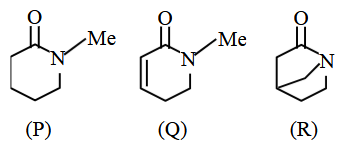
The correct order of basicity for the following molecules is :
Sign in
Please select an account to continue using cracku.in
↓ →

Join Our JEE Preparation Group
Prep with like-minded aspirants; Get access to free daily tests and study material.
The correct order of basicity for the following molecules is :
Login to view the detailed solution.
The incorrect relationship in the following pairs in relation to ionisation enthalpies is :
Login to view the detailed solution.
Which among the following compounds give yellow solid when reacted with NaOI/NaOH?
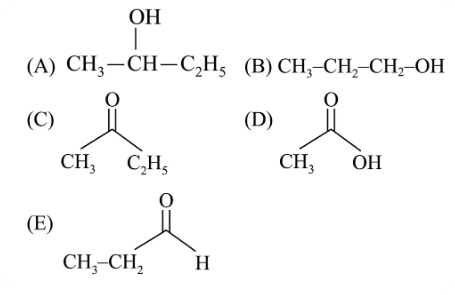
Choose the correct answer from the options given below :
Login to view the detailed solution.
.webp)
A dipeptide, "x" on complete hydrolysis gives "y" and "z". "y" on treatment with aq. HNO$$_2$$ produces lactic acid. On the other hand "z" on heating gives a cyclic molecule.
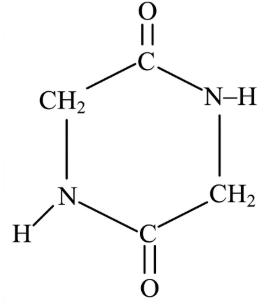
Based on the information given, the dipeptide X is:
Login to view the detailed solution.
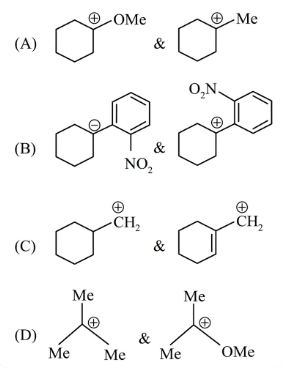
In which pairs, the first ion is more stable than the second?
Login to view the detailed solution.
Given below are two statements :
Statement (I) : Alcohols are formed when alkyl chlorides are treated with aqueous potassium hydroxide by elimination reaction.
Statement (II) : In alcoholic potassium hydroxide, alkyl chlorides form alkenes by abstracting the hydrogen from the $$\beta$$-carbon.
In the light of the above statements, choose the most appropriate answer from the option given below :
Login to view the detailed solution.
.webp)
Given below are two statements :
Statement (I) : Molal depression constant $$K_f$$ is given by $$\frac{M_1 R T_f}{\Delta S_{fus}}$$, where symbols have their usual meaning.
Statement (II) : $$K_f$$ for benzene is less than the $$K_f$$ for water.
In the light of the above statements, choose the most appropriate answer from the options given below :
Login to view the detailed solution.
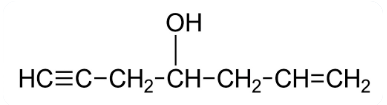
The IUPAC name of the following compound is :
Login to view the detailed solution.
Match List-I (Separation of) with List-II (Separation Technique) :
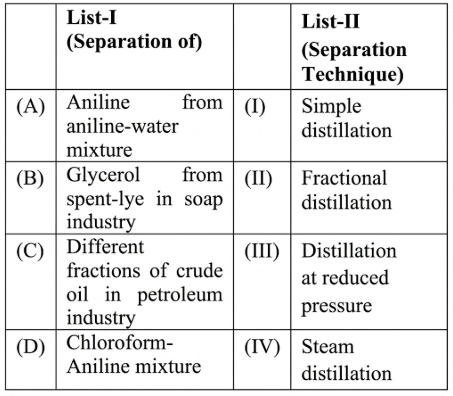
Choose the correct answer from the options given below :
Login to view the detailed solution.
.webp)
A toxic compound "A" when reacted with NaCN in aqueous acidic medium yields an edible cooking component and food preservative 'B'. "B" is converted to "C" by diborane and can be used as an additive to petrol to reduce emission. "C" upon reaction with oleum at $$140^{\circ}$$ C yields an inhalable anesthetic "D". Identify "A", "B", "C" and "D", respectively.
Login to view the detailed solution.
The correct order of $$[FeF_6]^{3-}$$, $$[CoF_6]^{3-}$$, $$[Ni(CO)_4]$$ and $$[Ni(CN)_4]^{2-}$$ complex species based on the number of unpaired electrons present is :
Login to view the detailed solution.
Consider the given data :
(a) $$HCl(g) + 10H_2O(l) \rightarrow HCl \cdot 10H_2O$$, $$\Delta H = -69.01$$ kJ mol$$^{-1}$$
(b) $$HCl(g) + 40H_2O(l) \rightarrow HCl \cdot 40H_2O$$, $$\Delta H = -72.79$$ kJ mol$$^{-1}$$
Choose the correct statement :
Login to view the detailed solution.
.webp)
Consider the ground state of chromium atom (Z = 24). How many electrons are with Azimuthal quantum number $$l = 1$$ and $$l = 2$$ respectively?
Login to view the detailed solution.
Given below are two statements :
Statement (I) : The first ionisation enthalpy of group 14 elements is higher than the corresponding elements of group 13.
Statement (II) : Melting points and boiling points of group 13 elements are in general much higher than those the corresponding elements of group 14.
In the light of the above statements, choose the most appropriate answer from the options given below :
Login to view the detailed solution.
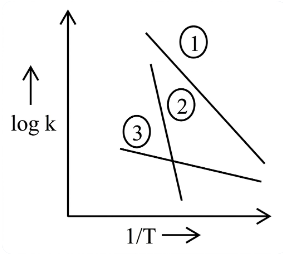
Consider the following plots of log of rate constant k (log k) vs $$\frac{1}{T}$$ for three different reactions. The correct order of activation energies of these reactions is :
Login to view the detailed solution.

'X' is the number of electrons in $$t_{2g}$$ orbitals of the most stable complex ion among $$[Fe(NH_3)_6]^{3+}$$, $$[Fe(Cl)_6]^{3-}$$, $$[Fe(C_2O_4)_3]^{3-}$$ and $$[Fe(H_2O)_6]^{3+}$$. The nature of oxide of vanadium of the type $$V_2O_x$$ is:
Login to view the detailed solution.
The elements of Group 13 with highest and lowest first ionisation enthalpies are respectively:
Login to view the detailed solution.
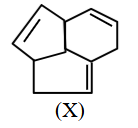
Consider the following molecule (X). The structure of X is
_1.webp)
Given below are two statements:
Statement (I) : for

, all three possible structures may be drawn.
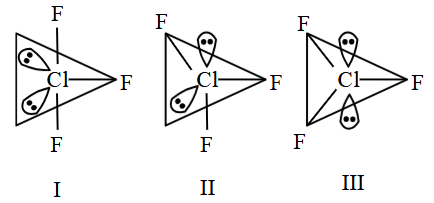
Statement (II) : Structure III is most stable, as the orbitals having the lone pairs are axial, where the $$lp-bp$$ repulsion is minimum.
In the light of the above statements, choose the most appropriate answer from the options given below:
Login to view the detailed solution.
Half life of zero order reaction $$A \rightarrow$$ product is 1 hour, when initial concentration of reaction is 2.0 mol L$$^{-1}$$. The time required to decrease concentration of A from 0.50 to 0.25 mol L$$^{-1}$$ is:
Login to view the detailed solution.
Sea water, which can be considered as a 6 molar (6 M) solution of NaCl, has a density of 2 g mL$$^{-1}$$. The concentration of dissolved oxygen (O$$_2$$) in sea water is 5.8 ppm. Then the concentration of dissolved oxygen (O$$_2$$) in sea water, is $$x \times 10^{-4}$$ m. (Nearest integer)
Given: Molar mass of $$NaCl$$ is 58.5 g $$mol^{-1}$$
Molar mass of $$O_{2}$$ is 32 g $$mol^{-1}$$
Login to view the detailed solution.
The amount of calcium oxide produced on heating 150 kg limestone (75% pure) is ______ kg. (Nearest integer)
Given : Molar mass (in g $$mol^{-1}$$) of $$Ca-40, O-16, C-12$$
Login to view the detailed solution.
A metal complex with a formula $$MCl_4 \cdot 3NH_3$$ is involved in $$sp^3d^2$$ hybridisation. It upon reaction with excess of $$AgNO_3$$ solution gives 'x' moles of AgCl. Consider 'x' is equal to the number of lone pairs of electron present in central atom of $$BrF_5$$. Then the number of geometrical isomers exhibited by the complex is ______.
Login to view the detailed solution.
The molar conductance of an infinitely dilute solution of ammonium chloride was found to be 185 S cm$$^2$$ mol$$^{-1}$$ and the ionic conductance of hydroxyl and chloride ions are 170 and 70 S cm$$^2$$ mol$$^{-1}$$, respectively. If molar conductance of 0.02 M solution of ammonium hydroxide is 85.5 S cm$$^2$$ mol$$^{-1}$$, its degree of dissociation is given by $$x \times 10^{-1}$$. The value of x is ______. (Nearest integer)
Login to view the detailed solution.
x mg of $$Mg(OH)_2$$ (molar mass = 58) is required to be dissolved in 1.0 L of water to produce a pH of 10.0 at 298 K. The value of x is ____ mg. (Nearest integer)
(Given : $$Mg(OH)_{2}$$ is assumed to dissociate completely in $$H_{2}O$$)
Login to view the detailed solution.
Educational materials for JEE preparation
 Share
Share