For the following questions answer them individually
When a concentrated solution of sulphanilic acid and 1-naphthylamine is treated with nitrous acid (273 K) and acidified with acetic acid, the mass (g) of 0.1 mole of product formed is :
(Given molar mass in g mol$$^{-1}$$ H : 1, C : 12, N : 14, O : 16, S : 32)
The d-orbital electronic configuration of the complex among $$[Co(en)_3]^{3+}$$, $$[CoF_6]^{3-}$$, $$[Mn(H_2O)_6]^{2+}$$ and $$[Zn(H_2O)_6]^{2+}$$ that has the highest CFSE is :
Given below are two statements :
Statement (I) : Neopentane forms only one monosubstituted derivative.
Statement (II) : Melting point of neopentane is higher than n-pentane.
In the light of the above statements, choose the most appropriate answer from the options given below :
Which among the following molecules is (a) involved in $$sp^3d$$ hybridization, (b) has different bond lengths and (c) has lone pair of electrons on the central atom ?
Formation of $$Na_4[Fe(CN)_5NOS]$$, a purple coloured complex formed by addition of sodium nitroprusside in sodium carbonate extract of salt indicates the presence of :
In 3,3-dimethylhex-1-ene-4-yne, there are _____ $$sp^3$$, _____ $$sp^2$$ and _____ $$sp$$ hybridised carbon atoms respectively :
Which of the following statements are true ?
(A) The subsidiary quantum number $$l$$ describes the shape of the orbital occupied by the electron.
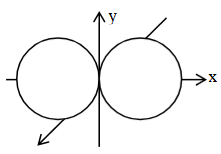
(B)Â

is the boundary diagram of the $$2p_x$$ orbital.
(C) The + and - signs in the wave function of the $$2p_x$$ orbital refer to charge.
(D) The wave function of $$2p_x$$ orbital is zero everywhere in the xy plane.
The type of hybridization and the magnetic property of $$[MnCl_6]^{3-}$$ are :
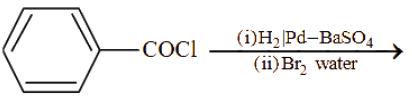
Consider the following reactions. From these reactions which reaction will give carboxylic acid as a major product ?
(A) $$R-C \equiv N \xrightarrow[\text{mild condition}]{(i) H^+/H_2O}$$
(B) $$R-MgX \xrightarrow[(ii) H_3O^+]{(i) CO_2}$$
(C) $$R-C \equiv N \xrightarrow[(ii) H_3O^+]{(i) SnCl_2/HCl}$$
(D) $$R-CH_2-OH \xrightarrow{PCC}$$
(E)Â

Choose the correct answer from the options given below :
Electronic configuration of four elements A, B, C and D are given below :
(A) $$1s^2 2s^2 2p^3$$
(B) $$1s^2 2s^2 2p^4$$
(C) $$1s^2 2s^2 2p^5$$
(D) $$1s^2 2s^2 2p^2$$
Which of the following is the correct order of increasing electronegativity (Pauling's scale) ?
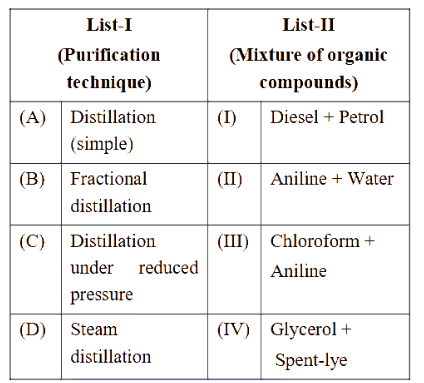
Match List-I with List-II.

Choose the correct answer from the options given below :
'x' g of NaCl is added to water in a beaker with a lid. The temperature of the system is raised from 1°C to 25°C. Which of the following plots, is best suited for the change in the molarity (M) of the solution with respect to temperature ?
[Consider the solubility of NaCl remains unchanged over the temperature range]
Arrange the following in order of magnitude of work done by the system / on the system at constant temperature :
(a) $$|w_{\text{reversible}}|$$ for expansion in infinite stage.
(b) $$|w_{\text{irreversible}}|$$ for expansion in single stage.
(c) $$|w_{\text{reversible}}|$$ for compression in infinite stage.
(d) $$|w_{\text{irreversible}}|$$ for compression in single stage.
Choose the correct answer from the options given below :
Reactant A converts to product D through the given mechanism (with the net evolution of heat) :
$$A \to B$$ Â slow ; $$\Delta H = +ve$$
$$B \to C$$ Â fast ; $$\Delta H = -ve$$
$$C \to D$$ Â fast ; $$\Delta H = -ve$$
Which of the following represents the above reaction mechanism ?
The nature of oxide $$(TeO_2)$$ and hydride $$(TeH_2)$$ formed by Te, respectively are :
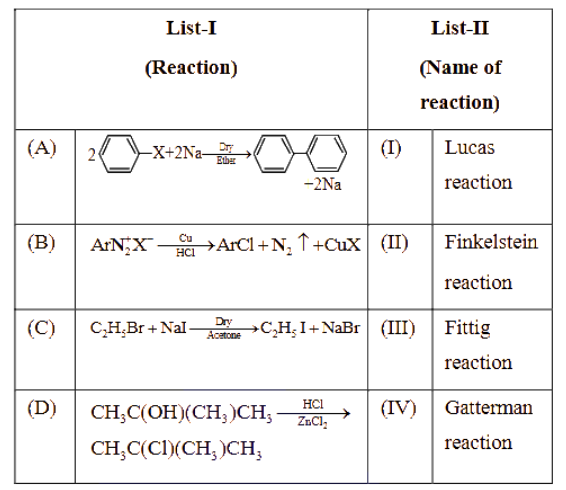
Match List-I with List-II.

Choose the correct answer from the options given below :
Consider the following chemical equilibrium of the gas phase reaction at a constant temperature :
$$A(g) \rightleftharpoons B(g) + C(g)$$
If p being the total pressure, $$K_p$$ is the pressure equilibrium constant and $$\alpha$$ is the degree of dissociation, then which of the following is true at equilibrium ?
Which of the following graphs correctly represents the variation of thermodynamic properties of Haber's process ?
A tetrapeptide "x" on complete hydrolysis produced glycine (Gly), alanine (Ala), valine (Val), leucine (Leu) in equimolar proportion each. The number of tetrapeptides (sequences) possible involving each of these amino acids is
In Dumas' method for estimation of nitrogen, 0.5 gram of an organic compound gave 60 mL of nitrogen collected at 300 K temperature and 715 mm Hg pressure. The percentage composition of nitrogen in the compound (Aqueous tension at 300 K = 15 mm Hg) is
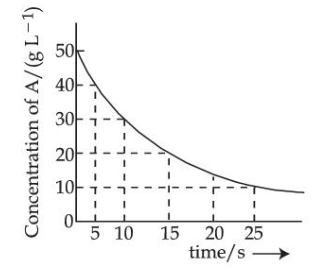
For the reaction $$A \to B$$ the following graph was obtained. The time required (in seconds) for the concentration of A to reduce to 2.5 g L$$^{-1}$$ (if the initial concentration of A was 50 g L$$^{-1}$$) is _________.
(Nearest integer)
Given : $$\log 2 = 0.3010$$
0.2 % (w/v) solution of NaOH is measured to have resistivity 870.0 m$$\Omega$$ m. The molar conductivity of the solution will be _________ $$\times 10^2$$ mS dm$$^2$$ mol$$^{-1}$$.
(Nearest integer)

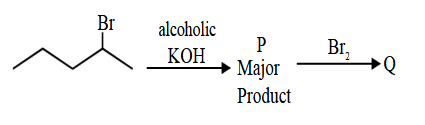
Consider the above sequence of reactions. 151 g of 2-bromopentane is made to react. Yield of major product P is 80% whereas Q is 100%.
Mass of product Q obtained is _________ g.
(Given molar mass in g mol$$^{-1}$$ H: 1, C: 12, O: 16, Br: 80)
When 1 g each of compounds AB and $$AB_2$$ are dissolved in 15 g of water separately, they increased the boiling point of water by 2.7 K and 1.5 K respectively. The atomic mass of A (in amu) is _________ $$\times 10^{-1}$$.
(Nearest integer)
(Given : Molal boiling point elevation constant is 0.5 K kg mol$$^{-1}$$)
The spin-only magnetic moment value of $$M^{n+}$$ ion formed among Ni, Zn, Mn and Cu that has the least enthalpy of atomisation is _________. (in nearest integer)
Here n is equal to the number of diamagnetic complexes among $$K_2[NiCl_4]$$, $$[Zn(H_2O)_6]Cl_2$$, $$K_3[Mn(CN)_6]$$ and $$[Cu(PPh_3)_3I]$$