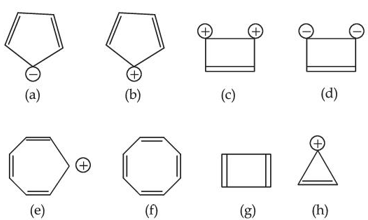
Designate whether each of the following compounds is aromatic or not aromatic.
Sign in
Please select an account to continue using cracku.in
↓ →

Join Our JEE Preparation Group
Prep with like-minded aspirants; Get access to free daily tests and study material.
Designate whether each of the following compounds is aromatic or not aromatic.
Login to view the detailed solution.
An optically active alkyl halide $$C_4H_9Br$$ [A] reacts with hot KOH dissolved in ethanol and forms alkene [B] as major product which reacts with bromine to give dibromide [C]. The compound [C] is converted into a gas [D] upon reacting with alcoholic NaNH$$_2$$. During hydration 18 gram of water is added to 1 mole of gas [D] on warming with mercuric sulphate and dilute acid at 333 K to form compound [E]. The IUPAC name of compound [E] is:
Login to view the detailed solution.
The property/properties that show irregularity in first four elements of group-17 is/are:
(A) Covalent radius
(B) Electron affinity
(C) Ionic radius
(D) First ionization energy
Choose the correct answer from the options given below:
Login to view the detailed solution.
.webp)
Which of the following graph correctly represents the plots of $$K_H$$ at 1 bar gases in water versus temperature?
Login to view the detailed solution.
According to Bohr's model of hydrogen atom, which of the following statement is incorrect?
Login to view the detailed solution.
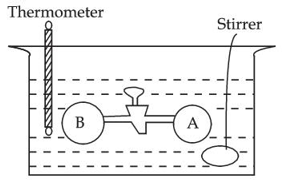
Two vessels A and B are connected via stopcock. The vessel A is filled with a gas at a certain pressure. The entire assembly is immersed in water and is allowed to come to thermal equilibrium with water. After opening the stopcock the gas from vessel A expands into vessel B and no change in temperature is observed in the thermometer. Which of the following statement is true?
Login to view the detailed solution.
.webp)
A solution is made by mixing one mole of volatile liquid A with 3 moles of volatile liquid B. The vapour pressure of pure A is 200 mm Hg and that of the solution is 500 mm Hg. The vapour pressure of pure B and the least volatile component of the solution, respectively, are:
Login to view the detailed solution.
$$CaCO_3(s) + 2HCl(aq) \rightarrow CaCl_2(aq) + CO_2(g) + H_2O(l)$$
Consider the above reaction, what mass of $$CaCl_2$$ will be formed if 250 mL of 0.76 M HCl reacts with 1000 g of $$CaCO_3$$?
(Given: Molar mass of Ca, C, O, H and Cl are 40, 12, 16, 1 and 35.5 g mol$$^{-1}$$, respectively)
Login to view the detailed solution.
If equal volumes of $$AB_2$$ and XY (both are salts) aqueous solutions are mixed, which of the following combination will give a precipitate of $$AY_2$$ at 300 K?
(Given $$K_{sp}$$ (at 300 K) for $$AY_2 = 5.2 \times 10^{-7}$$)
Login to view the detailed solution.
.webp)
Among $$SO_2$$, $$NF_3$$, $$NH_3$$, $$XeF_2$$, $$ClF_3$$ and $$SF_4$$, the hybridization of the molecule with non-zero dipole moment and highest number of lone pairs of electrons on the central atom is:
Login to view the detailed solution.
Given below are two statements:
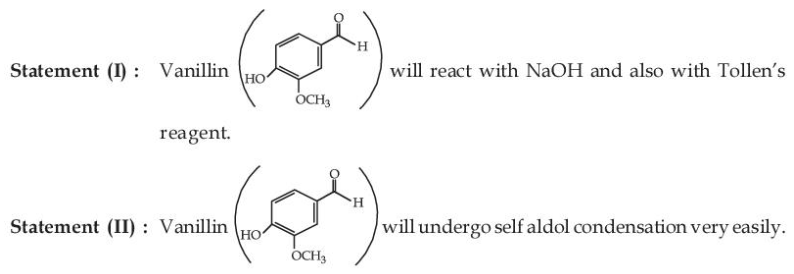
In the light of the above statements, choose the most appropriate answer from the options given below:
Login to view the detailed solution.
Identify the correct statement among the following:
Login to view the detailed solution.
.webp)
The correct order of basic nature on aqueous solution for the bases $$NH_3$$, $$H_2N-NH_2$$, $$CH_3CH_2NH_2$$, $$(CH_3CH_2)_2NH$$ and $$(CH_3CH_2)_3N$$ is:
Login to view the detailed solution.
Given below are two statements:
Statement (I): The metallic radius of Al is less than that of Ga.
Statement (II): The ionic radius of Al$$^{3+}$$ is less than that of Ga$$^{3+}$$.
In the light of the above statements, choose the most appropriate answer from the options given below:
Login to view the detailed solution.
Given below are two statements:
Statement (I): In octahedral complexes, when $$\Delta_o \lt P$$ high spin complexes are formed. When $$\Delta_o \gt P$$ low spin complexes are formed.
Statement (II): In tetrahedral complexes because of $$\Delta_t \lt P$$, low spin complexes are rarely formed.
In the light of the above statements, choose the most appropriate answer from the options given below:
Login to view the detailed solution.

Choose the correct tests with respective observations.
(A) $$CuSO_4$$ (acidified with acetic acid) + $$K_4[Fe(CN)_6]$$ $$\rightarrow$$ Chocolate brown precipitate.
(B) $$FeCl_3 + K_4[Fe(CN)_6]$$ $$\rightarrow$$ Prussian blue precipitate.
(C) $$ZnCl_2 + K_4[Fe(CN)_6]$$, neutralised with $$NH_4OH$$ $$\rightarrow$$ White or bluish white precipitate.
(D) $$MgCl_2 + K_4[Fe(CN)_6]$$ $$\rightarrow$$ Blue precipitate.
(E) $$BaCl_2 + K_4[Fe(CN)_6]$$, neutralised with NaOH $$\rightarrow$$ White precipitate.
Choose the correct answer from the options given below:
Login to view the detailed solution.
On complete combustion 1.0 g of an organic compound (X) gave 1.46 g of $$CO_2$$ and 0.567 g of $$H_2O$$. The empirical formula mass of compound (X) is ________ g.
(Given molar mass in g mol$$^{-1}$$ C: 12, H: 1, O: 16)
Login to view the detailed solution.
Consider the following compound (X):
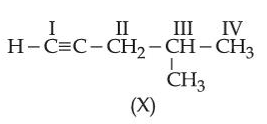
The most stable and least stable carbon radicals, respectively, produced by homolytic cleavage of corresponding C-H bond are:
Login to view the detailed solution.
_1.webp)
Consider the following molecules:
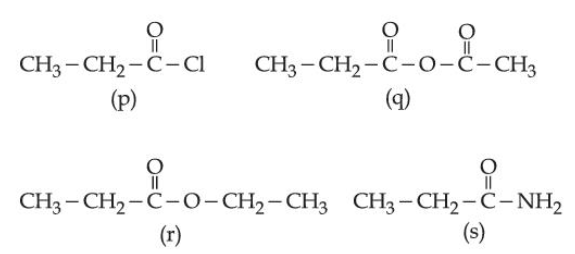
The correct order of rate of hydrolysis is:
Login to view the detailed solution.
A molecule with the formula $$AX_4Y$$ has all its elements from p-block. Element $$A$$ is rarest, monoatomic, non-radioactive from its group and has the lowest ionization enthalpy value among$$ A, X$$ and $$Y$$. Elements $$X$$ and $$Y$$ have first and second highest electronegativity values respectively among all the known elements. The shape of the molecule is:
Login to view the detailed solution.
A transition metal $$(M)$$ among $$Mn, Cr, Co$$ and $$Fe$$ has the highest standard electrode potential ($$M^{3+}/M^{2+}$$). It forms a metal complex of the type $$[M(CN)_6]^{4-}$$. The number of electrons present in the $$e_g$$ orbital of the complex is ______.
Login to view the detailed solution.
Consider the following electrochemical cell at standard condition.
$$Au(s)|QH_2,Q|NH_4X(0.01M)||Ag^+(1M)|Ag(s)$$
$$E_{cell} = +0.4V$$
The couple $$QH_2/Q$$ represents quinhydrone electrode, the half cell reaction is given below:
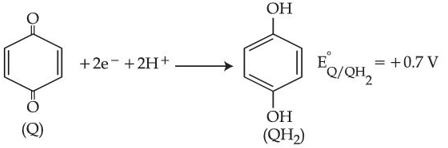
[Given: $$E^o_{Ag^+/Ag} = +0.8V$$ and $$\frac{2.303RT}{F} = 0.06V$$]
The $$pK_b$$ value of the ammonium halide salt ($$NH_4X$$) used here is ______. (nearest integer)
Login to view the detailed solution.
0.1 mol of the following given antiviral compound (P) will weigh _______ $$\times 10^{-1}$$ g.
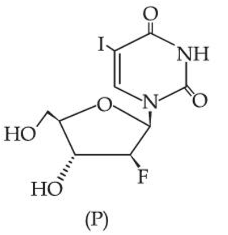
(Given: molar mass in g mol$$^{-1}$$ H: 1, C: 12, N: 14, O: 16, F: 19, I: 127)
Login to view the detailed solution.
Consider the following equilibrium,
$$CO(g) + 2H_2(g) \rightleftharpoons CH_3OH(g)$$
0.1 mol of CO along with a catalyst is present in a 2 dm$$^3$$ flask maintained at 500 K. Hydrogen is introduced into the flask until the pressure is 5 bar and 0.04 mol of $$CH_3OH$$ is formed. The $$K_p^0$$ is _______ $$\times 10^{-3}$$. (nearest integer)
Given $$R = 0.08$$ dm$$^3$$ bar K$$^{-1}$$ mol$$^{-1}$$
Assume only methanol is formed as the product and the system follows ideal gas behaviour.
Login to view the detailed solution.
For the reaction $$A \rightarrow$$ products.
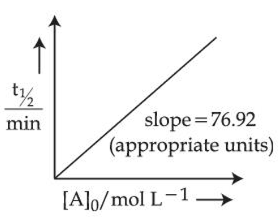
The concentration of A at 10 minutes is _______ $$\times 10^{-3}$$ mol L$$^{-1}$$. (nearest integer).
The reaction was started with 2.5 mol L$$^{-1}$$ of A.
Login to view the detailed solution.
Educational materials for JEE preparation
 Share
Share

