The number of subshells associated with $$n = 4$$ and $$m = -2$$ quantum numbers is:

Join Our JEE Preparation Group
Prep with like-minded aspirants; Get access to free daily tests and study material.
Sign in
Please select an account to continue using cracku.in
↓ →
Join Our JEE Preparation Group
Prep with like-minded aspirants; Get access to free daily tests and study material.
The number of subshells associated with $$n = 4$$ and $$m = -2$$ quantum numbers is:
Login to view the detailed solution.
Three elements X, Y and Z are in the 3$$^{rd}$$ period of the periodic table. The oxides of X, Y and Z, respectively, are basic, amphoteric and acidic. The correct order of the atomic numbers of X, Y and Z is:
Login to view the detailed solution.
The shape/structure of $$[XeF_5]^-$$ and $$XeO_3F_2$$, respectively are:
Login to view the detailed solution.
.webp)
Match the type of interaction in column A with the distance dependence of their interaction energy in column B:
A B
(i) ion - ion (a) $$\frac{1}{r}$$
(ii) Dipole - dipole (b) $$\frac{1}{r^2}$$
(iii) London dispersion (c) $$\frac{1}{r^3}$$
(iv) $$\frac{1}{r^6}$$
Login to view the detailed solution.
The molecular geometry of $$SF_6$$ is octahedral. What is the geometry of $$SF_4$$ (including lone pair(s) of electrons, if any)?
Login to view the detailed solution.
Two elements A and B have similar chemical properties. They don't form solid hydrogencarbonates, but react with nitrogen to form nitrides. A and B, respectively, are:
Login to view the detailed solution.
.webp)
Arrange the following labelled hydrogens in decreasing order of acidity:
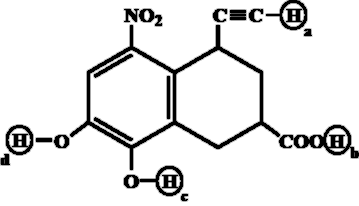
Login to view the detailed solution.
An organic compound 'A' $$(C_9H_{10}O)$$ when treated with conc. HI undergoes cleavage to yield compound 'B' and 'C'. 'B' gives yellow precipitate with $$AgNO_3$$ where as 'C' tautomerizes to 'D'. 'D' gives positive iodoform test. 'A' could be:
Login to view the detailed solution.
The major product of the following reaction is:
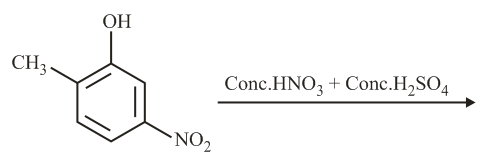
.webp)
The size of a raw mango shrinks to a much smaller size when kept in a concentrated salt solution. Which one of the following process can explain this?
Login to view the detailed solution.
The results given in the below table were obtained during kinetic studies of the following reaction:
$$2A + B \to C + D$$
| Experiment | [A]/mol L$$^{-1}$$ | [B]/mol L$$^{-1}$$ | Initial rate/mol L$$^{-1}$$ min$$^{-1}$$ |
|---|---|---|---|
| I | 0.1 | 0.1 | $$6.00 \times 10^{-3}$$ |
| II | 0.1 | 0.2 | $$2.40 \times 10^{-2}$$ |
| III | 0.2 | 0.1 | $$1.20 \times 10^{-2}$$ |
| IV | X | 0.2 | $$7.20 \times 10^{-2}$$ |
| V | 0.3 | Y | $$2.88 \times 10^{-1}$$ |
X and Y in the given table are respectively:
Login to view the detailed solution.
Amongst the following statements regarding adsorption, those that are valid are:
(a) $$\Delta H$$ becomes less negative as adsorption proceeds.
(b) On a given adsorbent, ammonia is adsorbed more than nitrogen gas.
(c) On adsorption, the residual force acting along the surface of the adsorbent increases
(d) With increase in temperature, the equilibrium concentration of adsorbate increases.
Login to view the detailed solution.
.webp)
Cast iron is used for the manufacture of:
Login to view the detailed solution.
Simplified absorption spectra of three complexes ((i) and (ii) and (iii)) of $$M^{+n}$$ ion are provided below; their $$\lambda_{max}$$ values are marked as A, B and C respectively. The correct match between the complexes and their $$\lambda_{max}$$ values is: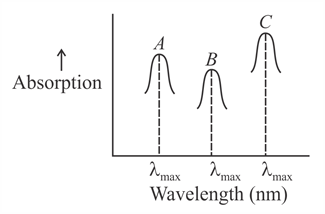
(i) $$[M(NCS)_6]^{(-6+n)}$$
(ii) $$[MF_6]^{(-6+n)}$$
(iii) $$[M(NH_3)_6]^{n+}$$
The one that is not expected to show isomerism is:
Login to view the detailed solution.

The major product obtained from $$E_2$$-elimination of 3-bromo-2-fluoropentane is:
Consider the reaction sequence given below:
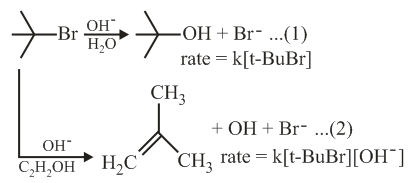
Which of the following statements is true:
Login to view the detailed solution.
Two compounds A and B with same molecular formula $$(C_3H_6O)$$ undergo Grignard reaction with methylmagnesium bromide to give products C and D. Products C and D show following chemical tests:
| Test | C | D |
|---|---|---|
| Ceric ammonium nitrate Test | Positive | Positive |
| Lucas Test | Turbidity obtained after five minutes | Turbidity obtained Immediately |
| Iodoform Test | Positive | Negative |
C and D respectively are:
Login to view the detailed solution.
_1.webp)
If you spill a chemical toilet cleaning liquid on your hand, your first aid would be:
Login to view the detailed solution.
The correct observation in the following reaction is:
$$Sucrose \xrightarrow[Cleavage \; (Hydrolysis)]{Glycosidic \; bond \; } A + B \xrightarrow[ Reagent]{Seliwanoff } ?$$
Login to view the detailed solution.
The ratio of the mass percentages of 'C & H' and 'C & O' of a saturated acyclic organic compound 'X' are 4 : 1 and 3 : 4 respectively. Then, the moles of oxygen gas required for complete combustion of two moles of organic compound 'X' is ___________.
Login to view the detailed solution.
The work function of sodium metal is $$4.41 \times 10^{-19}$$ J. If photons of wavelength 300 nm are incident on the metal, the kinetics energy of the ejected electrons will be $$(h = 6.63 \times 10^{-34}$$ J s; $$c = 3 \times 10^8$$ m s$$^{-1})$$ ___________ $$\times 10^{-21}$$ J.
Login to view the detailed solution.
The heat of combustion of ethanol into carbon dioxides and water is $$-327$$ Kcal at constant pressure. The heat evolved (in cal) at constant volume at 27$$°$$C (if all gases behave ideally) is $$(R = 2$$ cal mol$$^{-1}$$ K$$^{-1})$$ ___________.
Login to view the detailed solution.
The oxidation states of transition metal atoms in $$K_2Cr_2O_7$$, $$KMnO_4$$ and $$K_2FeO_4$$, respectively, are x, y and z. The sum of x, y and z is ___________.
Login to view the detailed solution.
For the disproportionation reaction $$2Cu^+(aq) \rightleftharpoons Cu(s) + Cu^{2+}(aq)$$ at 298K, ln K (where K is the equilibrium constant) is ___________ $$\times 10^{-1}$$.
Given: $$(E^°_{Cu^{2+}/Cu^+} = 0.16V, E^°_{Cu^+/Cu} = 0.52V, \frac{RT}{F} = 0.025)$$
Login to view the detailed solution.
Educational materials for JEE preparation
 Share
Share

