NTA JEE Main 2nd September 2020 Shift 1
For the following questions answer them individually
NTA JEE Main 2nd September 2020 Shift 1 - Question 11
Two identical strings X and Z made of same material have tension $$T_X$$ and $$T_Z$$ in them. If their fundamental frequencies are 450 Hz and 300 Hz, respectively, then the ratio $$T_X/T_Z$$ is:
NTA JEE Main 2nd September 2020 Shift 1 - Question 12
Consider four conducting materials copper, tungsten, mercury and aluminium with resistivity $$\rho_C$$, $$\rho_T$$, $$\rho_M$$ and $$\rho_A$$ respectively. Then:
NTA JEE Main 2nd September 2020 Shift 1 - Question 13
A beam of protons with speed $$4 \times 10^5$$ m s$$^{-1}$$ enters a uniform magnetic field of 0.3 T at an angle of 60$$°$$ to the magnetic field, the pitch of the resulting helical path of protons is close to: (Mass of the proton $$= 1.67 \times 10^{-27}$$ kg, charge of the proton $$= 1.69 \times 10^{-19}$$ C)

NTA JEE Main 2nd September 2020 Shift 1 - Question 14
A charged particle (mass m and charge q) moves along X axis with velocity $$V_0$$. When it passes through the origin it enters a region having uniform electric field $$\vec{E} = -E\hat{j}$$ which extends upto $$x = d$$. Equation of path of electron in the region $$x > d$$ is: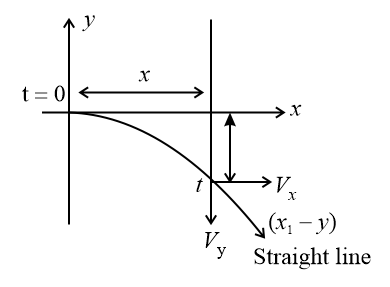
NTA JEE Main 2nd September 2020 Shift 1 - Question 15
Magnetic materials used for making permanent magnets (P) and magnets in a transformer (T) have different properties of the following, which property best matches for the type of magnet required?
NTA JEE Main 2nd September 2020 Shift 1 - Question 16
A plane electromagnetic wave, has frequency of $$2.0 \times 10^{10}$$ Hz and its energy density is $$1.02 \times 10^{-8}$$ J m$$^{-3}$$ in vacuum. The amplitude of the magnetic field of the wave is close to $$\left(\frac{1}{4\pi\epsilon_0} = 9 \times 10^9 \frac{Nm^2}{C^2}\right)$$ and speed of light $$= 3 \times 10^8$$ m s$$^{-1}$$.
NTA JEE Main 2nd September 2020 Shift 1 - Question 17
A spherical mirror is obtained as shown in the figure from a hollow glass sphere, if an object is positioned in front of the mirror, what will be the nature and magnification of the image of the object? (Figure down as schematic and not to scale)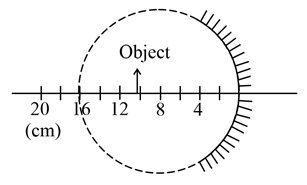
NTA JEE Main 2nd September 2020 Shift 1 - Question 18
Interference fringes are observed on a screen by illuminating two thin slits 1 mm apart with a light source $$(\lambda = 632.8 \; nm)$$. The distance between the screen and the slits is 100 cm. If a bright fringe is observed on a screen at distance of 1.27 mm from the central bright fringe, then the path difference between the waves, which are reaching this point from the slits is close to:
NTA JEE Main 2nd September 2020 Shift 1 - Question 19
An amplitude modulated wave is represented by expression $$v_m = 5(1 + 0.6\cos 6280t)\sin(211 \times 10^4 t)$$ V. The minimum and maximum amplitudes of the amplitude modulated wave are, respectively:
NTA JEE Main 2nd September 2020 Shift 1 - Question 20
The least count of the main scale of a vernier calipers is 1 mm. Its vernier scale is divided into 10 divisions and coincide with 9 divisions of the main scale. When jaws are touching each other, the 7$$^{th}$$ division of the vernier scale coincides with a division of the main scale and the zero of vernier scale is lying right side of the zero of the main scale. When this vernier is used to measure the length of the cylinder the zero of the vernier scale between 3.1 cm and 3.2 cm and 4$$^{th}$$ VSD coincides with the main scale division. The length of the cylinder is (VSD is vernier scale division):