The figure that is not a direct manifestation of the quantum nature of atom is:

Join Our JEE Preparation Group
Prep with like-minded aspirants; Get access to free daily tests and study material.
Sign in
Please select an account to continue using cracku.in
↓ →
Join Our JEE Preparation Group
Prep with like-minded aspirants; Get access to free daily tests and study material.
The figure that is not a direct manifestation of the quantum nature of atom is:
Login to view the detailed solution.
In general, the property (magnitudes only) that shows an opposite trend in comparison to other properties across a period is:
Login to view the detailed solution.
If $$AB_4$$ molecule is a polar molecule, a possible geometry of $$AB_4$$ is:
Login to view the detailed solution.
.webp)
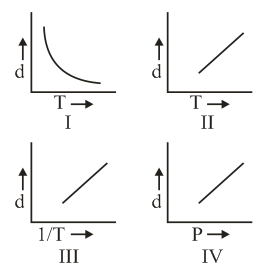
Which one of the following graphs is not correct for ideal gas?
d = Density, P = Pressure, T = Temperature
Login to view the detailed solution.
For the following Assertion and Reason, the correct option is:
Assertion (A): When Cu (II) and sulphide ions are mixed, they react together extremely quickly to give a solid.
Reason (R): The equilibrium constant of $$Cu^{2+}(aq) + S^{2-}(aq) \rightleftharpoons CuS(s)$$ is high because the solubility product is low.
Login to view the detailed solution.
An open beaker of water in equilibrium with water vapour is in a sealed container. When a few grams of glucose are added to the beaker of water, the rate at which water molecules:
Login to view the detailed solution.
.webp)
While titration dilute HCl solution with aqueous NaOH, which of the following will not be required?
Login to view the detailed solution.
The metal mainly used in devising photoelectric cells is:
Login to view the detailed solution.
On heating compound (A) gives a gas (B) which is constituent of air. This gas when treated with $$H_2$$ in the presence of a catalyst gives another gas (C) which is basic in nature. (A) should not be:
Login to view the detailed solution.
.webp)
In Carius method of estimation of halogen, 0.172 g of an organic compound showed presence of 0.08 g of bromine. Which of these is the correct structure of the compound?
Login to view the detailed solution.
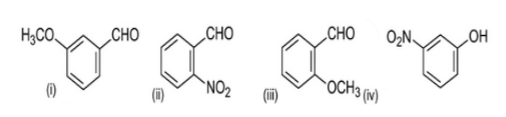
The increasing order of the following compounds towards HCN addition is:
Login to view the detailed solution.
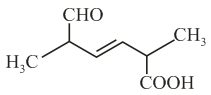
The IUPAC name for the following compound is:
Login to view the detailed solution.
.webp)
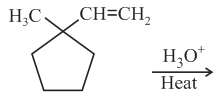
The major product in the following reaction is:
Login to view the detailed solution.
The statement that is not true about ozone is:
Login to view the detailed solution.
Which of the following is used for the preparation of colloids?
Login to view the detailed solution.

Consider that $$d^6$$ metal ion $$(M^{2+})$$ forms a complex with aqua ligands, and the spin only magnetic moment of the complex is 4.90 BM. The geometry and the crystal field stabilization energy of the complex is:
Login to view the detailed solution.
For octahedral Mn(II) and tetrahedral Ni(II) complexes, consider the following statements:
(I) both the complexes can be high spin.
(II) Ni(II) complex can very rarely be of low spin.
(III) with strong field ligands, Mn(II) complexes can be low spin.
(IV) aqueous solution of Mn(II) ions is yellow in color.
The correct statements are:
Login to view the detailed solution.
Which of the following compounds will show retention in configuration on nucleophilic substitution by $$OH^-$$ ion?
Login to view the detailed solution.
_1.webp)
The major aromatic product C in the following reaction sequence will be:

Login to view the detailed solution.
Consider the following reactions:
(i) Glucose + ROH $$\xrightarrow{dry \; HCl}$$ Acetal $$\xrightarrow{x \; eq. \; of \; (CH_3CO)_2O}$$ acetyl derivative
(ii) Glucose $$\xrightarrow{Ni/H_2}$$ A $$\xrightarrow{y \; eq. \; of \; (CH_3CO)_2O}$$ acetyl derivative
(iii) Glucose $$\xrightarrow{z \; eq. \; of \; (CH_3CO)_2O}$$ acetyl derivative
'x', 'y' and 'z' in these reactions are respectively:
Login to view the detailed solution.
The Gibbs energy change (in J) for the given reaction at $$[Cu^{2+}] = [Sn^{2+}] = 1$$ M and 298 K is:
$$Cu(s) + Sn^{2+}(aq.) \to Cu^{2+}(aq.) + Sn(s)$$;
$$(E^0_{Sn^{2+}|Sn} = -0.16 \; V, E^0_{Cu^{2+}|Cu} = 0.34 \; V, \text{Take } F = 96500 \; C \; mol^{-1})$$
Login to view the detailed solution.
The internal energy change (in J) when 90 g of water undergoes complete evaporation at 100$$°$$C is ___________.
(Given: $$\Delta H_{vap}$$ for water at 373 K $$= 41$$ kJ/mol, R $$= 8.314$$ J K$$^{-1}$$ mol$$^{-1}$$)
Login to view the detailed solution.
The number of chiral carbons present in the molecule given below is ___________.
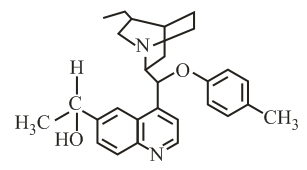
Login to view the detailed solution.
The mass of gas adsorbed, x, per unit mass of adsorbate, m, was measured at various pressures, p. A graph between $$\log \frac{x}{m}$$ and $$\log p$$ gives a straight line with slope equal to 2 and the intercept equal to 0.4771. The value of $$\frac{x}{m}$$ at a pressure of 4 atm is:
(Given $$\log 3 = 0.4771$$)
Login to view the detailed solution.
The oxidation states of iron atoms in compounds (A), (B) and (C), respectively, are x, y and z. Then sum of x, y and z is ___________.
(A) $$Na_4[Fe(CN)_5(NOS)]$$ (B) $$Na_4[FeO_4]$$ (C) $$[Fe_2(CO)_9]$$
Login to view the detailed solution.
Educational materials for JEE preparation
 Share
Share