NTA JEE Main 17th March 2021 Shift 2
For the following questions answer them individually
NTA JEE Main 17th March 2021 Shift 2 - Question 21
A body of mass 1 kg rests on a horizontal floor with which it has a coefficient of static friction $$\frac{1}{\sqrt{3}}$$. It is desired to make the body move by applying the minimum possible force $$F$$ N. The value of $$F$$ will be ________. (Round off to the Nearest Integer) [Take $$g = 10$$ m s$$^{-2}$$]
789
456
123
0.-
Clear All
NTA JEE Main 17th March 2021 Shift 2 - Question 22
A boy of mass 4 kg is standing on a piece of wood having mass 5 kg. If the coefficient of friction between the wood and the floor is 0.5, the maximum force that the boy can exert on the rope so that the piece of wood does not move from its place is ________ N. (Round off to the Nearest Integer) [Take $$g = 10$$ m s$$^{-2}$$]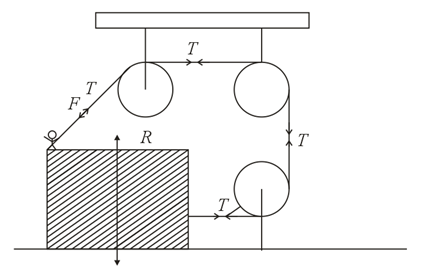
789
456
123
0.-
Clear All
NTA JEE Main 17th March 2021 Shift 2 - Question 23
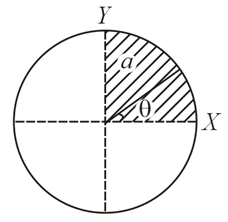
The disc of mass $$M$$ with uniform surface mass density $$\sigma$$ is shown in the figure. The center of mass of the quarter disc (the shaded area) is at the position $$\left(\frac{xa}{3\pi}, \frac{xa}{3\pi}\right)$$ where $$x$$ is ________. (Round off to the Nearest Integer) [$$a$$ is an area as shown in the figure]
789
456
123
0.-
Clear All

NTA JEE Main 17th March 2021 Shift 2 - Question 24
Suppose you have taken a dilute solution of oleic acid in such a way that its concentration becomes 0.01 cm$$^3$$ of oleic acid per cm$$^3$$ of the solution. Then you make a thin film of this solution (monomolecular thickness) of area 4 cm$$^2$$ by considering 100 spherical drops of radius $$\left(\frac{3}{40\pi}\right)^{1/3} \times 10^{-3}$$ cm. Then the thickness of oleic acid layer will be $$x \times 10^{-14}$$ m. Where $$x$$ is ________.
789
456
123
0.-
Clear All
NTA JEE Main 17th March 2021 Shift 2 - Question 25
The electric field intensity produced by the radiation coming from a 100 W bulb at a distance of 3 m is $$E$$. The electric field intensity produced by the radiation coming from 60 W at the same distance is $$\sqrt{\frac{x}{5}}E$$. Where the value of $$x$$ is ________.
789
456
123
0.-
Clear All
NTA JEE Main 17th March 2021 Shift 2 - Question 26
The electric field in a region is given by $$\vec{E} = \frac{2}{5}E_0\hat{i} + \frac{3}{5}E_0\hat{j}$$ with $$E_0 = 4.0 \times 10^3$$ N C$$^{-1}$$. The flux of this field through a rectangular surface, area 0.4 m$$^2$$ parallel to the $$Y-Z$$ plane is ________ N m$$^2$$ C$$^{-1}$$.
789
456
123
0.-
Clear All
NTA JEE Main 17th March 2021 Shift 2 - Question 27
A 2$$\mu$$F capacitor $$C_1$$ is first charged to a potential difference of 10 V using a battery. Then the battery is removed and the capacitor is connected to an uncharged capacitor $$C_2$$ of 8$$\mu$$F. The charge in $$C_2$$ on equilibrium condition is ________ $$\mu$$C. (Round off to the Nearest Integer)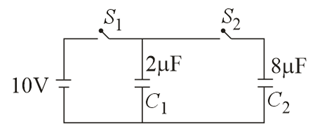
789
456
123
0.-
Clear All
NTA JEE Main 17th March 2021 Shift 2 - Question 28
Seawater at a frequency $$f = 9 \times 10^2$$ Hz, has permittivity $$\varepsilon = 80\varepsilon_0$$ and resistivity $$\rho = 0.25$$ $$\Omega$$ m. Imagine a parallel plate capacitor is immersed in seawater and is driven by an alternating voltage source $$V(t) = V_0 \sin(2\pi ft)$$. Then the conduction current density becomes $$10^x$$ times the displacement current density after time $$t = \frac{1}{800}$$ s. The value of $$x$$ is ________. (Given: $$\frac{1}{4\pi\varepsilon_0} = 9 \times 10^9$$ N m$$^2$$ C$$^{-2}$$)
789
456
123
0.-
Clear All
NTA JEE Main 17th March 2021 Shift 2 - Question 29
The image of an object placed in air formed by a convex refracting surface is at a distance of 10 m behind the surface. The image is real and is at $$\frac{2rd}{3}$$ of the distance of the object from the surface. The wavelength of light inside the surface is $$\frac{2}{3}$$ times the wavelength in air. The radius of the curved surface is $$\frac{x}{13}$$ m, the value of $$x$$ is ________.
789
456
123
0.-
Clear All
NTA JEE Main 17th March 2021 Shift 2 - Question 30
A particle of mass $$m$$ moves in a circular orbit in a central potential field $$U(r) = U_0 r^4$$. If Bohr's quantization conditions are applied, radii of possible orbitals $$r_n$$ vary with $$n^{1/\alpha}$$, where $$\alpha$$ is ________.
789
456
123
0.-
Clear All