Amongst the following, the linear species is:

Join Our JEE Preparation Group
Prep with like-minded aspirants; Get access to free daily tests and study material.
Sign in
Please select an account to continue using cracku.in
↓ →
Join Our JEE Preparation Group
Prep with like-minded aspirants; Get access to free daily tests and study material.
Amongst the following, the linear species is:
Login to view the detailed solution.
During which of the following processes, does entropy decrease?
(A) Freezing of water to ice at 0°C
(B) Freezing of water to ice at -10°C
(C) N$$_2$$(g) + 3H$$_2$$(g) $$\to$$ 2NH$$_3$$(g)
(D) Adsorption of CO(g) and lead surface
(E) Dissolution of NaCl in water
Login to view the detailed solution.
The functional groups that are responsible for the ion-exchange property of cation and anion exchange resins, respectively, are:
Login to view the detailed solution.
.webp)
The set of elements that differ in mutual relationship from those of the other sets is:
Login to view the detailed solution.
One of the by-products formed during the recovery of NH$$_3$$ from Solvay process is:
Login to view the detailed solution.
The correct pair(s) of the ambident nucleophiles is (are):
(A) AgCN / KCN
(B) RCOOAg / RCOOK
(C) AgNO$$_2$$ / KNO$$_2$$
(D) AgI / KI
Login to view the detailed solution.
.webp)
Nitrogen can be estimated by Kjeldahl's method for which of the following compound?
Login to view the detailed solution.
Given below are two statements:
Statement-I: 2-methylbutane on oxidation with KMnO$$_4$$ gives 2-methylbutan-2-ol.
Statement-II: n-alkanes can be easily oxidised to corresponding alcohol with KMnO$$_4$$.
Choose the correct option:
Login to view the detailed solution.
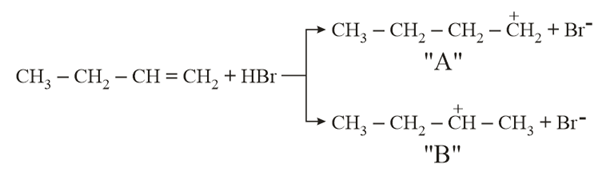
Choose the correct statement regarding the formation of carbocations A and B given:
Login to view the detailed solution.
.webp)
Which of the following statement(s) is (are) incorrect reason for eutrophication?
(A) excess usage of fertilisers
(B) excess usage of detergents
(C) dense plant population in water bodies
(D) lack of nutrients in water bodies that prevent plant growth
Choose the most appropriate answer from the options given below:
Login to view the detailed solution.
For the coagulation of a negative sol, the species below, that has the highest flocculating power is:
Login to view the detailed solution.
Match List-I and List-II:
List-I List-II
a. Haematite i. Al$$_2$$O$$_3$$ . xH$$_2$$O
b. Bauxite ii. Fe$$_2$$O$$_3$$
c. Magnetite iii. CuCO$$_3$$ . Cu(OH)$$_2$$
d. Malachite iv. Fe$$_3$$O$$_4$$
Choose the correct answer from the options given below:
Login to view the detailed solution.
.webp)
The set that represents the pair of neutral oxides of nitrogen is:
Login to view the detailed solution.
The common positive oxidation states for an element with atomic number 24, are:
Login to view the detailed solution.
Match List-I with List-II:
List-I List-II
a. [Co(NH$$_3$$)$$_6$$][Cr(CN)$$_6$$] i. Linkage isomerism
b. [Co(NH$$_3$$)$$_3$$(NO$$_2$$)$$_3$$] ii. Solvate isomerism
c. [Cr(H$$_2$$O)$$_6$$]Cl$$_3$$ iii. Co-ordination isomerism
d. $$cis$$-[CrCl$$_2$$(ox)$$_2$$]$$^{3-}$$ iv. Optical isomerism
Choose the correct answer from the options given below:
Login to view the detailed solution.

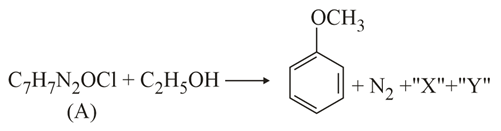
In the above reaction, the structural formula of (A), "X" and "Y" respectively are:
Login to view the detailed solution.
Primary, secondary and tertiary amines can be separated using:
Login to view the detailed solution.
Match List-I with List-II:
List-I (Chemical Compound) List-II (Used as)
a. Sucralose i. Synthetic detergent
b. Glyceryl ester of stearic acid ii. Artificial sweetener
c. Sodium benzoate iii. Antiseptic
d. Bithional iv. Food preservative
Choose the correct match:
Login to view the detailed solution.
_1.webp)
Fructose is an example of:
Login to view the detailed solution.
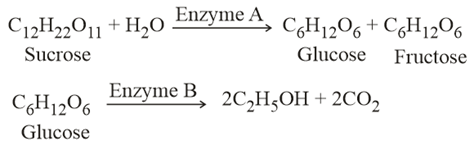
In the above reactions, the enzyme A and enzyme B respectively are:
Login to view the detailed solution.
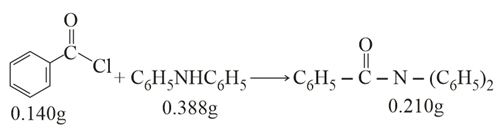
Consider the above reaction. The percentage yield of amide product is ________ (Round off to the Nearest Integer).
(Given: Atomic mass: C: 12.0u, H: 1.0u, N: 14.0u, O: 16.0u, Cl: 35.5u)
Login to view the detailed solution.
The number of chlorine atoms in 20 mL of chlorine gas at STP is ________ $$\times 10^{21}$$. (Round off to the Nearest Integer).
[Assume chlorine is an ideal gas at STP. R = 0.083 L bar mol$$^{-1}$$ K$$^{-1}$$, $$N_A = 6.023 \times 10^{23}$$]
Login to view the detailed solution.
Consider the reaction $$N_2O_4(g) \rightleftharpoons 2NO_2(g)$$. The temperature at which $$K_C = 20.4$$ and $$K_P = 600.1$$, is ________ K. (Round off to the Nearest Integer). [Assume all gases are ideal and R = 0.0831 L bar K$$^{-1}$$ mol$$^{-1}$$]
Login to view the detailed solution.
The total number of C-C sigma bond/s in mesityl oxide ($$C_6H_{10}O$$) is ________ (Round off to the Nearest Integer).
Login to view the detailed solution.
KBr is doped with $$10^{-5}$$ mole percent of SrBr$$_2$$. The number of cationic vacancies in 1 g of KBr crystal is $$10^{14}$$ ________. (Round off to the Nearest Integer). [Atomic Mass: K: 39.1u, Br: 79.9u, $$N_A = 6.023 \times 10^{23}$$]
Login to view the detailed solution.
A 1 molal $$K_4Fe(CN)_6$$ solution has a degree of dissociation of 0.4. Its boiling point is equal to that of another solution which contains 18.1 weight percent of a non electrolytic solute A. The molar mass of A is ________ u. (Round off to the Nearest Integer). [Density of water = 1.0 g cm$$^{-3}$$]
Login to view the detailed solution.
A KCl solution of conductivity 0.14 S m$$^{-1}$$ shows a resistance of 4.19$$\Omega$$ in a conductivity cell. If the same cell is filled with an HCl solution, the resistance drops to 1.03$$\Omega$$. The conductivity of the HCl solution is ________ $$\times 10^{-2}$$ S m$$^{-1}$$. (Round off to the Nearest Integer).
Login to view the detailed solution.
The reaction $$2A + B_2 \to 2AB$$ is an elementary reaction. For a certain quantity of reactants, if the volume of the reaction vessel is reduced by a factor of 3, the rate of the reaction increases by a factor of ________. (Round off to the Nearest Integer).
Login to view the detailed solution.
In the ground state of atomic Fe (Z = 26), the spin-only magnetic moment is ________ $$\times 10^{-1}$$ BM. (Round off to the Nearest Integer).
[Given: $$\sqrt{3} = 1.73, \sqrt{2} = 1.41$$]
Login to view the detailed solution.
On complete reaction of FeCl$$_3$$ with oxalic acid in aqueous solution containing KOH, resulted in the formation of product A. The secondary valency of Fe in the product A is ________. (Round off to the Nearest Integer).
Login to view the detailed solution.
Educational materials for JEE preparation
 Share
Share

