NTA JEE Main 16th March 2021 Shift 2
For the following questions answer them individually
NTA JEE Main 16th March 2021 Shift 2 - Question 1
In order to determine the Young's Modulus of a wire of radius 0.2 cm (measured using a scale of least count = 0.001 cm) and length 1 m (measured using a scale of least count = 1 mm), a weight of mass 1 kg (measured using a scale of least count = 1 g) was hanged to get the elongation of 0.5 cm (measured using a scale of least count 0.001 cm). What will be the fractional error in the value of Young's Modulus determined by this experiment?
NTA JEE Main 16th March 2021 Shift 2 - Question 2
A mosquito is moving with a velocity $$\vec{v} = 0.5t^2\hat{i} + 3t\hat{j} + 9\hat{k}$$ m s$$^{-1}$$ and accelerating in uniform conditions. What will be the direction of mosquitoes after 2 s?
NTA JEE Main 16th March 2021 Shift 2 - Question 3
Statement I: A cyclist is moving on an unbanked road with a speed of 7 km h$$^{-1}$$ and takes a sharp circular turn along a path of the radius of 2 m without reducing the speed. The static friction coefficient is 0.2. The cyclist will not slip and pass the curve ($$g = 9.8$$ m s$$^{-2}$$).
Statement II: If the road is banked at an angle of 45°, cyclist can cross the curve of 2 m radius with the speed of 18.5 km h$$^{-1}$$ without slipping. In the light of the above statements, choose the correct answer from the options given below.

NTA JEE Main 16th March 2021 Shift 2 - Question 4
A large block of wood of mass $$M = 5.99$$ kg is hanging from two long massless cords. A bullet of mass $$m = 10$$ g is fired into the block and gets embedded in it. The (block + bullet) then swing upwards, their center of mass rising a vertical distance $$h = 9.8$$ cm before the (block + bullet) pendulum comes momentarily to rest at the end of its arc. The speed of the bullet just before the collision is: (Take $$g = 9.8$$ m s$$^{-2}$$)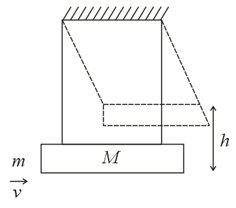
NTA JEE Main 16th March 2021 Shift 2 - Question 5
What will be the nature of flow of water from a circular tap, when its flow rate increased from 0.18 L (min)$$^{-1}$$ to 0.48 L (min)$$^{-1}$$? The radius of the tap and viscosity of water are 0.5 cm and $$10^{-3}$$ Pa s, respectively. (Density of water: $$10^{3}$$ kg m$$^{-3}$$)
NTA JEE Main 16th March 2021 Shift 2 - Question 6
A bimetallic strip consists of metals $$A$$ and $$B$$. It is mounted rigidly as shown. The metal $$A$$ has higher coefficient of expansion compared to that of metal $$B$$. When the bimetallic strip is placed in a cold bath, it will: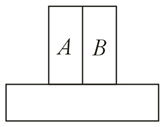
NTA JEE Main 16th March 2021 Shift 2 - Question 7
Calculate the value of the mean free path ($$\lambda$$) for oxygen molecules at temperature 27°C and pressure $$1.01 \times 10^{5}$$ Pa. Assume the molecular diameter 0.3 nm and the gas is ideal. ($$k = 1.38 \times 10^{-23}$$ J K$$^{-1}$$)
NTA JEE Main 16th March 2021 Shift 2 - Question 8
The amplitude of a mass-spring system, which is executing simple harmonic motion decreases with time. If mass = 500 g, Decay constant = 20 g s$$^{-1}$$ then how much time is required for the amplitude of the system to drop to half of its initial value? ($$\ln 2 = 0.693$$)
NTA JEE Main 16th March 2021 Shift 2 - Question 9
Find out the surface charge density at the intersection of point $$x = 3$$ m plane and $$x$$-axis, in the region of uniform line charge of 8 nC m$$^{-1}$$ lying along the $$z$$-axis in free space.
NTA JEE Main 16th March 2021 Shift 2 - Question 10
A resistor develops 500 J of thermal energy in 20 s when a current of 1.5 A is passed through it. If the current is increased from 1.5 A to 3 A, what will be the energy developed in 20 s.