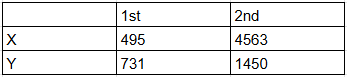
Identify the elements X and Y using the ionization energy values given below:
Ionization energy (kJ/mol):
Sign in
Please select an account to continue using cracku.in
↓ →

Join Our JEE Preparation Group
Prep with like-minded aspirants; Get access to free daily tests and study material.
Identify the elements X and Y using the ionization energy values given below:
Ionization energy (kJ/mol):
Login to view the detailed solution.
The characteristics of elements X, Y and Z with atomic numbers, respectively, 33, 53 and 83 are:
Login to view the detailed solution.
Statement I: Sodium hydride can be used as an oxidising agent.
Statement II: The lone pair of electrons on nitrogen in pyridine makes it basic.
Choose the CORRECT answer from the options given below:
Login to view the detailed solution.
.webp)
The exact volumes of 1 M NaOH solution required to neutralise 50 mL of 1 M $$H_3PO_3$$ solution and 100 mL of 2 M $$H_3PO_2$$ solution, respectively, are:
Login to view the detailed solution.
The correct statements about $$H_2O_2$$ are:
(A) used in the treatment of effluents.
(B) used as both oxidising and reducing agents.
(C) the two hydroxyl groups lie in the same plane.
(D) miscible with water.
Choose the correct answer from the options given below:
Login to view the detailed solution.
The INCORRECT statement regarding the structure of $$C_{60}$$ is:
Login to view the detailed solution.
.webp)
An unsaturated hydrocarbon X on ozonolysis gives A. Compound A when warmed with ammoniacal silver nitrate forms a bright silver mirror along the sides of the test tube. The unsaturated hydrocarbon X is:
Login to view the detailed solution.
The green house gas/es is (are):
(A) Carbon dioxide
(B) Oxygen
(C) Water vapour
(D) Methane
Choose the most appropriate answer from the options given below:
Login to view the detailed solution.
The INCORRECT statements below regarding colloidal solutions is:
Login to view the detailed solution.
.webp)
Which of the following reduction reaction CANNOT be carried out with coke?
Login to view the detailed solution.
$$FeX_2$$ and $$FeY_3$$ are known when $$x$$ and $$y$$ are:
Login to view the detailed solution.
Arrange the following metal complex/compounds in the increasing order of spin only magnetic moment. Presume all the three, high spin system.
(Atomic numbers Ce = 58, Gd = 64 and Eu = 63.)
(a) $$(NH_4)_2[Ce(NO_3)_6]$$
(b) $$Gd(NO_3)_3$$
(c) $$Eu(NO_3)_3$$
Login to view the detailed solution.
.webp)
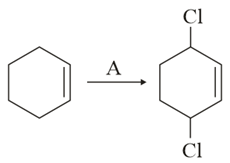
Identify the reagent(s) 'A' and condition(s) for the reaction:
Login to view the detailed solution.
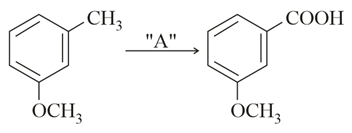
In the above reaction, the reagent "A" is:
Login to view the detailed solution.
Ammonolysis of Alkyl halides followed by the treatment with NaOH solution can be used to prepare primary, secondary and tertiary amines. The purpose of NaOH in the reaction is.
Login to view the detailed solution.

Which of the following is least basic?
Login to view the detailed solution.
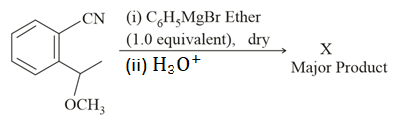
The structure of X is:
Login to view the detailed solution.
Which of the following polymer is used in the manufacture of wood laminates?
Login to view the detailed solution.
_1.webp)
Match List-I with List-II:
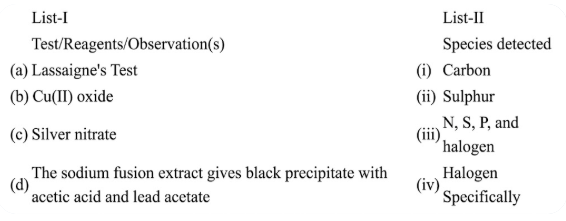
The correct match is:
Login to view the detailed solution.
The secondary structure of protein is stabilised by:
Login to view the detailed solution.
When 35 mL of 0.15 M lead nitrate solution is mixed with 20 mL of 0.12 M chromic sulphate solution, ________ $$\times 10^{-5}$$ moles of lead sulphate precipitate out. (Round off to the Nearest Integer).
Login to view the detailed solution.
The number of orbitals with $$n = 5$$, $$m_l = +2$$ is ________. (Round off to the Nearest Integer).
Login to view the detailed solution.
At 25°C, 50 g of iron reacts with HCl to form $$FeCl_2$$. The evolved hydrogen gas expands against a constant pressure of 1 bar. The work done by the gas during this expansion is ________ J. (Round off to the Nearest Integer)
[Given: $$R = 8.314$$ J mol$$^{-1}$$ K$$^{-1}$$. Assume, hydrogen is an ideal gas]
[Atomic mass of Fe is 55.85 u]
Login to view the detailed solution.
Sulphurous acid ($$H_2SO_3$$) has $$Ka_1 = 1.7 \times 10^{-2}$$ and $$Ka_2 = 6.4 \times 10^{-8}$$. The pH of 0.588 M $$H_2SO_3$$ is ________. (Round off to the Nearest Integer).
Login to view the detailed solution.
In Duma's method of estimation of nitrogen, 0.1840 g of an organic compound gave 30 mL of nitrogen collected at 287 K and 758 mm of Hg pressure. The percentage composition of nitrogen in the compound is ________. (Round off to the Nearest Integer).
[Given: Aqueous tension at 287 K = 14 mm of Hg]
Login to view the detailed solution.
Ga (atomic mass 70 u) crystallizes in a hexagonal close packed structure. The total number of voids in 0.581 g of Ga is ________ $$\times 10^{21}$$. (Round off to the Nearest Integer).
Login to view the detailed solution.
At 363 K, the vapour pressure of A is 21 kPa and that of B is 18 kPa. One mole of A and 2 moles of B are mixed. Assuming that this solution is ideal, the vapour pressure of the mixture is ________ kPa. (Round off to the Nearest Integer).
Login to view the detailed solution.
A 5.0 m mol dm$$^{-3}$$ aqueous solution of KCl has a conductance of 0.55 mS when measured in a cell constant 1.3 cm$$^{-1}$$. The molar conductivity of this solution is ________ mS m$$^2$$ mol$$^{-1}$$. (Round off to the Nearest Integer)
Login to view the detailed solution.
A and B decompose via first order kinetics with half-lives 54.0 min and 18.0 min respectively. Starting from an equimolar non-reactive mixture of A and B, the time taken for the concentration of A to become 16 times that of B is ________ min. (Round off to the Nearest Integer).
Login to view the detailed solution.
$$[Ti(H_2O)_6]^{3+}$$ absorbs light of wavelength 498 nm during a d-d transition. The octahedral splitting energy for the above complex is ________ $$\times 10^{-19}$$ J. (Round off to the Nearest Integer).
$$h = 6.626 \times 10^{-34}$$ Js; $$c = 3 \times 10^8$$ ms$$^{-1}$$.
Login to view the detailed solution.
Educational materials for JEE preparation
 Share
Share