For the following questions answer them individually
Let $$\vec{A} = (\hat{i} + \hat{j})$$ and $$\vec{B} = (2\hat{i} - \hat{j})$$. The magnitude of a coplanar vector $$\vec{C}$$ such that $$\vec{A} \cdot \vec{C} = \vec{B} \cdot \vec{C} = \vec{A} \cdot \vec{B}$$ is given by:
The percentage errors in quantities P, Q, R and S are 0.5%, 1%, 3% and 1.5% respectively in the measurement of a physical quantity $$A = \frac{P^3 Q^2}{\sqrt{RS}}$$. The maximum percentage error in the value of A will be:
A body of mass m starts moving from rest along x-axis so that its velocity varies as $$v = a\sqrt{s}$$ where a is a constant and s is the distance covered by the body. The total work done by all the forces acting on the body in the first t second after the start of the motion is:
Two particles of the same mass m are moving in circular orbits because of force, given by $$F(r) = -\frac{16}{r} - r^3$$. The first particle is at a distance r = 1, and the second, at r = 4. The best estimate for the ratio of kinetic energies of the first and the second particle is closest to:
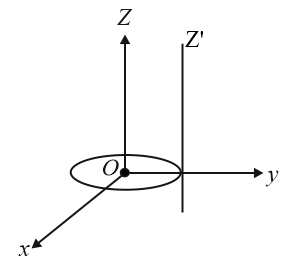
A thin circular disk is in the xy plane as shown in the figure. The ratio of its moment of inertia about z and z' axes will be:
The relative uncertainty in the period of a satellite orbiting around the earth is $$10^{-2}$$. If the relative uncertainty in the radius of the orbit is negligible, the relative uncertainty in the mass of the earth is:
Suppose that the angular velocity of rotation of the Earth is increased. Then, as a consequence:
A small soap bubble of radius 4 cm is trapped inside another bubble of radius 6 cm without any contact. Let P$$_2$$ be the pressure inside the inner bubble and P$$_0$$, the pressure outside the outer bubble. Radius of another bubble with pressure difference P$$_2$$ - P$$_0$$ between its inside and outside would be:
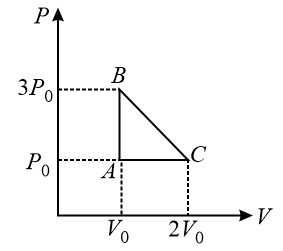
One mole of an ideal monatomic gas is taken along the path ABCA as shown in the PV diagram. The maximum temperature attained by the gas along the path BC is given by:
Two moles of helium are mixed with n moles of hydrogen. If $$\frac{C_p}{C_v} = \frac{3}{2}$$ for the mixture then the value of n is:
An oscillator of mass M is at rest in its equilibrium position in a potential, $$V = \frac{1}{2}k(x - X)^2$$. A particle of mass m comes from the right with speed u and collides completely inelastic with M and sticks to it. This process repeats every time the oscillator crosses its equilibrium position. The amplitude of oscillations after 13 collisions is: (M = 10, m = 5, u = 1, k = 1)
A particle executes simple harmonic motion and it is located at x = a, b and c at time t$$_0$$, 2t$$_0$$ and 3t$$_0$$ respectively. The frequency of the oscillation is:
The end correction of a resonance column is 1 cm. If the shortest length resonating with the tuning fork is 10 cm, the next resonating length should be:
Two sitar strings, A and B playing the note 'Dha' are slightly out of tune and produce beats of frequency 5 Hz. The tension of the string B is slightly increased and the beat frequency is found to decrease by 3 Hz. If the frequency of A is 425 Hz. The original frequency of B is:
Two identical conducting spheres A and B carry an equal charge. They are separated by a distance much larger than their diameters, and the force between them is F. A third identical conducting sphere, C, is uncharged. Sphere C is first touched to A, then to B, and then removed. As a result, force between A and B would be equal to:
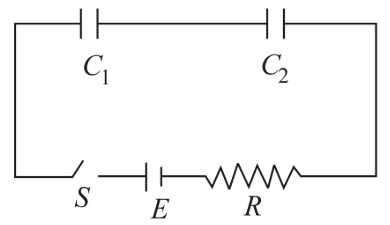
In the following circuit the switch S is closed at t = 0. The charge on the capacitor C$$_1$$ as a function of time will be given by $$\left(C_{eq} = \frac{C_1 C_2}{C_1 + C_2}\right)$$:
A heating element has a resistance of 100 $$\Omega$$ at room temperature. When it is connected to a supply of 220 V, a steady current of 2 A passes in it and temperature is 500$$^\circ$$C more than the room temperature. The temperature coefficient of resistance of the heating element is:
A galvanometer with its coil resistance 25 $$\Omega$$ requires a current of 1 mA for its full deflection. In order to construct an ammeter to read up to a current of 2 A the approximate value of the shunt resistance should be:
In a circuit for finding the resistance of a galvanometer by half deflection method, a 6 V battery and a high resistance of 11 k$$\Omega$$ are used. The figure of merit of the galvanometer is 60 $$\mu$$A division$$^{-1}$$. In the absence of shunt resistance, the galvanometer produces a deflection of $$\theta$$ = 9 divisions when current flows in the circuit. The value of the shunt resistance that can cause the deflection of $$\frac{\theta}{2}$$, is closest to:
A charge q is spread uniformly over an insulated loop of radius r. If it is rotated with an angular velocity $$\omega$$ with respect to normal axis then magnetic moment of the loop is:
A coil of cross-sectional area A having n turns is placed in a uniform magnetic field B. When it is rotated with an angular velocity $$\omega$$, the maximum e.m.f. induced in the coil will be:
A power transmission line feeds input power at 2300 V to a step-down transformer with its primary windings having 4000 turns giving the output power at 230 V. If the current in the primary coil of the transformer is 5 A and its efficiency is 90%, the output current would be:
A plane electromagnetic wave of wavelength $$\lambda$$ has an intensity I. It is propagating along the positive Y-direction. The allowed expressions for the electric and magnetic fields are given by:
A ray of light is incident at an angle of 60$$^\circ$$ on one face of a prism of angle 30$$^\circ$$. The emergent ray of light makes an angle of 30$$^\circ$$ with incident ray. The angle made by the emergent ray with second face of prism will be:
Unpolarized light of intensity I is incident on a system of two polarizers, A followed by B. The intensity of emergent light is $$\frac{I}{2}$$. If a third polarizer C is placed between A and B, the intensity of emergent light is reduced to $$\frac{I}{3}$$. The angle between the polarizers A and C is $$\theta$$, then:
The de-Broglie wavelength ($$\lambda_B$$) associated with the electron orbiting in the second excited state of hydrogen atom is related to that in the ground state ($$\lambda_G$$) by:
Both the nucleus and the atom of some element are in their respective first excited states. They get de-excited by emitting photons of wavelengths $$\lambda_N$$, $$\lambda_A$$ respectively. The ratio $$\frac{\lambda_N}{\lambda_A}$$ is closest to:
At some instant, a radioactive sample S$$_1$$ having an activity 5$$\mu$$Ci has twice the number of nuclei as another sample S$$_2$$ which has an activity of 10$$\mu$$Ci. The half lives of S$$_1$$ and S$$_2$$ are:
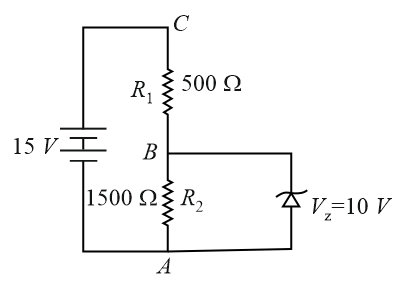
In the given circuit the current through zener diode is:
A carrier wave of peak voltage 14 V is used for transmitting a message signal. The peak voltage of the modulating signal given to achieve a modulation index of 80% will be: