For the following questions answer them individually
An unknown chlorohydrocarbon has 3.55% of chlorine. If each molecule of the hydrocarbon has one chlorine atom only; chlorine atoms present in 1 g of chlorohydrocarbon are: (Atomic wt. of Cl = 35.5 u; Avogadro constant = 6.023 $$\times$$ 10$$^{23}$$ mol$$^{-1}$$)
Which of the following statements is false?
Which of the following conversions involves change in both shape and hybridisation?
The most polar compound among the following is:
The incorrect geometry is represented by:
Assuming ideal gas behavior, the ratio of density of ammonia to that of hydrogen chloride at same temperature and pressure is: (Atomic weight of Cl is 35.5 u)
At 320 K, a gas A$$_2$$ is 20% dissociated to A(g). The standard Gibbs free energy change at 320 K and 1 atm in J mol$$^{-1}$$ is approximately: (R = 8.314 J K$$^{-1}$$ mol$$^{-1}$$; ln 2 = 0.693; ln 3 = 1.098)
For which of the following processes, $$\Delta S$$ is negative?
For standardizing NaOH solution, which of the following is used as a primary standard?
The gas phase reaction 2NO$$_2$$(g) $$\rightarrow$$ N$$_2$$O$$_4$$(g) is an exothermic reaction. The decomposition of N$$_2$$O$$_4$$, in equilibrium mixture of NO$$_2$$(g) and N$$_2$$O$$_4$$(g) can be increased by:
A group 13 element 'X' reacts with chlorine gas to produce a compound XCl$$_3$$. XCl$$_3$$ is electron deficient and easily reacts with NH$$_3$$ to form Cl$$_3$$X $$\leftarrow$$ NH$$_3$$ adduct; however, XCl$$_3$$ does not dimerize. X is:
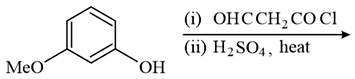
The major product of the following reaction is:
The mass of a non-volatile, non-electrolyte solute (molar mass = 50 g mol$$^{-1}$$) needed to be dissolved in 114 g octane to reduce its vapour pressure by 75%, is:
When 9.65 ampere current was passed for 1.0 hour into nitrobenzene in acidic medium, the amount of p-aminophenol produced is:
If 50% of a reaction occurs in 100 second and 75% of the reaction occurs in 200 second, the order of this reaction is:
Which one of the following is not a property of physical adsorption?
In the extraction of copper from its sulphide ore, metal is finally obtained by the oxidation of cuprous sulphide with:
Among the oxides of nitrogen: N$$_2$$O$$_3$$, N$$_2$$O$$_4$$ and N$$_2$$O$$_5$$; the molecule(s) having nitrogen-nitrogen bond is/are:
When XO$$_2$$ is fused with an alkali metal hydroxide in presence of an oxidizing agent such as KNO$$_3$$; a dark green product is formed which disproportionate in acidic solution to afford a dark purple solution. X is:
The incorrect statement is:
In a complexometric titration of metal ion with ligand M (Metal ion) + L(Ligand) $$\rightarrow$$ C (Complex). End point is estimated spectrophotometrically (through light absorption). If 'M' and 'C' do not absorb light and only 'L' absorbs then the titration plot between absorbed light (A) versus volume of ligand 'L' (V) would look like:
In Wilkinson's catalyst, the hybridization of central metal ion and its shape are respectively:
Which of the following complexes will show geometrical isomerism?
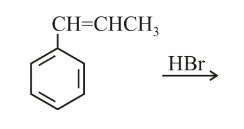
The major product of the following reaction is:
Which of the following compounds will most readily be dehydrated to give alkene under acidic condition?
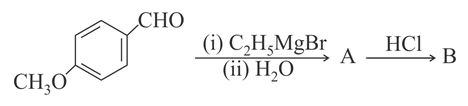
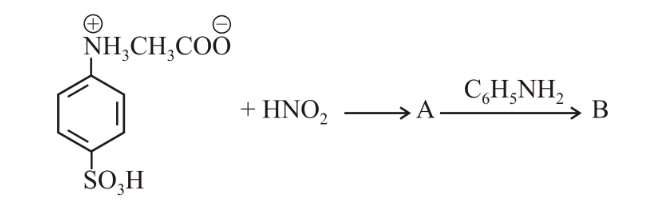
The major product B formed in the following reaction sequence is:
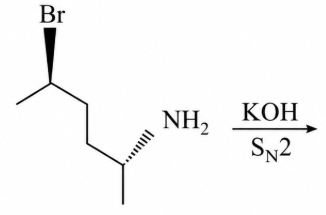
Products A and B formed in the following reactions are respectively:
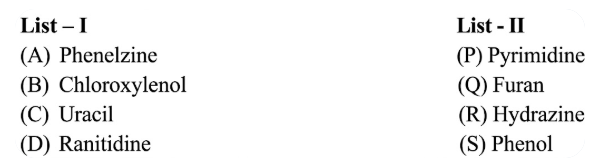
The correct match between items of List-I and List-II is:
Among the following, the incorrect statement is: