NTA JEE Main 15th April 2018 Shift 2
For the following questions answer them individually
NTA JEE Main 15th April 2018 Shift 2 - Question 1
The characteristic distance at which quantum gravitational effects are significant, the Planck length, can be determined from a suitable combination of the fundamental physical constants G, h and c. Which of the following correctly gives the Planck length?
NTA JEE Main 15th April 2018 Shift 2 - Question 2
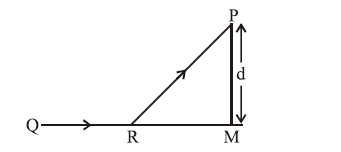
A man in a car at location Q on a straight highway is moving with speed v. He decides to reach a point P in a field at a distance d from highway (point M) as shown in the figure. Speed of the car in the field is half to that on the highway. What should be the distance RM, so that the time taken to reach P is minimum?
NTA JEE Main 15th April 2018 Shift 2 - Question 3
A body of mass 2 kg slides down with an acceleration of 3 m/s$$^2$$ on a rough inclined plane having a slope of 30$$^\circ$$. The external force required to take the same body up the plane with the same acceleration will be: (g = 10 m/s$$^2$$)

NTA JEE Main 15th April 2018 Shift 2 - Question 4
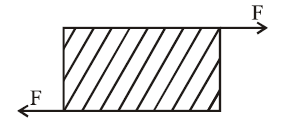
As shown in the figure, forces of $$10^5$$ N each are applied in opposite directions, on the upper and lower faces of a cube of side 10 cm, shifting the upper face parallel to itself by 0.5 cm. If the side of another cube of the same material is, 20 cm then under similar conditions as above, the displacement will be:
NTA JEE Main 15th April 2018 Shift 2 - Question 5
A disc rotates about its axis of symmetry in a horizontal plane at a steady rate of 3.5 revolutions per second. A coin placed at a distance of 1.25 cm from the axis of rotation remains at rest on the disc. The coefficient of friction between the coin and the disc is (g = 10 m/s$$^2$$)
NTA JEE Main 15th April 2018 Shift 2 - Question 6
A proton of mass m collides elastically with a particle of unknown mass at rest. After the collision, the proton and the unknown particle are seen moving at an angle of 90$$^\circ$$ with respect to each other. The mass of unknown particle is:
NTA JEE Main 15th April 2018 Shift 2 - Question 7
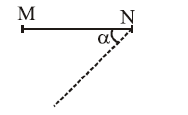
A thin rod MN, free to rotate in the vertical plane about the fixed end N, is held horizontal. When the end M is released, the speed of this end, when the rod makes an angle $$\alpha$$ with the horizontal, will be proportional to: (see figure)
NTA JEE Main 15th April 2018 Shift 2 - Question 8
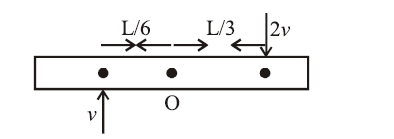
A thin uniform bar of length L and mass 8 m lies on a smooth horizontal table. Two point masses m and 2 m moving in the same horizontal plane from opposite sides of the bar with speeds 2v and v respectively. The masses stick to the bar after collision at a distance $$\frac{L}{3}$$ and $$\frac{L}{6}$$ respectively from the centre of the bar. If the bar starts rotating about its center of mass as a result of collision, the angular speed of the bar will be:
NTA JEE Main 15th April 2018 Shift 2 - Question 9
When an air bubble of radius r rises from the bottom to the surface of a lake, its radius becomes $$\frac{5r}{4}$$. Taking the atmospheric pressure to be equal to 10 m height of water column, the depth of the lake would approximately be (ignore the surface tension and the effect of temperature):
NTA JEE Main 15th April 2018 Shift 2 - Question 10
A body takes 10 minutes to cool from 60$$^\circ$$C to 50$$^\circ$$C. The temperature of surroundings is constant at 25$$^\circ$$C. Then, the temperature of the body after next 10 minutes will be approximately